
The Sequence
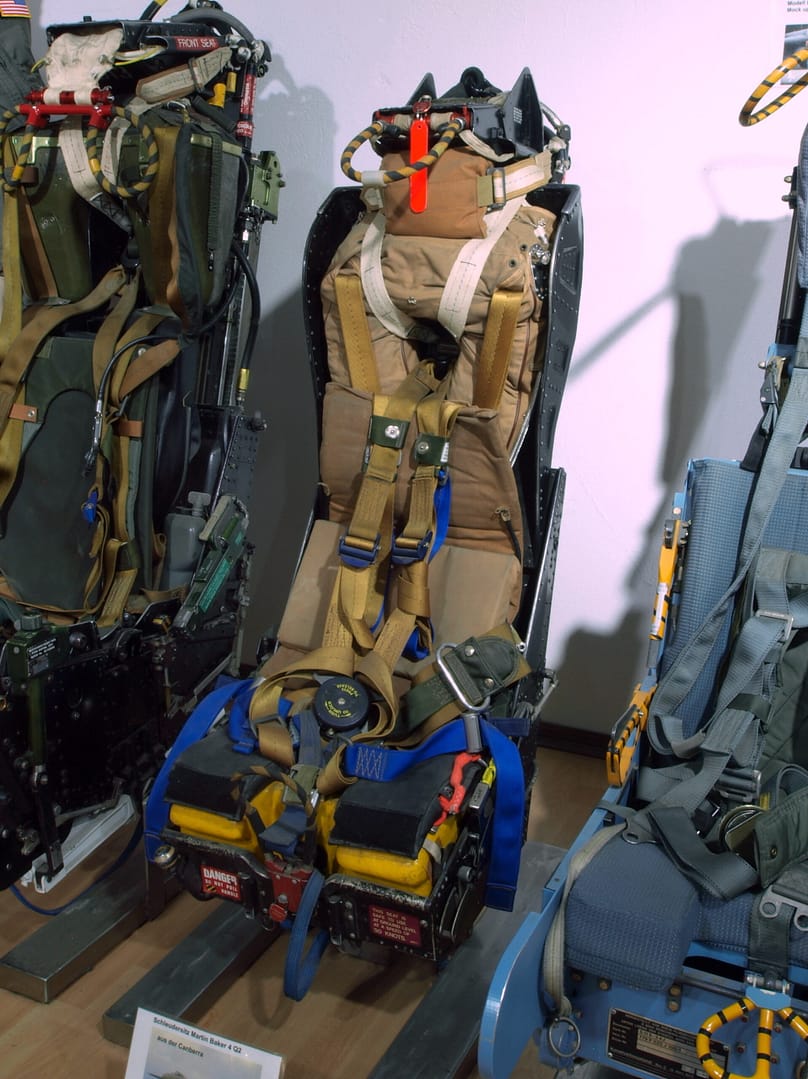
Modern ejection seats — the Martin-Baker Mk.16 is the current standard in most Western fighters — perform the following sequence in approximately 2.5 seconds: T+0.0 seconds: The pilot pulls the ejection handle (either between the legs or above the head, depending on the aircraft). The canopy is jettisoned or shattered by a miniature detonating cord embedded in the Plexiglas. In some aircraft, the seat fires through the canopy using a canopy breaker — a sharp spike on top of the headrest. T+0.3 seconds: The seat's rocket catapult fires. This is not a gentle push. The seat accelerates at 12–14g — twelve to fourteen times the force of gravity — propelling the pilot and seat up the guide rails and clear of the cockpit. The initial catapult is a ballistic charge; a sustainer rocket ignites immediately after to boost the seat to a safe altitude. T+0.5 seconds: The seat clears the aircraft. Stabilisation systems activate — either a drogue chute (older seats) or gyroscopic stabilisers and vernier rockets (modern seats) — to prevent the seat from tumbling. An uncontrolled tumble at high speed would subject the pilot to lethal rotational forces. T+1.0–1.5 seconds: The seat's electronic sequencer determines the deployment timing based on altitude and airspeed. At high altitude, the seat free-falls to a breathable altitude before deploying the parachute. At low altitude, the parachute deploys immediately. The seat literally decides what to do based on where it is. T+2.0–2.5 seconds: The main parachute deploys. The harness releases separate the pilot from the seat. A survival kit — containing a life raft, emergency radio, water, and signalling equipment — deploys automatically. The pilot descends under canopy.Ejection Seat — Key Specifications (Martin-Baker Mk.16)
- Ejection force: 12–14g initial, sustained at 6–8g
- Zero-zero capability: Yes — can save a pilot at zero altitude, zero airspeed
- Maximum speed: Capable up to 600 KEAS (knots equivalent airspeed)
- Sequence time: ~2.5 seconds from handle pull to parachute
- Weight: ~80 kg (176 lb) with all systems
- Seat manufacturer: Martin-Baker (UK) — 70%+ of Western ejection seats
- Lives saved: Over 7,700 (Martin-Baker seats alone, as of 2025)
- Used in: F-35, Eurofighter Typhoon, Rafale, T-6, and others
“When I ejected, I got out with a third of a second to spare. If I waited one-third of a second longer to pull the handle, I would have impacted the water still in my seat.”
— Captain Brian Udell, USAF, who holds the record for the highest-speed ejection from a US fighter jet (nearly 800 mph from an F-15E Strike Eagle, 1995). The windblast ripped his helmet off and broke every blood vessel in his face.
The Physics Problem
An ejection seat must solve three contradictory engineering problems simultaneously. First, it must accelerate the pilot fast enough to clear the aircraft's tail. A fighter jet's vertical stabiliser can be 5–6 metres above the cockpit rail. At 500 knots, the seat has a fraction of a second to climb above that height before the airstream sweeps it backward into the tail. The solution is raw acceleration — which is why ejection forces regularly cause spinal compression fractures. Second, it must decelerate the pilot from aircraft speed to parachute speed without killing them. At 600 knots, the windblast alone exerts forces exceeding 40g on exposed limbs. Modern seats use arm and leg restraints that automatically retract the pilot's extremities before ejection. Helmets with visors and oxygen masks protect the face. Even so, high-speed ejections routinely cause injuries — broken bones, dislocated shoulders, spinal damage. Third, it must work at every combination of altitude and speed — from zero altitude and zero airspeed (the "zero-zero" case, such as a runway accident) to 50,000 feet and Mach 2. The electronic sequencer inside the seat is programmed with a decision tree that selects the correct deployment sequence for each scenario.The Martin-Baker Story
One company dominates the ejection seat market: Martin-Baker, a British firm founded in 1934. Sir James Martin developed the first practical ejection seat after his business partner, Captain Valentine Baker, was killed in a crash. Martin spent the rest of his career ensuring that no pilot would die in an accident that an ejection seat could have prevented. The first live ejection using a Martin-Baker seat took place on July 24, 1946, when Bernard Lynch ejected from a modified Gloster Meteor at 320 mph over Chalgrove Airfield. Martin-Baker seats have since saved over 7,700 lives. The company maintains a register of every pilot who has ejected in one of its seats, and each survivor receives a tie and membership in the Ejection Tie Club. The only major competitor is the Russian NPP Zvezda K-36 series, used in all modern Russian fighters including the Su-27, Su-35, and Su-57. The K-36 is widely regarded as one of the best ejection seats ever built — it was designed to handle ejections at speeds up to 1,400 km/h and features an automated arm-and-leg restraint system.The Human Cost
Ejection saves lives. It does not save them gently. Spinal compression injuries occur in roughly 20–30% of ejections. The 14g acceleration compresses vertebrae, and even with modern seats designed to minimise loading, the human spine was not engineered for this. Many pilots who eject never fly again — not because of the incident that caused the ejection, but because of the ejection itself. High-speed ejections are worse. The windblast at 500+ knots can break limbs, rip off helmets, and cause hypoxia from the sudden exposure to high-altitude air. Pilots who eject above 40,000 feet face frostbite and decompression sickness during the free-fall before the parachute deploys. Despite all of this, the mathematics are clear: without an ejection seat, the survival rate in an unrecoverable aircraft emergency is close to zero. With one, it is above 90%. The most violent ride a pilot will ever take is also the one that saves their life.“There’s no other way to describe what happened next other than it was the definition of violence.”
— Air Force Captain Trent Meisel, describing his ejection from an F-16
“An ejection is about 70 unrelated miracles that happen in about seven seconds.”Sources: Martin-Baker, RAF Museum, Smithsonian National Air and Space Museum, NPP Zvezda, USAF Safety Center
— Gen. David Goldfein, who ejected from an F-16 over Serbia in 1999
Related Questions
How do ejection seats work?
An ejection seat fires the pilot clear of the aircraft and lands them under a parachute in about 2.5 seconds. The canopy is jettisoned or shattered, a rocket catapult drives the seat up the rails at 12–14g, stabilisation systems prevent tumbling, and an electronic sequencer deploys the parachute based on altitude and airspeed. The Martin-Baker Mk.16 is the current Western standard.
How many Gs does an ejection seat pull?
A modern ejection seat accelerates the pilot at 12–14g initially, sustained at around 6–8g as the rocket motor boosts the seat to a safe altitude. These forces are violent enough to compress the spine — which is why ejection can leave a pilot measurably shorter afterward.
What is a zero-zero ejection seat?
A zero-zero ejection seat can save a pilot at zero altitude and zero airspeed — for example, a stationary aircraft on the runway. This capability, standard on seats like the Martin-Baker Mk.16, relies on a rocket motor powerful enough to loft the seat high enough for the parachute to fully deploy even from a standstill on the ground.
Who makes most fighter jet ejection seats?
The British firm Martin-Baker makes more than 70% of Western ejection seats, fitting aircraft including the F-35, Eurofighter Typhoon, Rafale, and T-6. Its Mk.16 seat is the current standard in most Western fighters. Martin-Baker seats alone are credited with saving over 7,700 lives as of 2025.
How many lives have ejection seats saved?
Martin-Baker ejection seats alone are credited with over 7,700 saved lives as of 2025, and the company supplies more than 70% of Western seats. The ejection seat traces a long lineage of aircrew survival technology, stretching back to the first man saved by an emergency parachute jump in 1922.
What is the highest-speed ejection ever survived?
Captain Brian Udell of the USAF holds the record for the highest-speed ejection from a US fighter, ejecting at nearly 800 mph from an F-15E Strike Eagle in 1995. He has said he got out "with a third of a second to spare" before impacting the water — showing how narrow the survival margin can be.
Is ejecting from a fighter jet dangerous?
Yes. Although modern seats save lives in the large majority of ejections, the process subjects the body to extreme force — windblast at 600+ knots can crack visors and injure limbs, and spinal compression can end a flying career. Ejecting over water adds danger; drowning under the canopy is a leading cause of over-water ejection deaths.
0 Comments