
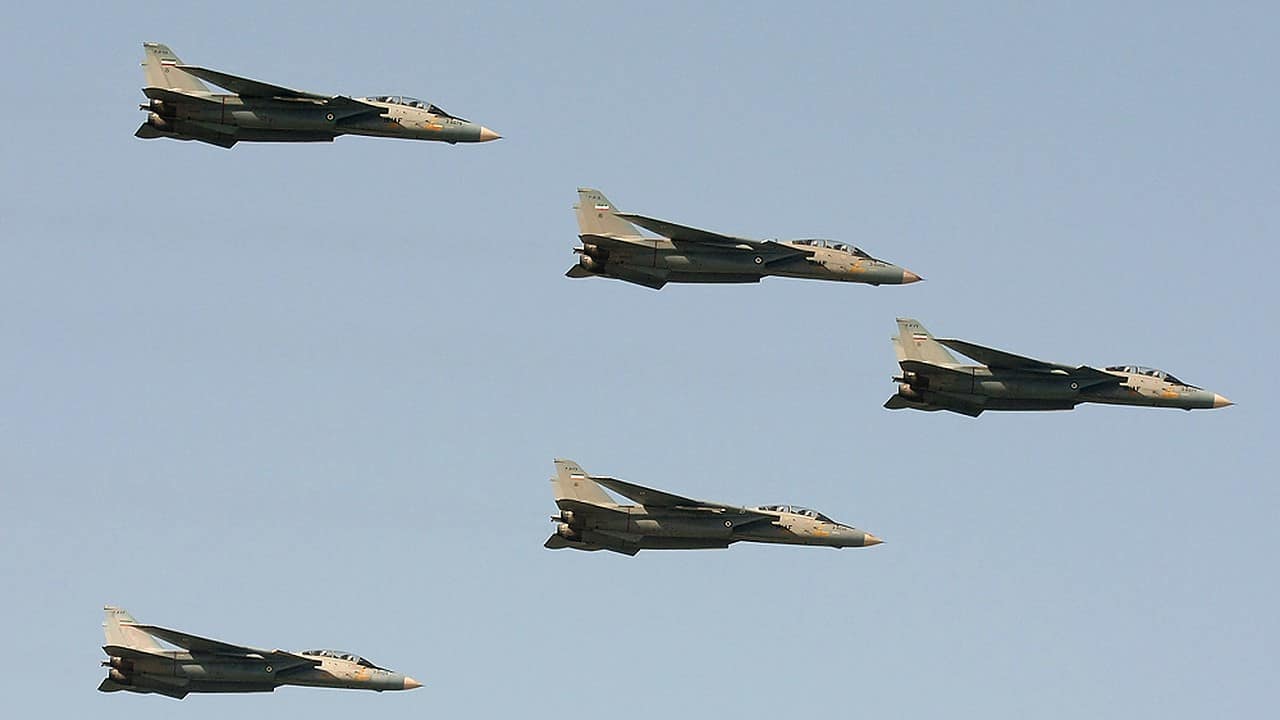
Half a century ago, the Shah of Iran bought 80 American F-14A Tomcats and 633 AIM-54 Phoenix long-range missiles for $2 billion. It was the most advanced fighter deal the United States had ever made with a foreign country.
Then came the revolution, the hostage crisis, the embargo, and four decades of sanctions. Washington assumed the Tomcats would rot without American spare parts. Iran had other plans.
In June 2026, Iranian F-14s are flying combat missions — the first confirmed Tomcat combat sorties since the Iran-Iraq War.
Quick Facts
- Aircraft: Grumman F-14A Tomcat
- Delivered to Iran: 1976–1979 (79 aircraft)
- Iran–Iraq War claims: ~130 kills vs 4 losses
- Current status: Estimated 40–50 airframes, unknown operational count
- Key weapon: AIM-54 Phoenix long-range missile
- Notable feat: One Phoenix destroyed 3 MiGs in a single shot
The Shah's Trophy Fighter
Shah Mohammad Reza Pahlavi wanted the F-14 for a specific reason: Soviet MiG-25 Foxbats were making reconnaissance flights over Iranian airspace, and only the Tomcat's AWG-9 radar and Phoenix missile could engage targets at the ranges needed. Deliveries began in 1976. By the time the Islamic Revolution swept through in January 1979, 79 of the 80 aircraft had arrived. The 80th was held back by the U.S. and never shipped.
When the embassy fell and the hostages were taken, Washington cut everything — parts, technical support, munitions, training. American advisors left overnight. The conventional wisdom was that Iran's Tomcats would be grounded within months.
Forty-Seven Years Without a Phone Call to Grumman
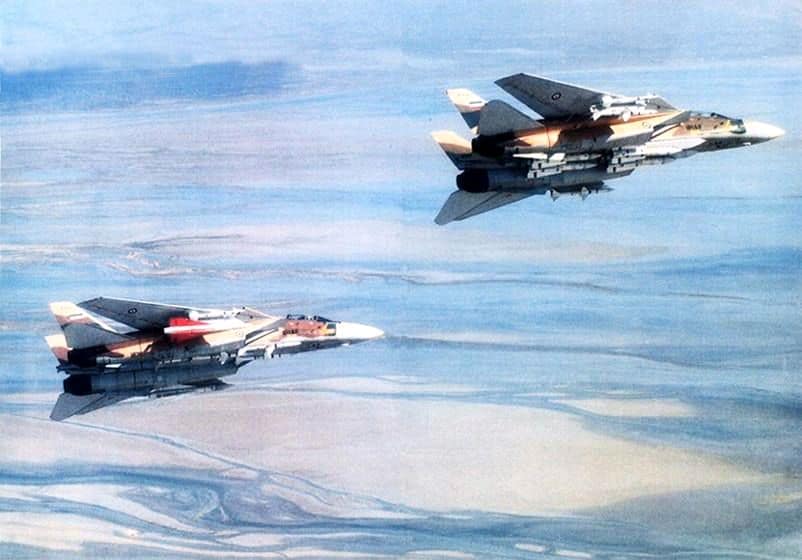
Iran's response to the embargo was remarkable. The IRIAF built an indigenous industrial base, reverse-engineering components and making over 300 modifications to the F-14's design — replacing the radar, avionics, and electronic warfare systems with domestically produced alternatives. When the original AIM-54 Phoenix missiles expired, Iranian engineers developed the Fakour-90: a domestically produced long-range missile with a 150 km range and Mach 5 speed, based on the Phoenix and MIM-23 Hawk.
Before the 2026 strikes, estimates put the operational fleet at roughly 20-25 aircraft out of approximately 40-45 surviving airframes. Not bad for a fighter that Washington assumed would be a hangar ornament by 1980.
Isfahan, March 7, 2026
When the United States and Israel launched strikes against Iran in February-March 2026, Israeli aircraft hit Isfahan's 8th Tactical Fighter Base on March 7. Satellite imagery from the following day showed extensive cratering across the base's taxiways. Open-source analysts confirmed at least eight destroyed F-14s on the airfield, along with other aircraft.
Israel claimed complete destruction of Iran's F-14 fleet. The claim was premature.
The Tomcat Flies Combat Again
On June 10, 2026, footage emerged showing Iranian F-14 Tomcats landing after completing combat missions. While Iran's F-4s, F-5s, MiG-29As, and Yak-130s had all been seen flying sorties during the conflict, this was the first confirmation that Tomcats had survived the strikes and were operational — and the first confirmed F-14 combat since the Iran-Iraq War ended in 1988.
How many survived is unclear. But enough remained — either dispersed before the strikes or sheltered in hardened facilities — to return to the fight. Thirty-eight years after their last combat, Iran's Tomcats were at war again.
Meanwhile, in Washington
In a twist that borders on surreal, the U.S. Congress passed the Maverick Act in April 2026 — legislation authorizing the transfer of three retired Tomcats from storage at Davis-Monthan AFB for preservation. For nearly 20 years, the U.S. had been destroying retired Tomcats specifically to deny Iran access to parts. The 2026 strikes on Iran's fleet eased these security concerns enough for Congress to save the last three.
There's your irony: America is preserving Tomcats in museums at the same moment Iran is flying them in combat.
The Forgotten Ace
The greatest F-14 pilot in history was not American. Jalil Zandi (1951-2001) of the IRIAF scored 11 aerial victories during the Iran-Iraq War — four MiG-23s, two Su-22s, two MiG-21s, and three Mirage F1s. In one engagement, an Iranian F-14 reportedly destroyed three Iraqi MiGs with a single Phoenix missile.
Fifty years after the Shah signed the contract, his Tomcats are still flying, still fighting, and still refusing to die. The F-14 was built to last 6,000 flight hours. Iran has made it last half a century through sheer engineering stubbornness and a refusal to accept that an American embargo could ground an American fighter.
Grumman should be quietly proud.
Sources: The Aviation Geek Club, National Security Journal, 19FortyFive, Wikipedia (F-14 operational history), Kaveh Farrokh
Related Questions
Does Iran still fly the F-14 Tomcat?
Yes. Iran is the only country still flying the Grumman F-14 Tomcat in combat service. It received 79 of the fighters in the 1970s under the Shah, and an estimated 40–50 airframes remain, some still flying nearly 50 years later.
How did Iran get F-14 Tomcats?
The United States sold 79 F-14A Tomcats to Iran between 1976 and 1979, while it was a close U.S. ally under the Shah. After the 1979 revolution Iran kept the jets, becoming the only F-14 operator besides the U.S. Navy.
How did Iran's F-14s perform in the Iran-Iraq War?
Very effectively. Iranian F-14s are credited with roughly 130 aerial victories for only about 4 losses during the 1980s Iran–Iraq War, using their powerful radar and long-range missiles to dominate Iraqi aircraft.
What is the AIM-54 Phoenix missile?
The AIM-54 Phoenix is the F-14's long-range air-to-air missile, able to engage targets from great distances. Iranian Tomcats used it to devastating effect — in one famous instance a single Phoenix shot reportedly destroyed three Iraqi MiGs at once.
Why did the Shah want the F-14?
Soviet MiG-25 Foxbats were flying high-speed reconnaissance over Iran that nothing in its arsenal could catch. The Shah bought the F-14 specifically because its powerful radar and long-range Phoenix missile could intercept those high, fast intruders.
Related Posts
Operation Mole Cricket 19

0 Comments