
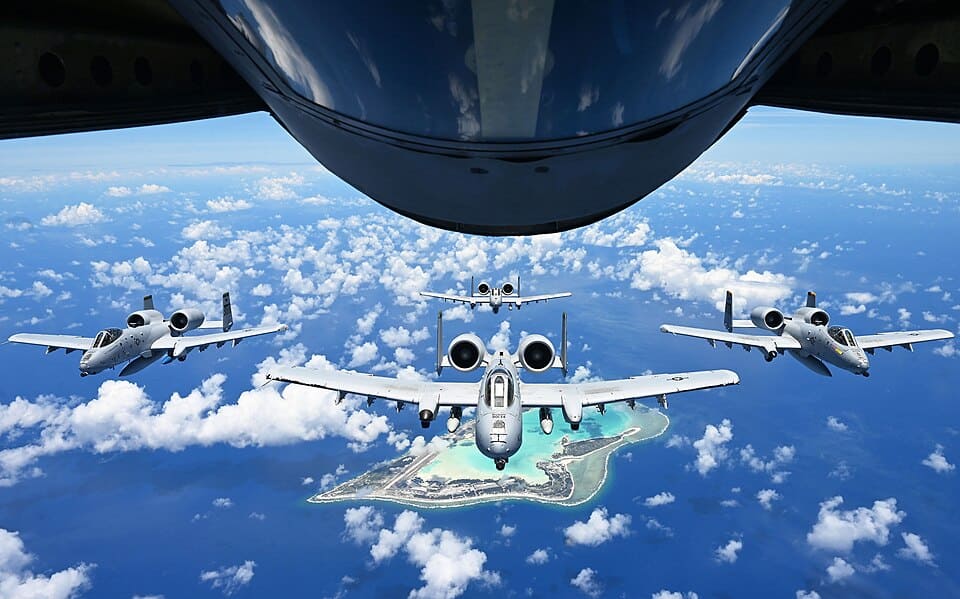
Aircraft Approximately 20 A-10C Thunderbolt II “Warthogs”
Operation Epic Fury (ongoing since February 28, 2026)
Staging Route Portsmouth, NH → RAF Lakenheath, England → Middle East
Primary Roles Maritime strike against Iranian naval assets, close air support, commando raid support
Retirement Timeline Fleet retirement begins Fall 2026; Idaho transitions to F-16 in Spring 2027
Significance Likely the A-10’s final combat deployment in its 50-year career

Somewhere over the Atlantic, roughly twenty A-10C Warthogs are grinding east. Their destination: the Persian Gulf. Their mission: Operation Epic Fury. Their distinction: this is almost certainly the last time the most beloved ground-attack jet in history will fly to war.
Flight-tracking data picked up the formation gathering at Portsmouth International Airport in New Hampshire — eight jets plus two spares in the first wave, staging through RAF Lakenheath in England before heading to the Middle East. The aircraft belong to the 124th Fighter Wing of the Idaho Air National Guard and the 127th Wing of the Michigan Air National Guard, two of the last units still flying the Warthog.
The Air Force has been trying to retire the A-10 for decades. Congress kept saying no. But this time the numbers are final: fleet retirement begins in the fall of 2026, and Idaho’s 124th is already scheduled to transition to F-16 Fighting Falcons by spring 2027. More than 300 Idaho Airmen deployed on March 29. For many of them, this deployment is both a first and a last.
Built Around a Gun
The A-10 was designed in the early 1970s with one job: destroy Soviet tanks pouring through the Fulda Gap. Republic Aviation (later Fairchild Republic) didn’t design a plane and then fit a gun to it. They designed the GAU-8/A Avenger — a seven-barrel, 30mm Gatling cannon firing 3,900 rounds per minute — and then built an airframe around it. The gun is so large it had to be mounted slightly off-centre so the firing barrel aligns with the aircraft’s centreline.
The result is a jet that looks like it was drawn by a nine-year-old who wanted the ugliest, toughest plane imaginable. Twin engines mounted high on the rear fuselage, out of ground-debris range. A titanium “bathtub” cockpit that can absorb direct hits from 23mm rounds. Redundant hydraulic systems. A manual backup for the flight controls that works even if every hydraulic line is severed. The A-10 wasn’t built to be pretty. It was built to come home.

And it did come home — again and again. In Desert Storm, A-10s destroyed more than 900 Iraqi tanks, 2,000 military vehicles, and 1,200 artillery pieces. In Afghanistan, Warthog pilots flew dangerously low to support pinned-down ground troops when faster jets couldn’t get close enough. In Iraq, a pilot named Captain Kim Campbell flew her A-10 home after ground fire shredded the hydraulics, the horizontal stabiliser, and punched hundreds of holes through the fuselage. She switched to manual reversion and landed without incident. That’s the kind of airplane this is.
A Naval Mission Nobody Expected
The Warthog’s final war won’t be fought over open desert. It will be fought over water. Iran’s Islamic Revolutionary Guard Corps Navy (IRGCN) has deployed swarms of fast attack boats in the Strait of Hormuz, and the A-10 — originally designed to kill tanks — turns out to be devastatingly effective against small, fast surface targets. The GAU-8’s armour-piercing rounds chew through fibreglass hulls like they’re made of cardboard.
This isn’t a new trick. In 1988, during Operation Praying Mantis, A-10s helped destroy Iranian naval assets in the same waters. Nearly four decades later, the Warthog is back in the Persian Gulf doing the same job — except this time, it’s not coming back.
Beyond maritime strike, the deploying A-10s will provide close air support for ongoing ground operations inside Iranian territory, including the kind of commando raids that have already put U.S. special operations forces deep behind enemy lines. The Warthog’s ability to loiter low and slow over a battlefield, absorb ground fire, and deliver precision firepower makes it irreplaceable for troops in contact — which is exactly why the infantry has fought so hard to keep it flying.

One Last Ride
Maj. Gen. Tim Donnellan, adjutant general of Idaho, said it plainly: the 124th has “a legacy of service to our state and nation, and this mission further cements our commitment to protecting the United States of America.” What he didn’t say — but everyone in the unit knows — is that this is the final chapter. The 124th received its first A-10s in 1996. Thirty years later, the jets are heading to war for the last time.
The A-10 has outlived every attempt to kill it. Air Force leadership tried to retire it in 2015. Congress blocked them. They tried again in 2022. Blocked again. The jet’s survival became a symbol of a larger argument: do you build weapons for the wars you want to fight, or the wars you actually fight? The infantry and the special operations community wanted the Warthog. The Air Force wanted the money for stealth jets. In the end, time won the argument. The airframes are simply too old.
But before the hangars go quiet, the Warthog gets one more deployment. One more war. One more chance to do what it was built to do — fly low, fly slow, and bring everyone home. When the last A-10 lands for good sometime in the late 2020s, the pilots and ground crews heading east right now will be the ones who wrote the final page.
Fifty years of service. Every major American conflict since the Cold War. And a retirement party over the Strait of Hormuz. The Warthog wouldn’t have it any other way.
Sources: The War Zone, Air & Space Forces Magazine, Scramble Magazine, Idaho Air National Guard


 English
0 Comments