
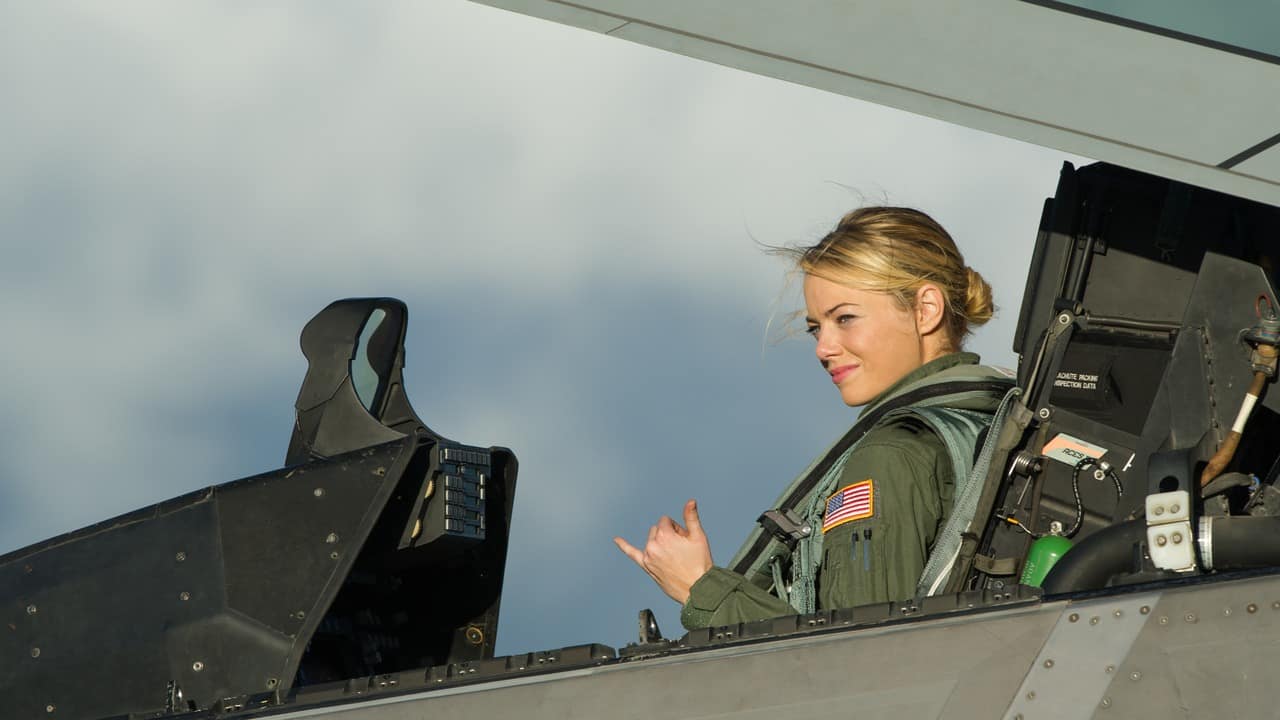
Every so often, a clip resurfaces online claiming that the Hollywood star Emma Stone made history as “the first civilian to fly in an F-22 Raptor.” It collects millions of views, a flurry of amazed comments, and the occasional breathless re-share. It is also completely false — and the aircraft itself tells you why.
As with most durable internet myths, there is a small kernel of truth buried inside it. So let us separate the real story from the nonsense.
Quick Facts
- The claim: viral clips say actress Emma Stone “flew” in an F-22 Raptor — some now AI-enhanced
- The truth: she sat in an F-22 cockpit on the ground, for the 2015 film Aloha. She never flew
- Why it is impossible: the F-22 is single-seat — there is no two-seat version, so no passenger can ride in one
- The real first: she was reportedly the first civilian, not a pilot or mechanic, allowed in an F-22 cockpit
The Kernel of Truth
Back in 2015, Emma Stone starred alongside Bradley Cooper in Cameron Crowe’s film Aloha, partly shot around U.S. military facilities in Hawaii. As a special concession to the production, Stone was reportedly allowed to climb into the cockpit of an F-22 Raptor — becoming, by several accounts, the first person who was neither a pilot nor a mechanic permitted to do so.
That is genuinely a neat piece of trivia. But note the key word: she sat in it. On the ground. The canopy closed for a photo, and that was the extent of the adventure.
Why She Couldn’t Have Flown — Even If She Wanted To
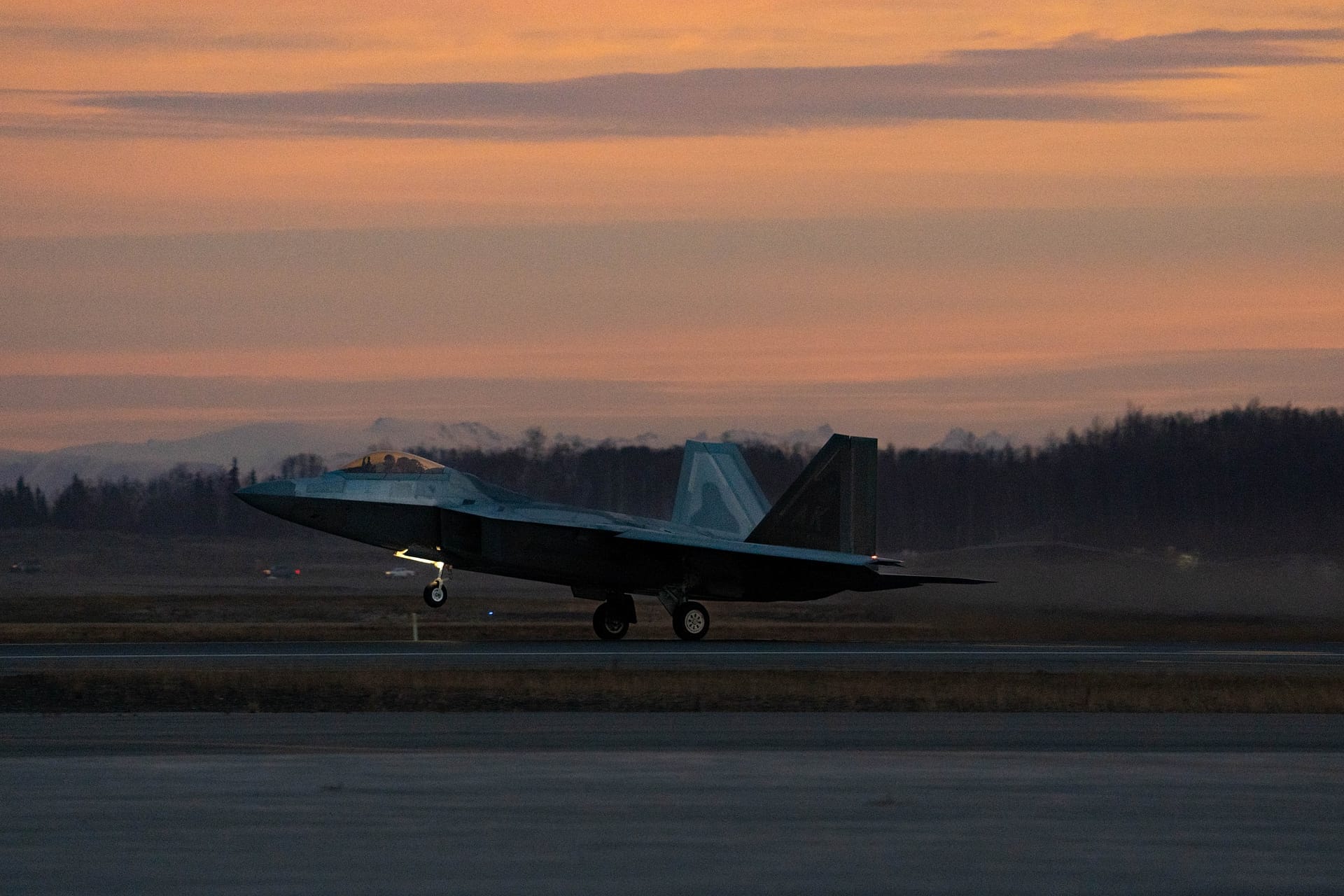
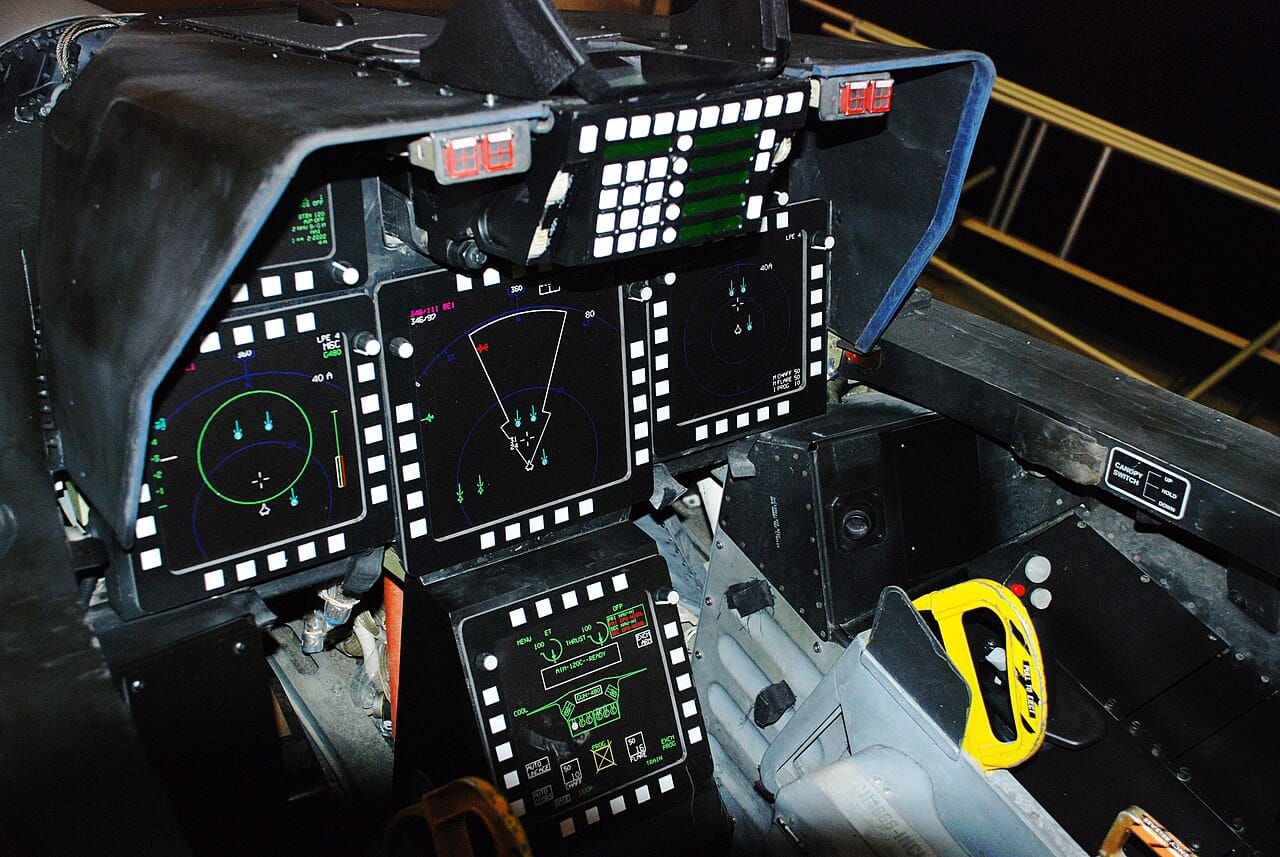
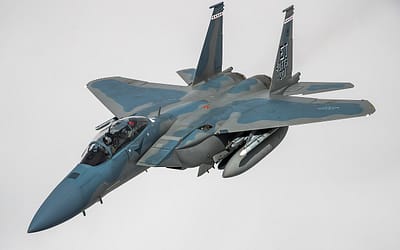
Here is the detail that instantly debunks the whole story: the F-22 Raptor is a single-seat fighter. Unlike many combat aircraft, it was never built in a two-seat training version. There is no back seat, no second cockpit, nowhere to strap in a passenger. Flying in an F-22 as a civilian is not merely against the rules — it is physically impossible. There is simply no seat to put you in.
Enter the Fake Videos
None of that has stopped the claim from circulating for years as clickbait — and lately, AI-generated clips have given the myth a glossy new coat of paint, complete with fabricated “cockpit” footage of Stone supposedly airborne. The clip below is one of those misleading posts. It looks slick. It is not real.
How to Spot the Nonsense
The Emma Stone story is a perfect little case study in how misinformation works: take a true, modest fact — an actress sat in a fighter cockpit for a movie — and inflate it into something impossible and far more clickable. A few quick reality checks will save you every time. Single-seat aircraft cannot carry passengers. Civilians are not handed the controls of frontline stealth fighters. And if a clip seems too remarkable to be true, it usually is.
The real story needed no embellishment. Being the first civilian ever to sit in the cockpit of an F-22 is a pretty good claim to fame all on its own.
Sources: Aloha production notes (Cameron Crowe); U.S. Air Force; Lockheed Martin.
Related Questions
Did Emma Stone fly an F-22 Raptor?
No. Emma Stone sat in an F-22 Raptor cockpit on the ground during filming of the 2015 movie Aloha — she never flew in one. Viral clips suggesting she took to the air are misleading, and some have been AI-enhanced.
Is there a two-seat F-22 Raptor?
No. The F-22 Raptor is a single-seat fighter and no two-seat trainer version was ever built. That is why it is physically impossible for a passenger to ride along in an F-22, regardless of what viral videos claim.
Why was Emma Stone in an F-22 cockpit?
As a concession to the production of Cameron Crowe’s film Aloha, shot partly around US military facilities in Hawaii, Emma Stone was allowed to climb into an F-22 Raptor cockpit on the ground. By several accounts she was the first civilian, neither a pilot nor a mechanic, permitted to do so.
What is the F-22 Raptor?
The F-22 Raptor is the US Air Force’s stealth air-superiority fighter, a single-seat twin-engine jet built by Lockheed Martin. It remains one of the most capable fighters in the world and regularly trains with allied air forces.
Can a civilian fly in a fighter jet?
Not in a single-seater like the F-22, which has no passenger seat. Civilians can, however, fly in two-seat jets — MiGFlug arranges fighter jet experiences, and enthusiasts often ask whether they can fly aircraft like the F-14 Tomcat. The answer depends on which two-seat types are still airworthy.
Related Posts
Hands Off the Raptor: Congress Blocks F-22 Retirement
How AESA Radar Changed Air Combat Forever

0 Comments