
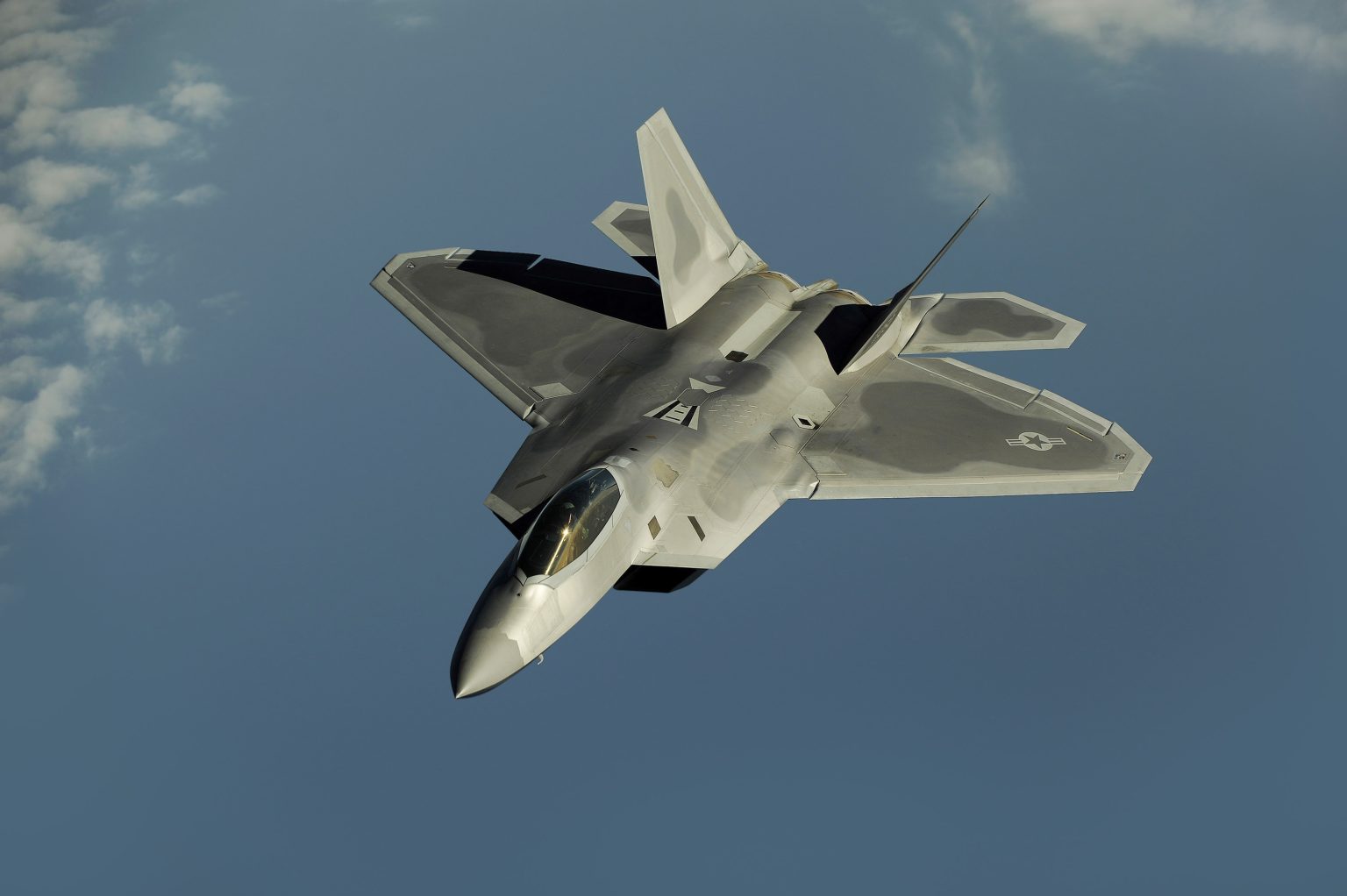
Lockheed Martin F-22
“Raptor”
The world’s first operational fifth-generation fighter — a stealthy, supercruising, thrust-vectoring air-dominance machine so advanced and so costly that only 195 were ever built, and U.S. law forbids selling a single one abroad.
The F-22 Raptor: first of the fifth generation
The F-22 Raptor is the world’s first operational fifth-generation fighter — the aircraft that defined what “fifth-gen” even means. It fused four capabilities no previous fighter combined: all-aspect stealth, supercruise (sustained supersonic flight without afterburner), thrust-vectoring super-maneuverability, and sensor fusion that blends radar, electronic-warfare and datalink information into a single picture for one pilot.
In exercises the Raptor has posted lopsided simulated kill ratios and has been called the most dominant air-superiority fighter ever fielded. Yet it arrived at the wrong moment: conceived to defeat Soviet fighter fleets, it entered service into an era of counter-insurgency wars where its air-to-air edge went largely unused.
Extreme cost and a 2011 production cap left the U.S. Air Force with fewer than 190 jets — a small, irreplaceable, export-banned force that remains America’s premier air-dominance asset while the sixth-generation NGAD is developed to replace it.
01The F-22 Raptor’s fifth-generation formula: what actually makes it “fifth-gen”
Before the Raptor, fighters were “fourth generation” — fast, agile and radar-equipped, but visible and reliant on numbers. The F-22 rewrote the definition by combining, in one airframe, four traits that had never been fielded together: a very low radar cross-section from all aspects, the ability to cruise supersonically without afterburner, thrust-vectoring maneuverability, and a computer that fuses every sensor into one clear tactical picture.
The result is an aircraft that can see first, shoot first and leave before it is ever detected. Every fifth-generation fighter since — the F-35, China’s J-20, Russia’s Su-57 — is measured against the template the F-22 Raptor set in 2005.
What makes the F-22 Raptor special
All-aspect stealth & internal carriage
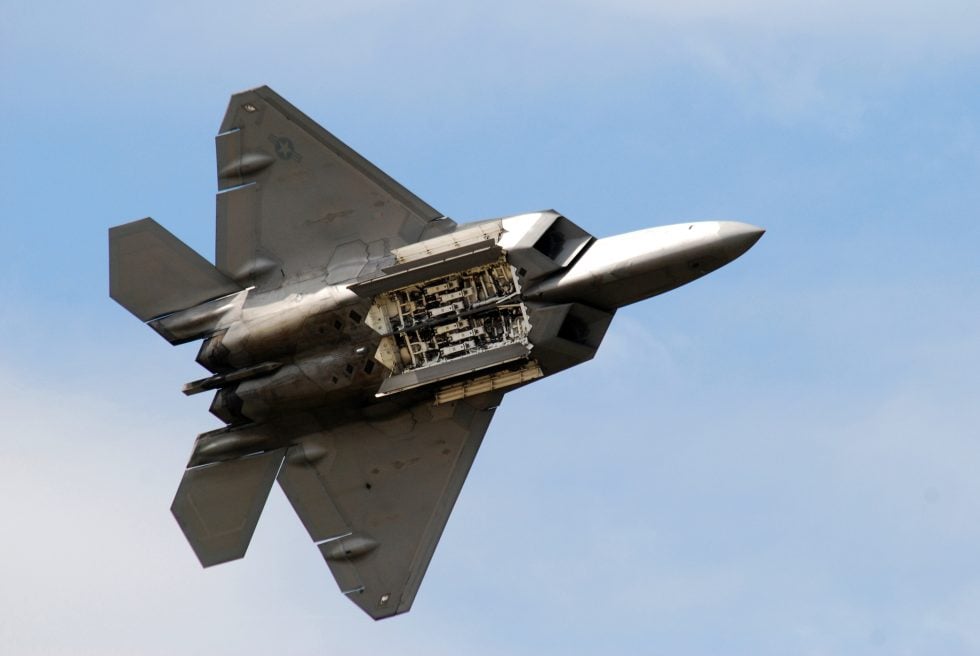
The Raptor’s faceted, planform-aligned shaping, radar-absorbent materials and carefully aligned edges give it a very low radar cross-section from every angle. All primary weapons ride in internal bays — side and belly — so the jet stays clean and stealthy, with no external stores to betray it on an enemy scope.
Twin F119s: supercruise & thrust vectoring
Two Pratt & Whitney F119-PW-100 afterburning turbofans in the ~35,000-lb-thrust class let the Raptor supercruise at roughly Mach 1.8 without afterburner. Two-dimensional pitch-axis thrust-vectoring nozzles give it extraordinary nose-pointing authority and post-stall maneuverability.
Sensor fusion & AESA radar
The AN/APG-77 active electronically scanned array radar, blended with electronic-warfare and communications sensors, feeds a sensor-fusion system that merges everything into one integrated picture — cutting pilot workload and enabling first-look, first-shot, first-kill engagements.
02The F-22 Raptor’s stealth: shaped to vanish, armed from within
Stealth is not one trick but many working together. The Raptor’s airframe is shaped so that its edges — wings, tails, bay doors, inlets — are aligned into a few directions, scattering radar energy away from the emitter. Radar-absorbent coatings soak up what shaping cannot deflect. And because bombs and missiles hung under the wings would light up on radar, the F-22 carries everything inside: six AIM-120 AMRAAMs and two AIM-9 Sidewinders in internal bays, opened only for the split second it takes to fire. The penalty is maintenance-hungry coatings and a smaller weapons load than a non-stealthy jet — the price of being nearly invisible.
03The F-22 Raptor’s F119 engines: the muscle behind supercruise
Most fighters need fuel-gulping afterburner to break the sound barrier. The Raptor’s two F119 turbofans produce so much dry thrust that it can hold roughly Mach 1.8 without reheat — extending range, missile reach and time on station while staying efficient and harder to spot on infrared. The same engines drive two-dimensional nozzles that pivot the exhaust up and down, letting the jet point its nose in ways aerodynamics alone forbid. Together they make the F-22 both a sprinter and an acrobat — a rare combination even a generation later.
Full F-22 Raptor specifications
Baseline: the production F-22A in Block 30/35 configuration, the standard the front-line squadrons actually fight with. Dimensions and weights follow the US Air Force fact sheet. Performance is a problem — the Air Force publishes almost nothing about this aircraft, so figures that are estimates, test-demonstrated one-offs or simply unreleased are flagged in grey, as are the deltas for the 32 Block 20 training jets.
Dimensions & weights
- Crew
- 1
- Length
- 18.90 m (62 ft 1 in)
- Wingspan
- 13.56 m (44 ft 6 in)
- Height
- 5.08 m (16 ft 8 in)
- Wing area
- 78.04 m² (840 sq ft)
- Leading-edge sweep
- 42°
- Empty weight
- 19,700 kg (43,340 lb)
- Gross weight, clean
- 29,410 kg (64,840 lb) with full internal fuel and an air-to-air load
- Max take-off weight
- 38,000 kg (83,500 lb)
- Internal fuel
- ~8,200 kg (~18,000 lb)
- External fuel
- 3,630 kg (8,000 lb) in two 2,270-litre (600 US gal) tanks
- External hardpoints
- Four underwing, each rated 2,270 kg (5,000 lb); normally carried empty or not at all
- Radar cross-section
- Officially undisclosed. The widely repeated 0.0001 m² "marble" figure is an estimate that has never been confirmed by the Air Force or Lockheed Martin.
Performance
- Max speed
- Mach 2.25, 2,410 km/h (1,500 mph) at altitude — the USAF fact sheet says only "Mach two class"
- Supercruise
- Mach 1.5, 1,590 km/h (990 mph) at 15,240 m (50,000 ft) without afterburner
- Supercruise, demonstrated
- Mach 1.82 has been quoted from flight test; how long the aircraft can hold it, and at what altitude, is not published.
- Service ceiling
- 19,800 m (65,000 ft) — the fact sheet claims only "above 50,000 ft"
- Combat radius
- ~850 km (~460 nmi) on internal fuel — a working estimate; the true figure has never been released
- Ferry range
- 2,960 km (1,600 nmi) with two external tanks
- Rate of climb
- Not published. Every number in circulation is an inference from thrust and weight.
- Take-off run
- Under 915 m (3,000 ft)
- g limits
- +9.0 / −3.0, sustainable at take-off gross weight with full internal fuel
- Wing loading
- 377 kg/m² (77 lb/sq ft) at gross weight
- Thrust-to-weight
- 1.08 at gross weight, about 1.25 at half fuel
Propulsion & systems
- Engines
- Two Pratt & Whitney F119-PW-100 afterburning turbofans with two-dimensional convergent-divergent nozzles vectoring ±20° in pitch
- Thrust
- 156 kN (35,000 lbf) class each with afterburner; dry thrust of roughly 116 kN (26,000 lbf) is an estimate, never officially stated
- Fuel system
- ~8,200 kg (~18,000 lb) internal in wing and fuselage tanks, boom refuelling receptacle behind the cockpit
- Radar & mission computing
- AN/APG-77(V)1 active electronically scanned array, roughly 1,500 transmit/receive modules, low-probability-of-intercept search and synthetic-aperture ground mapping; two Common Integrated Processors run the whole aircraft
- Sights
- Head-up display and AN/AAR-56 missile launch detector. The Raptor flew for nearly two decades with no helmet-mounted sight at all; the Thales Scorpion display was only contracted in September 2024 and is being fielded from 2025.
- Electronic warfare
- AN/ALR-94 passive receiver and warning system, chaff and flare dispensers. No towed decoy. A new Infrared Defensive System was placed under contract in 2025.
- Data links
- Intra-Flight Data Link between Raptors; Link 16 receive only. The F-22 cannot transmit its own picture to anything except another F-22 — the single largest reason it sits awkwardly alongside the F-35.
- Ejection seat
- ACES II, zero-zero
- First flight
- YF-22 demonstrator 29 September 1990; production-standard F-22A 7 September 1997
- Service entry
- Initial operational capability 15 December 2005 with the 27th Fighter Squadron at Langley AFB; full operational capability December 2007
- Number built
- 195 airframes — 8 test aircraft and 187 production F-22As. Last delivery 2 May 2012.
- Unit cost
- ~US$143 million flyaway per the USAF fact sheet; ~US$350 million each once the development bill is spread across only 187 aircraft
- Cost per flying hour
- ~US$85,000, the figure most often cited in recent years. It moves with accounting method and fleet size, and roughly a third of the maintenance effort goes on the low-observable coatings alone.
04The F-22 Raptor’s cost: why 195 was all America bought
The Raptor is famously expensive, and the figures depend on how you count. The flyaway cost — the price of one more jet off the line — is commonly cited above $143 million. But spread the programme’s roughly $67 billion in research and procurement across just 195 airframes and the programme-unit cost balloons toward $350 million each. Cite whichever you mean and say so. Either way, the number is why the Air Force’s planned 750 jets became 381, then 195: the F-22 was simply too costly to buy in the quantities first imagined, and the line closed in 2011.
Armament & payload
The Raptor carries its entire war inside itself, and pays for that in variety
Everything about the F-22’s armament follows from one decision: the weapons live inside the aeroplane, because a pylon is a radar reflector. Six AMRAAM in a ventral bay, one Sidewinder in each cheek bay on a trapeze that swings it into the airstream, and a 20 mm gun behind a door that snaps open for the burst and shuts again. That bought an air-to-air fit nothing else could match for twenty years. It also capped the air-to-ground fit at two 1,000 lb JDAMs or eight small-diameter bombs against fixed coordinates — there is no targeting pod, no laser designator, no anti-radiation missile and no moving-target weapon, so an F-15E carries more useful ordnance on one wing station than a Raptor carries in total. Almost none of this applies to the 32 Block 20 aircraft, which are wired and coded for training; the AIM-9X, AIM-120D and small-diameter bomb all arrived with Increment 3 software on Block 30/35 jets only.
Gun
- One M61A2 Vulcan 20 mm six-barrel rotary cannon, 480 rounds, mounted above the starboard wing root.
- The muzzle sits behind a hinged low-observable door that opens only for the burst, so there is no permanent aperture scattering radar energy.
- At 6,000 rounds per minute the magazine amounts to under five seconds of continuous fire.
- Retained because of the Vietnam-era lesson about gunless fighters, but the aircraft was designed to kill at ranges where a gun is irrelevant.
Air-to-air
- Main bay: up to six AIM-120C-5/C-7 or AIM-120D AMRAAM on LAU-142/A hydraulic vertical-eject launchers that punch each missile clear of the bay before the motor lights.
- Side bays: one AIM-9M or AIM-9X Sidewinder each, on an LAU-141/A trapeze that swings the missile out into the airstream so the seeker can acquire before release.
- The AIM-9X’s high-off-boresight shot was only half usable for years, because there was no helmet-mounted sight to cue it until the Scorpion arrived.
- The AIM-260 JATM is the intended AMRAAM replacement, sized to the same bay and the same launchers.
- The type’s only air-to-air kill so far is a Chinese surveillance balloon, shot down with an AIM-9X off South Carolina on 4 February 2023.
Air-to-surface guided
- None. The F-22 carries no air-to-surface guided missile of any type — no Maverick, no JASSM, no HARM, nothing.
- There is no targeting pod and no laser designator, so the aircraft cannot self-designate for any laser-guided weapon.
- Its entire ground attack rests on satellite-guided bombs cued against fixed coordinates, generated from the radar’s synthetic-aperture map.
- The GBU-53/B StormBreaker (SDB II), which gives the F-15E and F-35 a moving-target capability, has never been integrated.
- This is not an oversight to be excused: it is the honest limit of an interceptor that was given a strike role as a political argument rather than a requirement.
Bombs
- Two GBU-32(V)1/B JDAM of 1,000 lb (450 kg), on rack adapters that displace four of the six AMRAAM launchers in the main bay.
- Or eight GBU-39/B Small Diameter Bomb I of 250 lb (110 kg), cleared with Increment 3.1 from 2011.
- Maximum internal bomb load is 910 kg (2,000 lb), released supersonically from high altitude — the delivery profile is the point, not the tonnage.
- Two AIM-120 stay in the bay alongside the bombs, so the aircraft never surrenders its air-to-air role to strike.
- No unguided bombs, no cluster munitions, no nuclear role.
Rockets
- None carried. The F-22 has never been cleared for unguided rockets of any calibre.
- No station is plumbed or wired for a rocket pod, and hanging one outside would wreck the signature the aircraft exists to protect.
- Close air support and battlefield interdiction were never part of the Advanced Tactical Fighter requirement.
Pods & other stores
- Four underwing hardpoints of 2,270 kg (5,000 lb) each, normally left off entirely; the pylons themselves are jettisonable so the aircraft can go clean in seconds.
- Two 2,270-litre (600 US gal) drop tanks for deployment and ferrying. They compromise the signature until tanks and pylons are both gone.
- A low-observable tank-and-pylon set has been in flight test since 2023, intended to let the Raptor keep external fuel into contested airspace; squadron delivery was being targeted from 2026.
- Slim underwing infrared sensor pods have been flying on test aircraft since 2024, finally restoring the infrared search and track that was cut from the design on cost grounds in the 1980s.
- No targeting pod, no jamming pod, no gun pod and no reconnaissance pod has ever been cleared for the type.
Three typical loadouts
- Air superiority, clean
- 6 × AIM-120C/D in the main bay, 2 × AIM-9M/X in the side bays, 480 rounds of 20 mm. Nothing under the wings. This is the configuration the entire aeroplane was designed around.
- Long-range combat air patrol
- The same internal fit plus 2 × 2,270-litre (600 US gal) external tanks on jettisonable pylons. The aircraft is not stealthy until both tanks and both pylons have gone.
- Limited strike, Block 30/35
- 2 × GBU-32 JDAM or 8 × GBU-39 SDB in the main bay, 2 × AIM-120 alongside them, 2 × AIM-9 in the side bays, against pre-planned fixed coordinates.
Weapon fits are block-dependent and the Air Force releases very little. AIM-9X, AIM-120D and improved emitter geolocation came with Increment 3.2B on Block 30/35 aircraft from around 2019; the Block 20 jets have none of it. Payload figures here follow the USAF fact sheet and Lockheed Martin statements — bay capacities and stores clearances quoted elsewhere are frequently inference rather than fact.
Variants
The F-22 barely has variants, because the programme was killed before it could grow any
Most successful fighters spread into families — two-seaters, naval versions, strike derivatives, export marks with different radars. The Raptor did none of that. Two demonstrators, eight test aircraft, one production model, and a line shut down at 187 airframes. What looks like a variant list is really a list of production lots and software increments inside a single airframe standard, which is why the aircraft is unusually consistent and unusually inflexible at the same time.
The split that actually matters is Block 20 against Block 30/35. The early production jets were delivered before the combat software existed, and they were never brought forward; 32 of them remain training aircraft two decades later. The Air Force has asked to retire them in budget request after budget request, arguing that upgrading them would cost around US$3.3 billion and take some fifteen years. Congress has refused every time, on the reasoning that 32 stealth airframes are worth more in the inventory than in the desert.
Behind all of it sits the cancellation. The Advanced Tactical Fighter was sized against a Soviet air force that dissolved while the aeroplane was still in flight test. A requirement for 750 became 648, then 381, then 187 — and the threat the F-22 was built to beat has since reappeared in a different form, against which it is superb in a dogfight and clumsy in a network.
- YF-22 (1990–1992, 2 built)
- Dem/Val demonstrators flown off against the Northrop YF-23; first flight 29 September 1990. Larger-winged, rounder and aerodynamically quite different from the production aircraft; one was lost in a landing accident in April 1992.
- F-22A EMD (1997–2001, 8 test aircraft)
- Production-representative development jets. The first, 91-4001, flew on 7 September 1997 and set the shape that entered service unchanged.
- F/A-22 (2002–2005, designation only)
- A renaming intended to advertise a ground-attack capability the aircraft only marginally had, adopted to protect the budget and quietly dropped in December 2005.
- F-22A Block 10 (Lots 1–2, from 2003)
- First production standard, used for test and training only; later folded into the Block 20 configuration.
- F-22A Block 20 (Lots 3–4, 32 aircraft)
- Training configuration with older processors and without the combat mission software. Flown by the training unit and, since 2022, by the reactivated 65th Aggressor Squadron at Nellis, where a non-combat Raptor is genuinely useful.
- F-22A Block 30 (Lots 5–7)
- The first properly combat-coded standard. Increment 2 software added JDAM delivery and the initial ground-attack capability.
- F-22A Block 35 (Lots 8–9, deliveries to 2 May 2012)
- Final build standard. Increment 3.1 added synthetic-aperture mapping, electronic attack and the Small Diameter Bomb in 2011; Increment 3.2B added AIM-9X, AIM-120D and better emitter geolocation.
- F-22 mid-life upgrade (2024–, in test)
- Popularly "Raptor 2.0": stealthy external tanks and pylons, underwing infrared sensor pods, the Scorpion helmet display, an open mission-systems architecture and AIM-260 integration, intended to hold the line until the F-47 arrives.
- FB-22 (proposed 2002–2006, none built)
- A stretched, delta-winged regional bomber derivative with a much larger internal bay. Studied seriously, then killed by the 2006 Quadrennial Defense Review.
- F-22J (proposed 2005–2009, none built)
- The export version Japan asked for and offered to help build. It was never legally possible, and the request was the clearest demonstration of what the export ban cost.
Fleet, as of 2026: 195 airframes were built — 8 test aircraft and 187 production F-22As — against an original requirement of 750 and a revised plan of 381. Production was halted by Defence Secretary Robert Gates in 2009 and the last aircraft was handed over on 2 May 2012. Roughly 183 survive, at least five having been written off in crashes between 2004 and 2020; of the survivors about 150 are combat-coded Block 30/35 jets and 32 are Block 20 trainers, and only part of the fleet is available on any given day. The United States Air Force is the sole operator and always has been: the Obey Amendment, attached to the 1998 US defence appropriations act and renewed ever since, bars any foreign sale, which is why Japan never got an F-22J. Congress has blocked the Air Force’s repeated attempts to divest the Block 20 fleet, and in June 2026 the House Armed Services Committee approved language extending the retirement ban to 30 September 2032 — committee language, not yet enacted law, so check the signed NDAA before quoting it.
The F-22 Raptor: four decades in the making
The requirement is set
The USAF establishes the Advanced Tactical Fighter (ATF) requirement to counter projected Soviet fighters such as the Su-27 and MiG-29.
Fly-off begins
A demonstration/validation phase pits Lockheed’s YF-22 against Northrop’s YF-23.
Prototypes fly
Both the YF-22 and the YF-23 make their first flights.
YF-22 wins
In August the Lockheed-led YF-22 is declared the winner and moves into Engineering & Manufacturing Development.
First F-22A flight
The first production-standard F-22A flies on 7 September.
Initial Operational Capability
The Raptor reaches IOC on 15 December, entering frontline service.
Production ends
The line is capped and closed at 195 aircraft; the final airframe is delivered in 2012.
Combat debut
On 22 September the F-22 flies its first combat mission — air-to-ground strikes on ISIS targets over Syria.
First air-to-air kills
In February the Raptor downs a Chinese surveillance balloon and two other high-altitude objects — its first-ever aerial kills.
From the flight line: twelve F-22 Raptor stories
YF-22 vs YF-23: the fly-off that chose the future
Two radically different stealth prototypes dueled in 1990–91.
Read the full story
Supercruise: fast without the fuel bill
The Raptor cruises supersonic without ever lighting the afterburner.
Read the full story
The thrust-vectoring cobra
Vectoring nozzles let the Raptor point its nose where aerodynamics forbid.
Read the full story
Only ~187: a fleet too small
The Air Force wanted 750 Raptors and got fewer than 190 usable jets.
Read the full story
Banned from export by law
A 1998 U.S. law made it illegal to sell the F-22 to anyone.
Read the full story
The highest kill in history: the 2023 balloon
A single AIM-9X ended a Chinese spy balloon at over 60,000 feet.
Read the full story
Three shoot-downs in nine days
Days after the balloon, Raptors downed two more mystery objects.
Read the full story
The silent quarterback
In the Middle East the Raptor watched, escorted and deterred more than it fired.
Read the full story
The 100-plus-to-nothing exercises
Red Flag data is the root of the Raptor’s “unbeatable” reputation.
Read the full story
$67 billion and the 2011 line closure
The Raptor’s price made it politically fragile — and finite.
Read the full story
Raptors over Syria, 2014
The Raptor’s first shots in anger were bombs, not missiles.
Read the full story
Upgrade, or retire for NGAD?
With production long closed, the Raptor’s twilight is fiercely debated.
Read the full story
The F-22 Raptor in pictures
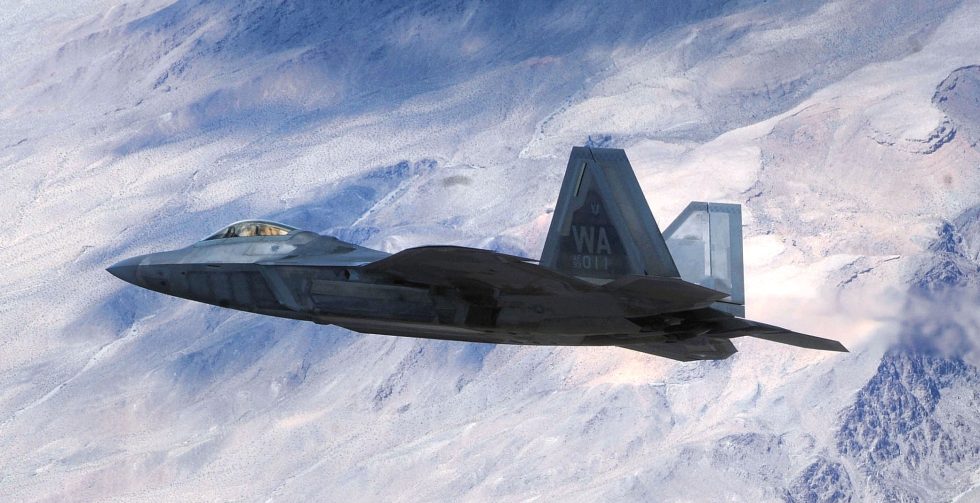
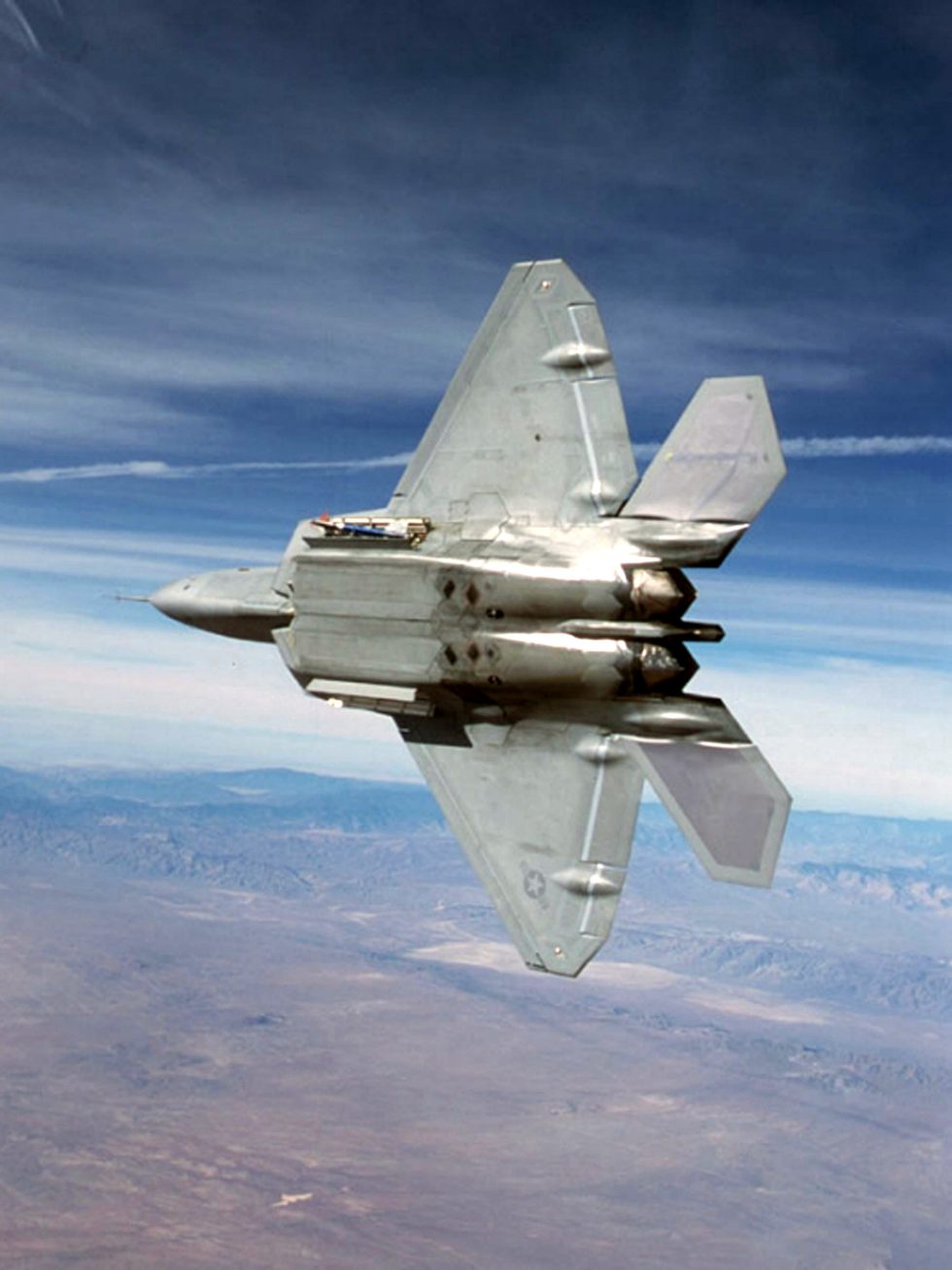
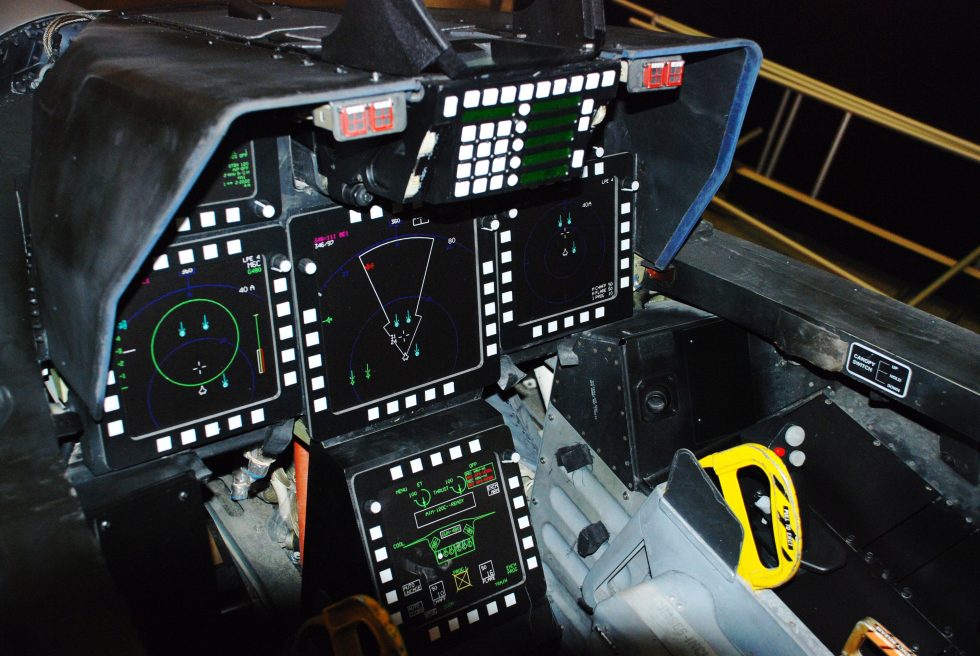
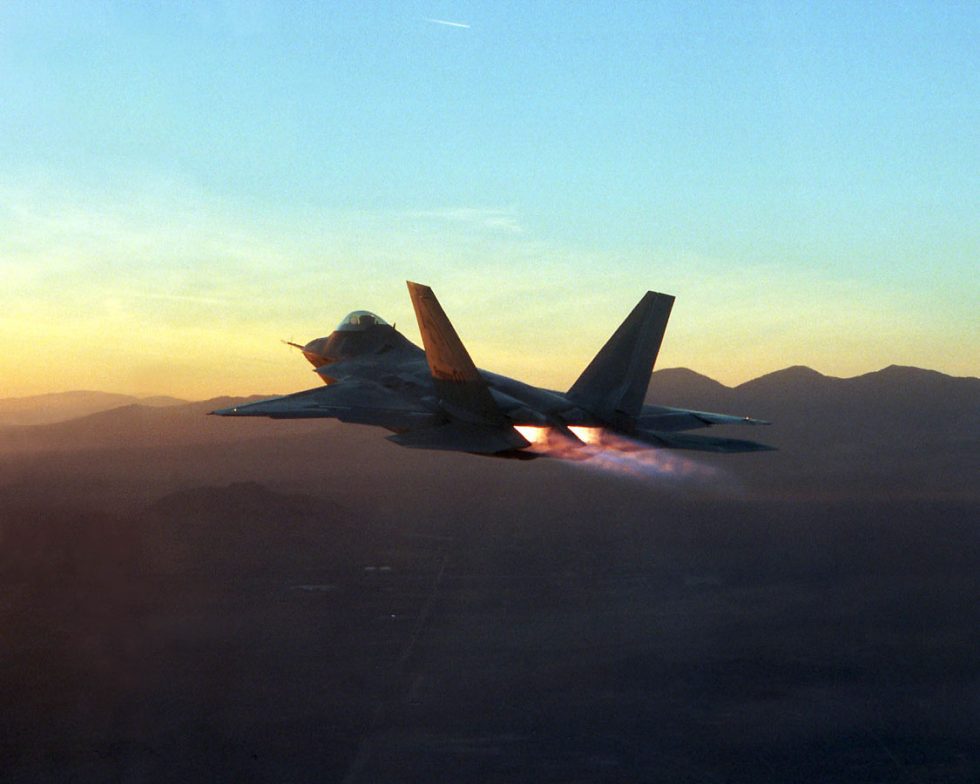
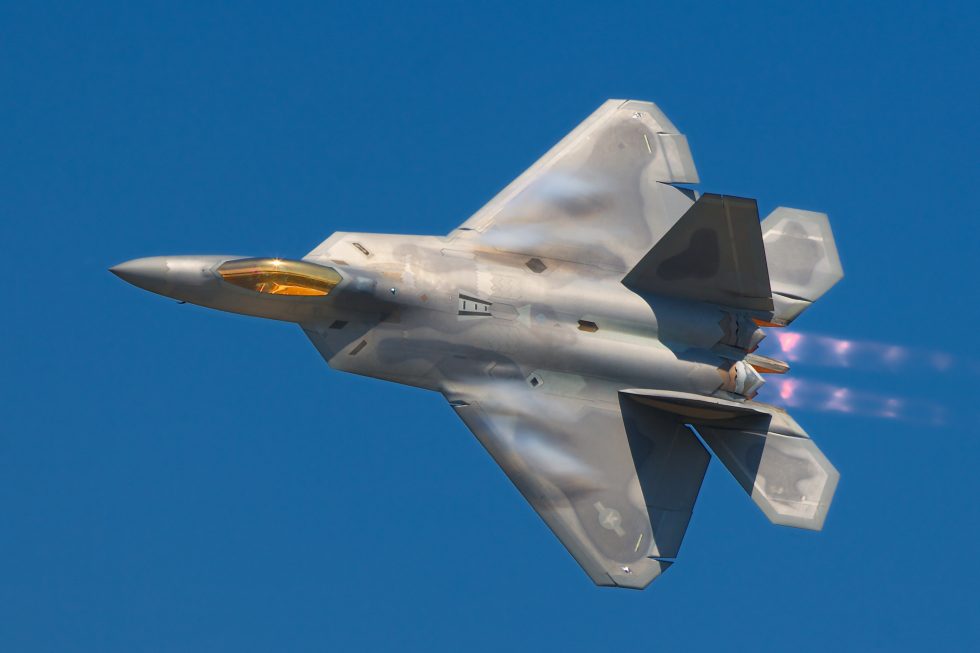
The F-22 Raptor in motion
A featured F-22 Raptor video — showcasing supercruise, high-alpha and thrust-vectoring maneuvers — is coming soon.
The F-22 Raptor in motion
DroneScapes — one of the most-watched F-22 Raptor films on YouTube.
Where the F-22 Raptor flies
The F-22 Raptor’s combat record
For all its dominance, the F-22 Raptor has never shot down an enemy fighter aircraft. Its combat debut, on 22 September 2014 over Syria, was an air-to-ground strike with GPS-guided JDAMs against ISIS targets near the Tishrin Dam. In deployments it has worked as an aerial “quarterback,” escorting strike packages and deterring adversary aircraft rather than fighting them.
The Raptor’s only air-to-air kills came in February 2023: on 4 February an F-22 downed the Chinese surveillance balloon off South Carolina with a single AIM-9X — likely the highest-altitude air-to-air kill on record — followed by two more high-altitude objects over Canada and Lake Huron. Compare the combat record of every military aircraft. Figures as of July 2026.
Everything people ask about the F-22 Raptor
Can I fly in an F-22 Raptor?
How fast is the F-22 Raptor?
Is the F-22 really stealthy?
Is the F-22 still in service?
Why were so few built, and why can’t other countries buy it?
Did the F-22 shoot down the Chinese balloon?
How many F-22s were built?
What’s the difference between the F-22 and the F-35?
You can’t fly the F-22.
These, you can.
Some legends only live in museums — others are fuelled and waiting. MiGFlug has put civilians in real military jet cockpits since 2004.
 Fly the L-39 AlbatrosThe world’s most-flown jet trainer — aerobatics included
 Fly the F-104 Starfighter“The missile with a man in it”
 Fly the MiG-21The Cold War’s most-produced jet
 Fly the T-33 Shooting StarAmerica’s first jet trainer
 Fly the DH VampireA piece of early jet history
 Fly the S.211Agile Italian jet trainer
 Fly the MB-326The classic Aermacchi jet
 Fly the MiG-15The Soviet legend of the Korean War
Continue the tour
Every F-22 Raptor fact, checked
- U.S. Air Force — F-22 Raptor Fact SheetOfficial specifications, service history and role.
- GlobalSecurity.org — F-22 Raptor HistoryATF program origins and development timeline.
- Lockheed Martin — F-22 RaptorManufacturer overview of the aircraft and its systems.
- Military MachineF-22 combat record and operational deployments.
- Simple FlyingWhy the F-22 is banned from export.
- Air & Space Forces MagazineOngoing F-22 coverage, upgrades and the NGAD debate.
- The AviationistThe F-22’s initial combat operations against ISIS.
- National Security JournalThe F-22 as the only U.S. fifth-gen fighter that cannot be legally exported.