
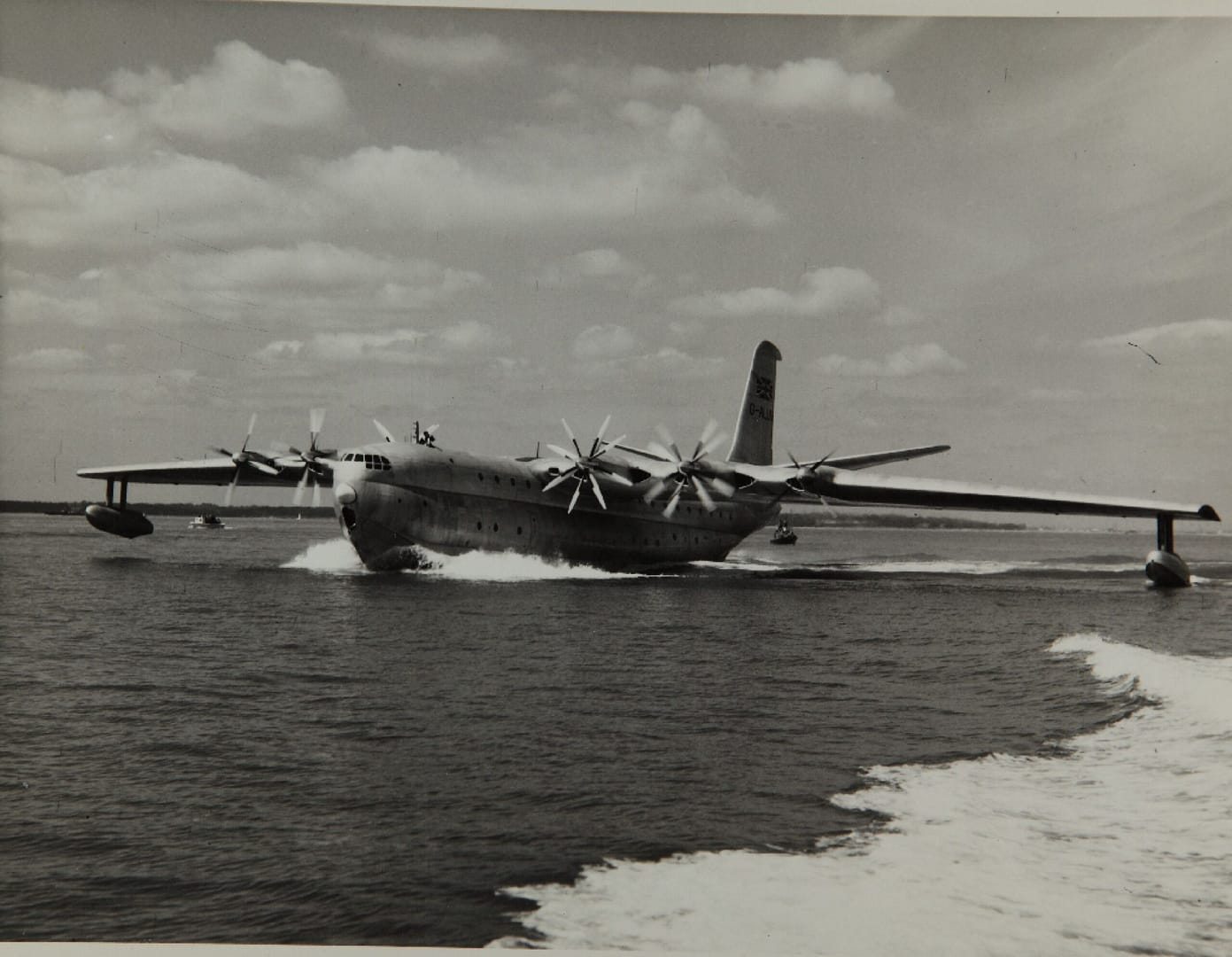
At the Farnborough air show in 1953, the crowd hears it before they see it. Ten engines, building from a hum to a roar, and then the largest all-metal flying boat ever built slides overhead — a silver whale of an aircraft, a 219-foot wing, an ocean liner that has somehow decided to fly. People point. Children gape. It is, by any measure, magnificent.
It is also already dead. The Saunders-Roe Princess was the grandest flying boat Britain ever conceived, and by the time it flew, the world it was built for had quietly ceased to exist.
- What: the Saunders-Roe SR.45 Princess — the largest all-metal flying boat ever built
- Engines: ten Bristol Proteus turboprops
- First flight: 22 August 1952, prototype G-ALUN, built at Cowes on the Isle of Wight
- Ambition: a double-deck transatlantic liner of the air for around 100 passengers in luxury
- The problem: by 1952 paved runways and land-based jets had made big flying boats obsolete
- The end: only one ever flew; the programme was cancelled in 1954 as BOAC chose the jet-powered de Havilland Comet
A liner with wings
The Princess was unapologetically a creature of a more romantic age of travel. Built at Cowes on the Isle of Wight, it was designed to sweep wealthy passengers across the Atlantic on two decks, in the unhurried comfort of an ocean liner. Its first prototype, G-ALUN, took to the air on 22 August 1952 on the strength of ten Bristol Proteus turboprops — the inner ones cleverly paired to spin contra-rotating propellers, a beautiful and temperamental piece of engineering.
Everything about it was vast, considered, and superbly made. And all of it was an answer to a question the post-war world had stopped asking.
Killed by concrete and jet fuel
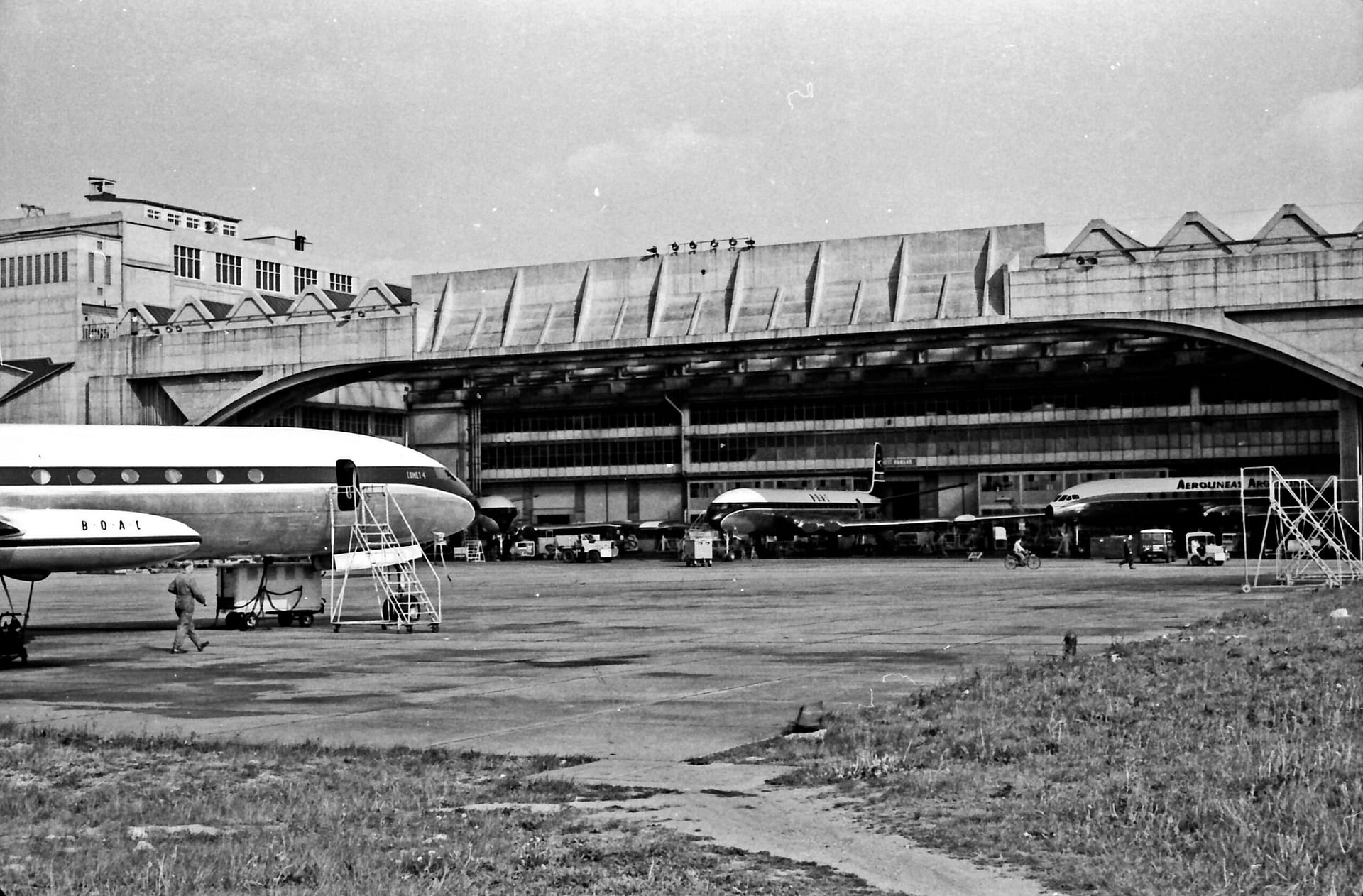
The flying boat’s entire logic was that it needed no airport — only a calm stretch of water. But the Second World War had bequeathed the planet thousands of miles of long concrete runway, and a land aeroplane, freed from the weight and drag of a boat-shaped hull, was simply faster and cheaper. The economics had inverted.
BOAC, the airline the Princess was meant to serve, saw it clearly. It had already wound up its flying-boat services in 1950, and its chairman dismissed the whole concept as outdated. When the airline cast its lot with fast, land-based jets — above all the de Havilland Comet — the Princess was orphaned. The programme was cancelled in 1954.
A beautiful full stop
Only one Princess ever flew. The other two were sealed up, unfinished, and all three were eventually broken up in the 1960s without carrying a single paying passenger. For years their cocooned hulls sat by the water at Cowes like beached sea creatures, monuments to a future that never arrived.
It is tempting to call the Princess a failure, but that is the wrong word. It was a triumph of engineering that simply finished its race after the finish line had been moved. It remains the high-water mark of the flying boat — the most magnificent example of a species that the jet age was already quietly retiring. A perfect answer, delivered a few years too late.
Sources: Wikipedia; Vintage Aviation News; Smithsonian Air & Space; Wight Aviation Museum.
Related Questions
What was the Saunders-Roe Princess?
The Saunders-Roe SR.45 Princess was a British flying boat of the early 1950s and the largest all-metal flying boat ever built. Powered by ten Bristol Proteus turboprop engines and designed to carry around 100 passengers across the Atlantic in double-deck luxury, it was intended to be the ultimate ocean liner of the air.
How many engines did the Princess have?
Ten. The Bristol Proteus turboprops were arranged across the huge 219-foot wing, with the inner engines paired to drive contra-rotating propellers and the outer two driving single propellers — a complex installation whose reliability problems plagued the test programme.
Why did the Princess fail?
Timing. By the time it first flew in 1952, the case for big flying boats had collapsed: the war had left the world covered in long paved runways, and faster, cheaper land-based airliners — soon jets like the de Havilland Comet — made the boat hull pure dead weight. BOAC decided it had no need for the Princess, and the programme was cancelled in 1954.
How many Princesses were built and did they fly?
Three were built, but only the first prototype, G-ALUN, ever flew, completing around 47 test flights and appearing at the Farnborough Airshow. The other two were never finished. All three were eventually scrapped in the 1960s without ever carrying a fare-paying passenger.
Why are there almost no flying boat airliners today?
Because land runways won. Flying boats made sense when airfields were rare and oceans were the highways, but paved runways, pressurised land airliners and jet engines made them slower, heavier and more expensive for the same job. The Princess was one of the last and grandest attempts to keep the flying boat alive — and it arrived just too late.
0 Comments