
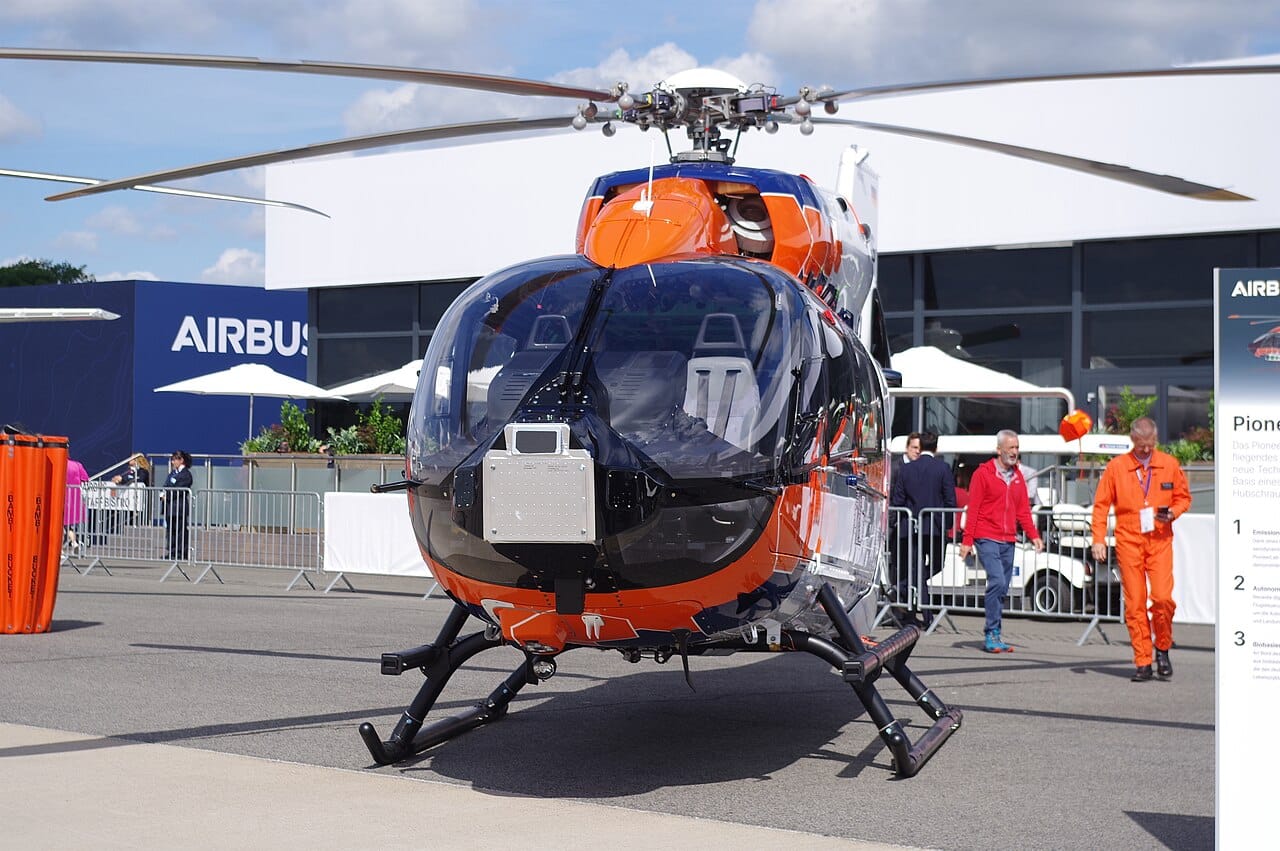
Walk the static line at ILA Berlin and you expect the usual choreography around a helicopter: a pilot strapping in, a crew chief signalling, the slow whine of an Arriel engine spooling up. This June, Airbus parked something stranger under the Brandenburg sun. The airframe was unmistakably an H145 — the same four-tonne twin that flies air ambulances over the Alps and police patrols over Paris. But where the cockpit should have been, there was no glass, no seats, no pilot at all. In its place: a hinged nose door and a flat cargo floor.
This is the U145, and it represents one of Europe’s clearest statements yet about where military rotary-wing flight is heading. Airbus Helicopters revealed a full-scale mock-up of the uncrewed, fully autonomous variant of the H145 on 8 June 2026, at the opening of the Berlin airshow. There is no human on board by design. A first flight — with a safety pilot watching over the machine’s shoulder — is planned for the end of this year.
The fixed-wing world has spent two decades absorbing the unmanned revolution, from Predators to loitering munitions. The helicopter, stubbornly, kept its pilot. The U145 is Airbus betting that the rotorcraft’s turn has finally come — and that the smartest way to get there is not to invent a new aircraft, but to take away the cockpit from one that already works.
Quick Facts — Airbus U145
- What it is: Uncrewed, fully autonomous variant of the Airbus H145 helicopter
- Revealed: Full-scale mock-up, ILA Berlin airshow, 8 June 2026
- Cockpit: None — replaced by an integrated nose cargo door, foldable loading table and dedicated cargo floor
- Autonomy: Specialised sensor suite plus artificial intelligence for full autonomy
- Max take-off weight: 3,800 kg
- Primary role: High-volume cargo and logistics resupply (civil and military)
- First flight: Planned for end of 2026, with a safety pilot onboard
- Service entry: Targeted for the beginning of the 2030s
Subtraction, not invention
The cleverness of the U145 lies in what Airbus removed rather than what it added. The H145 is one of the most thoroughly proven light helicopters flying. More than 1,800 of the family are in service across military, parapublic and civil operators, and between them they have logged over 8.5 million flight hours. The airframe, the rotor system, the twin Safran Arriel 2E engines with their digital engine control — all of it is mature, certified and understood.
Strip out the pilots and you free up the entire forward fuselage. Airbus used that space ruthlessly. The U145 has no physical cockpit; instead it carries an integrated nose door with a foldable loading table and a dedicated cargo floor, turning the front of the aircraft into a loading bay. The result is a machine optimised from the nose back for one thing: moving cargo without a crew.
That philosophy — build the unmanned aircraft around hardware you already trust — is becoming an Airbus signature. The H145 is the second crewed helicopter the company is converting into an uncrewed version, following the smaller VSR700, which is derived from the Cabri G2. It is a distinctly European, distinctly pragmatic way to reach autonomy: evolution over revolution.
Logistics is the killer mission
The headline use case is not strike or reconnaissance. It is resupply. With a maximum take-off weight of 3,800 kg, the U145 is pitched as a mission-agnostic solution for civil and military customers, but its primary job is high-volume cargo supply — ferrying ammunition, spare parts, blood, food and water to places that are dangerous, remote, or both.
For a military planner, the appeal is obvious. The most exposed link in any campaign is the supply run: the slow, predictable shuttle of materiel toward the front. Putting a crew in that aircraft means risking lives on the most routine and most ambushed of missions. An uncrewed helicopter that can fly the same route, land itself, disgorge its load through a nose door and turn around changes the arithmetic of risk entirely.
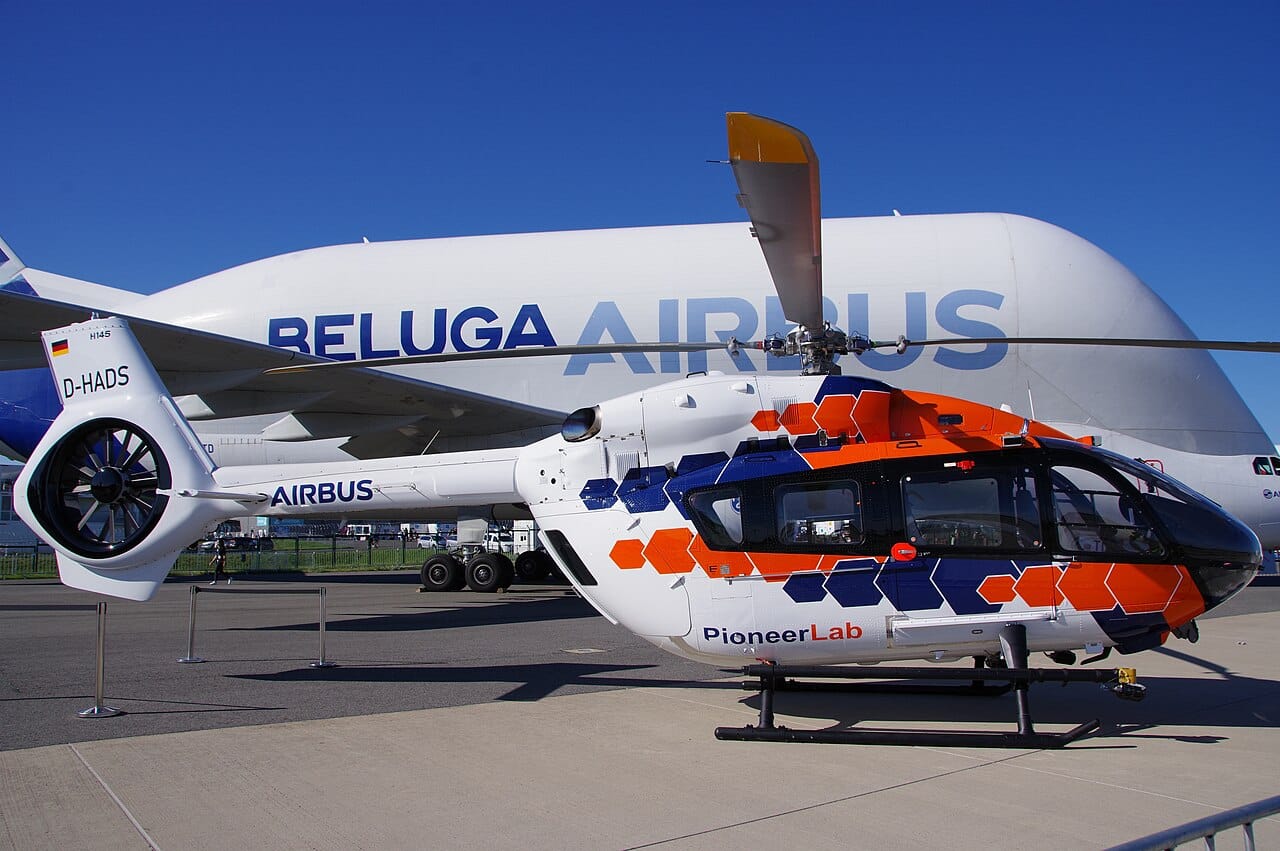
It is the rotary-wing answer to a logic the fixed-wing world settled long ago. Cargo drones, autonomous resupply quadcopters and uncrewed fixed-wing freighters are already reshaping how armies think about the “last tactical mile.” The U145 brings the helicopter’s unique gifts — vertical lift, the ability to land where there is no runway, the capacity to carry a serious payload — into that same uncrewed equation.
More than a flying truck
Airbus is careful to frame the U145 as a platform rather than a single-purpose drone. Its modular design, the company says, supports expansion into disaster management, firefighting, armed scouting and surveillance, and even a “drone mothership” role launching air-launched effects — a concept Airbus is pursuing with European missile house MBDA. Crewed-uncrewed teaming, where the U145 flies alongside piloted helicopters as a loyal wingman, is also on the roadmap.
To make any of that real, the aircraft will carry a specialised sensor suite and artificial intelligence designed for full autonomy — not a remote-control link with a pilot on the ground, but a machine making its own flight decisions. That is a high bar, and Airbus is sensibly not pretending it is cleared yet. The U145 shown at Berlin is a mock-up; the programme is in development, with the first real flight still ahead.
There is an American cousin to all this, too. In the United States, Airbus U.S. Space & Defense — with partners Shield AI, L3Harris and Parry Labs — is offering the US Marine Corps the MQ-72C, a fully autonomous variant of the proven UH-72B Lakota. The same idea, tailored to a different customer: take a trusted airframe, remove the crew, add a brain.
For Europe, the U145 is more than a product launch. It is a signal that the continent’s aerospace industry intends to own the autonomous-rotorcraft category rather than import it — building on the H145, one of its quietest successes, to define what the uncrewed helicopter looks like for the 2030s. The cockpit is gone. The mission, and the airframe, remain.
Sources: Airbus Helicopters press release (8 June 2026); Aviation Week; Janes; Vertical Magazine; Breaking Defense; New Atlas. Engine and fleet figures per Airbus and Safran.
Related Questions
What is the Airbus U145?
The U145 is an uncrewed, fully autonomous variant of the Airbus H145 light helicopter. Airbus Helicopters revealed a full-scale mock-up at the ILA Berlin airshow on 8 June 2026. It has no cockpit; the forward fuselage is rebuilt with an integrated nose cargo door, a foldable loading table and a dedicated cargo floor, optimising it for cargo and logistics.
Is the U145 based on the H145?
Yes. The U145 is a direct conversion of the proven H145, reusing its airframe, rotor system and twin Safran Arriel 2E engines. Airbus removed the cockpit and crew provisions and added a specialised sensor suite and artificial intelligence for full autonomy. It is the second crewed Airbus helicopter to be converted to uncrewed, after the VSR700.
When will the U145 fly for the first time?
Airbus plans a first flight with a safety pilot onboard by the end of 2026. Entry into service is targeted for the beginning of the 2030s. As of its Berlin reveal in June 2026, the U145 exists as a full-scale mock-up and is in development, not yet flying.
What is the U145 designed to do?
Its primary role is high-volume cargo and logistics resupply for civil and military operators, with a maximum take-off weight of 3,800 kg. Its modular design also supports disaster management, firefighting, armed scouting, surveillance, a drone-mothership role for air-launched effects (with MBDA), and crewed-uncrewed teaming.
How is the U145 different from a crewed H145?
The U145 has no physical cockpit. The space normally occupied by pilots is replaced by an integrated nose door, a foldable loading table and a dedicated cargo floor. It flies autonomously using onboard sensors and AI rather than a human crew, while keeping the H145’s proven airframe, power and useful load.
What engines power the H145 and U145?
The H145 family is powered by two Safran Arriel 2E turboshaft engines equipped with a full authority digital engine control (FADEC). Airbus states there are more than 1,800 H145-family helicopters in service worldwide, with over 8.5 million flight hours logged across military, parapublic and civil missions.
Related Posts
0 Comments