Twenty kills. Zero losses. In the spring of 1982, a handful of British Sea Harriers — subsonic, short-ranged, outnumbered — went to war over the South Atlantic against the Argentine Air Force. They were not supposed to win. They won anyway.
The Falklands War air campaign remains one of the most lopsided air-to-air records in modern military history. Twenty-eight Sea Harrier FRS.1 fighters, operating from two small aircraft carriers with no airborne early warning, no tanker support, and no land bases within 6,000 kilometres, destroyed 20 Argentine aircraft in aerial combat without losing a single jet to enemy fighters.
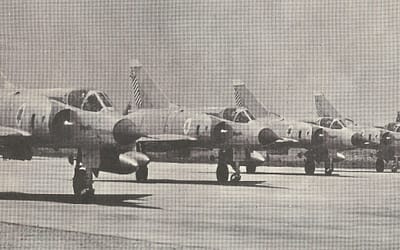
The score was not supposed to be possible. The Sea Harrier was slower, shorter-ranged, and less manoeuvrable than the Argentine Mirage IIIs and Daggers it faced. What it had was a secret weapon that changed everything.
Quick Facts
Aircraft: British Aerospace Sea Harrier FRS.1
Air-to-air record: 20 kills, 0 losses
Total Sea Harriers deployed: 28 (20 aboard HMS Invincible, 8 aboard HMS Hermes)
Conflict: Falklands War (April–June 1982)
Primary weapon: AIM-9L Sidewinder (all-aspect infrared missile)
Argentine aircraft destroyed: Mirage III, IAI Dagger, A-4 Skyhawk, Canberra, Pucará, C-130 Hercules
Sea Harriers lost (all causes): 6 (accidents, ground fire — none to air-to-air combat)
The Sidewinder Advantage
The Sea Harrier’s secret was the AIM-9L Sidewinder — the first all-aspect infrared missile available to Western forces. Previous Sidewinder variants could only lock onto a target’s hot exhaust from behind, forcing attackers into a classic tail chase. The AIM-9L could lock onto a target from any angle — head-on, beam, quarter — and track it with a cooled seeker that was far more resistant to countermeasures.
Argentine pilots, trained to defend against older rear-aspect missiles, discovered too late that the rules had changed. A Sea Harrier could fire head-on during a merge, or from the beam during a crossing attack, with lethal reliability. Of the 27 AIM-9L Sidewinders fired by Sea Harriers during the war, 19 scored kills — a hit rate exceeding 70 percent. In an era when missile reliability was often below 20 percent, those numbers were extraordinary.
The AIM-9L was so effective that it essentially negated the Mirage III’s speed advantage. An Argentine Mirage approaching at Mach 1.5 faced a missile that could be fired at it from any aspect. Speed without stealth was no longer survivable.
VIFF: The Manoeuvre Nobody Expected
The Sea Harrier had a second trick: vectoring in forward flight, or VIFF. By rotating its four engine nozzles while flying, the Sea Harrier could dramatically change its flight path in ways that no conventional fighter could match. A pursuing aircraft expecting its target to follow the laws of conventional aerodynamics would suddenly find the Sea Harrier decelerating, turning inside its pursuer, or dropping below the engagement entirely.
VIFF was not a gimmick. Sea Harrier pilots trained extensively in the technique and used it to generate firing solutions that would have been impossible in any other aircraft. In a turning fight with a Mirage or Dagger — both delta-winged aircraft that bled energy rapidly in sustained turns — the Sea Harrier’s ability to vector thrust gave it a decisive edge at low speeds.
Argentine pilots were deeply respectful of the Sea Harrier’s manoeuvring capability. Post-war debriefs revealed that many Argentine formations broke off engagements rather than enter a turning fight with a Harrier — a remarkable admission given the Mirage’s theoretical superiority in speed and altitude.
No Radar, No Warning, No Problem
The British task force fought without airborne early warning. The Royal Navy had retired its last fixed-wing AEW aircraft — the Fairey Gannet — when the old fleet carriers were decommissioned. The result was a radar picture that extended only as far as the ships’ own sensors could see, leaving dangerously short warning times against low-flying attackers.
The Sea Harriers compensated with combat air patrols (CAPs) stacked at multiple altitudes around the task force. Pilots maintained standing patrols for hours, cycling on and off the carriers in a relentless rotation that pushed both men and machines to their limits. The small number of aircraft — never more than 20 operational Sea Harriers at any given time — meant that every jet flew multiple sorties per day.
The sheer intensity of the flying programme was its own form of attrition. Six Sea Harriers were lost during the war — all to accidents or ground fire, none to Argentine fighters. The operational tempo, combined with South Atlantic weather and the demands of shipboard operations, pushed the force to the edge of sustainability. If the war had lasted another month, serviceability rates would have become critical.
The Argentine Perspective
The Argentine Air Force and Naval Aviation fought with extraordinary courage. Pilots flew low-level attack missions against the British fleet in aircraft — A-4 Skyhawks, Daggers, and Super Étendards — that were outmatched in air-to-air combat but lethal in the strike role. Argentine bombs sank HMS Sheffield, HMS Coventry, HMS Ardent, HMS Antelope, and the container ship Atlantic Conveyor. An Exocet missile destroyed Sheffield and Atlantic Conveyor.
But every strike mission had to run the Sea Harrier gauntlet. Argentine formations approaching the task force faced interception by CAP Harriers firing all-aspect Sidewinders. The losses mounted: Mirages, Daggers, Skyhawks, Canberras, even a C-130 Hercules were shot down. The attrition rate on strike missions became unsustainable.
The Argentine Air Force lost the air-to-air war conclusively, despite fielding faster and theoretically more capable aircraft. The lesson was brutal and enduring: technology, training, and tactics matter more than raw performance numbers.
Legacy of the 20–0
The Sea Harrier’s Falklands record reshaped thinking about naval aviation, close air support, and the viability of V/STOL fighters in high-intensity warfare. Before 1982, many defence analysts dismissed the Harrier concept as a compromise — too slow for air superiority, too short-ranged for strike, too complex for reliability. The Falklands silenced every one of those criticisms.
The 20–0 score stands as one of the cleanest air-to-air records of the modern jet age. It proved that a well-trained force flying a technologically inferior aircraft, armed with the right weapon, can dominate a numerically and qualitatively superior opponent.
Forty-four years later, the Sea Harrier’s lesson endures: wars are not won by the fastest jet. They are won by the smartest missile, the best-trained pilot, and the will to fight from a pitching deck in the middle of nowhere.
Sources: Royal Navy historical records, Sharkey Ward’s “Sea Harrier Over the Falklands,” Air Power History



 English
0 Comments