

The Pentagon has decided the next war will be won by arithmetic. Not by a handful of exquisite, million-dollar missiles, but by thousands of cheap ones — enough to swamp any air defence ever built.
On 16 July the Department of War signed multiyear framework agreements with three companies — Anduril, CoAspire and Zone 5 Technologies — to mass-produce low-cost cruise missiles under a program called the Family of Affordable Mass Missiles, or FAMM. Some are built to be shoved out the back of an ordinary cargo plane. The goal is blunt: buy them by the thousand, and never run out.
QUICK FACTS
| Announced | 16 July 2026, U.S. Department of War |
| Program | Family of Affordable Mass Missiles (FAMM) |
| Winners | Anduril (Barracuda), CoAspire (RAACM), Zone 5 (Rusty Dagger) |
| Structure | Seven-year, fixed-minimum-quantity frameworks |
| Volume goal | Up to ~8,000 missiles a year once production ramps (Pentagon) |
| Twist | Some launch palletized from C-130 / C-17 cargo planes |
| Fielding | Cargo-launch "Dragon Cart" expected in service by 2027 |
Quantity has a quality all its own
Modern air defences are formidable, but they can be arithmetically overwhelmed. Fire more missiles than a battery has interceptors, and something gets through. The catch has always been price: when each cruise missile costs as much as a house, you cannot afford to lose the maths race. FAMM is the Pentagon’s attempt to change the price tag.
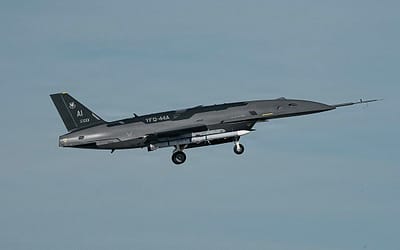
The three chosen weapons — Anduril’s Barracuda, CoAspire’s Rapidly Adaptable Affordable Cruise Missile, and Zone 5’s Rusty Dagger — are designed to behave less like precision heirlooms and more like rocket-powered, one-way attack drones. Simple, mass-produced, and cheap enough to fire in swarms.

The acquisition itself is the other half of the story. Instead of one winner-take-all contract, the Pentagon handed out seven-year frameworks to multiple firms, guaranteeing minimum orders to give industry the confidence to build new production lines.
Turning transports into bombers
The most striking piece is the delivery method. Part of the effort ties into Rapid Dragon — now a program of record called Dragon Cart — which lets an unmodified C-130 or C-17 become a standoff missile launcher. Roll a palletized module up the ramp, airdrop it, and the missiles fly out and light their engines in mid-air.
A single C-17 could carry as many as 45 such missiles this way. It turns every cargo aircraft in the inventory into a potential bomber — and multiplies, overnight, the number of platforms an adversary has to worry about.
The Pentagon has spoken of fielding thousands of these weapons a year, with the cargo-launch capability expected in service by 2027. It is a bet that in a great-power fight, cheap and plentiful beats expensive and rare. The age of the disposable cruise missile has arrived.
How Rapid Dragon turns a cargo plane into a cruise-missile launcher.
Sources: Air & Space Forces Magazine; The War Zone (TWZ); Defense Daily; Washington Times; U.S. Department of War.

0 Comments