
The A Shau valley, 10 March 1966. A Special Forces camp is being overrun by two thousand North Vietnamese regulars. The hills either side rise fifteen hundred feet and the cloud base is at eight hundred, which means any aircraft coming to help has to fly below the ridgelines, inside a corridor where the enemy is shooting down at it.
Into this, a propeller-driven aeroplane designed in 1944 arrives to do close air support. Then one of them is hit and belly-lands on the cratered airstrip, in the middle of the battle, two hundred yards from the enemy. The nearest helicopter is thirty minutes out. The pilot on the ground has maybe five.
Major Bernard Fisher, orbiting above in a second Skyraider, announces on the radio that he is going to land and pick him up.
Quick Facts
Aircraft: Douglas A-1 Skyraider, first flown 1945, a piston-engined attack aircraft fighting in the jet age
Rescue callsign: Sandy, coined late 1965 by Capt J.W. "Doc" George at Udorn, who was simply asked to pick one
The role: escort and cover for rescue helicopters, the Jolly Green Giants
Why the Skyraider: it could loiter for hours and carry an enormous weapons load, neither of which a fast jet could do
The A Shau rescue: 10 March 1966, Major Bernard Fisher lands under fire to recover Major Dafford "Jump" Myers
Damage: nineteen bullets struck Fisher's aircraft
Award: Medal of Honor, presented by President Johnson on 19 January 1967, the first to a US Air Force member in Vietnam
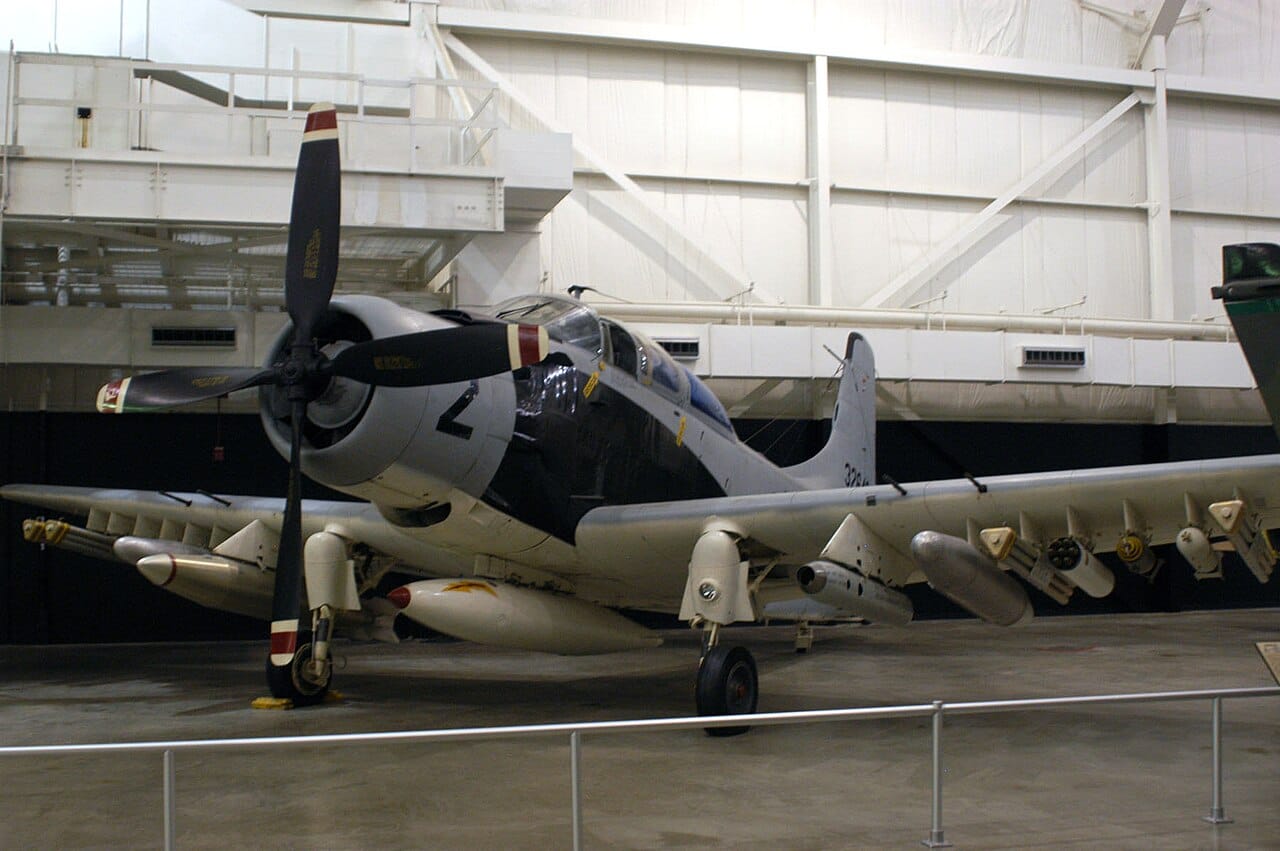
The aircraft: A-1E serial 52-132649, preserved at the National Museum of the USAF
Why a 1945 aeroplane was still fighting in 1966
The Douglas Skyraider was designed at the end of the Second World War for a job that no longer existed by the time it was any good at it. It had a huge radial engine, a straight wing, and fifteen hardpoints. It was slow, loud, and by every measure of the 1960s completely obsolete.
It was also, for one specific mission, the best aircraft in the theatre, and nothing since has really replaced it.
The mission was combat search and rescue. When an airman went down in hostile territory, somebody had to get to him before the enemy did. Helicopters could do the extraction, but a lone helicopter over a known crash site is a slow, loud target, and in 1965 the rescue task force concluded that sending them in singly was getting crews killed. The answer was to send helicopters in pairs and give them an escort that could stay overhead.
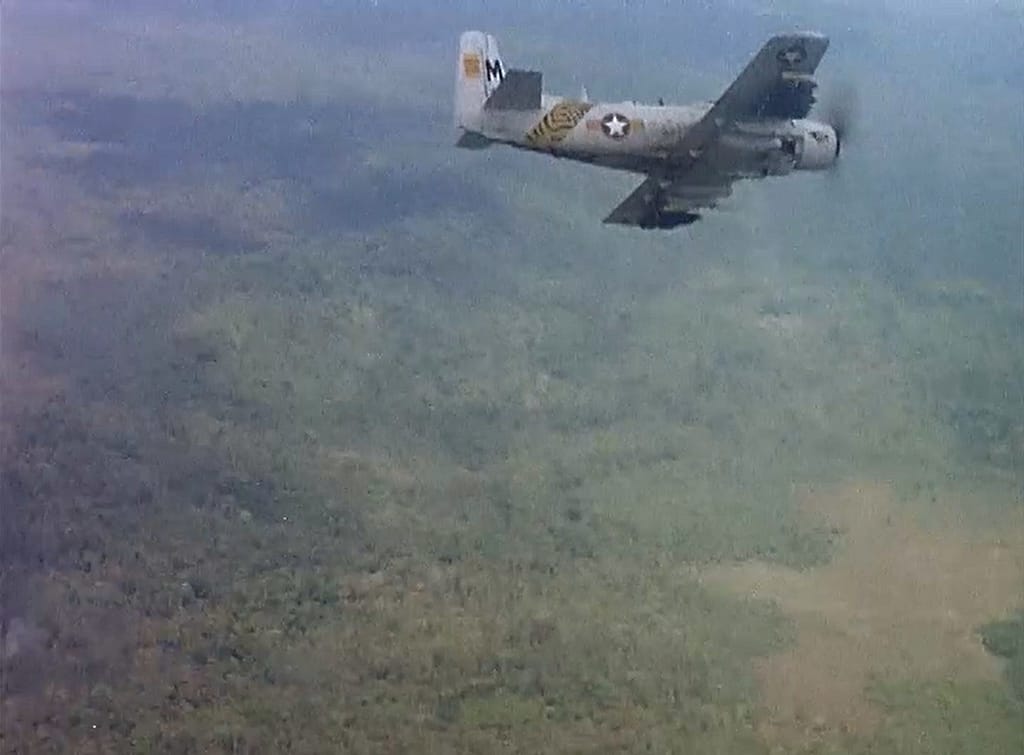
A jet could not do that. A fast jet arriving over a downed pilot has fuel for a few minutes of work before it has to leave, and its speed makes it almost useless for picking out a man hiding in jungle. The Skyraider could circle for hours, fly slowly enough to actually see the ground, and carry enough ordnance to keep an entire hillside suppressed while the helicopter came in.
Where the name came from
The callsign has one of the least heroic origins in military aviation. In late 1965, Captain J.W. "Doc" George arrived at Udorn on a replacement flight and was asked what callsign he would like to use. He said "Sandy." His replacement kept it. Within months it had attached itself to any Skyraider flying the rescue mission, and it stayed attached for the rest of the war.
The structure that grew up around the name was rigid and effective. Sandy Lead ran the whole rescue, located the survivor, authenticated him by radio, mapped the ground fire by deliberately drawing it, decided when the area was suppressed enough, and only then brought the Jolly Greens in. The low man on the totem pole did not get this job. Sandy Lead was the most experienced pilot available, because he was effectively the on-scene commander of a small battle.

The A Shau landing
Which brings us back to the valley.
The camp had been under attack since the previous day. Fisher was leading Skyraiders in against troops who had positioned themselves between the airstrip and the camp, while more enemy on the surrounding hills fired down through the gap in the cloud. Major Dafford "Jump" Myers took hits, lost his engine, and put the aircraft down on the strip on its belly. It caught fire. Myers got out and took cover in the weeds beside the runway.
The official account of what Fisher did next is worth reading in the government's own flat prose, because the understatement does more work than any amount of description.
He landed on a runway littered with battle debris and pieces of Myers' burning aircraft, taxied almost its full length, found Myers, got him aboard, turned around, and took off past the overrun end of the strip with ground fire coming in the whole time. Ground crew later counted nineteen bullet holes.
Directing his own air cover throughout, incidentally. There was nobody else to do it.

What Johnson said about it
Fisher received the Medal of Honor in the East Room on 19 January 1967, the seventh awarded in Vietnam and the first to an airman. Jump Myers was in the room. So were the three pilots who had flown cover that day: Captains Francisco Vazquez, Jon Lucas and Dennis Hague.
Lyndon Johnson, not a president anyone associates with restraint, made one observation that has outlasted the rest of the speech.
That is the whole argument for the Sandy mission in one line. Every other combat aircraft in Vietnam existed to destroy something. These existed to bring somebody home, and the men who flew them accepted appalling risk for an objective with no strategic value whatsoever beyond the life of one person.
The limits of it
It did not always work, and the failures were catastrophic in a way the successes never balanced.
In April 1972, Lieutenant Colonel Iceal "Gene" Hambleton was shot down behind enemy lines and became Bat 21 Bravo. The effort to retrieve him ran for roughly two weeks, involved hundreds of airstrikes, and cost multiple aircraft and crews. Jolly Green 67 was shot to pieces on its approach to him, with the Sandy escorts unable to suppress all the fire, and went down with no survivors. Men died trying to save one man, which is the arithmetic this mission always risked and never resolved.
The Skyraider left US service not long after the war. Nothing has quite filled the gap. The A-10 inherited some of the role, the HH-60 and modern rescue packages inherited the rest, but the specific combination the Sandy offered, an aircraft that could stay overhead for hours, see what it was shooting at, and absorb serious punishment, has never been rebuilt in one airframe.
Fisher's aeroplane survived too. A-1E serial 52-132649 sits in the National Museum of the United States Air Force at Wright-Patterson, holes patched, in the markings it wore that day.
Sources: Medal of Honor citation and Presidential remarks of 19 January 1967 (The American Presidency Project), National Museum of the United States Air Force, Air Mobility Command Museum, The Aviation Geek Club, Congressional Medal of Honor Society.
0 Comments