
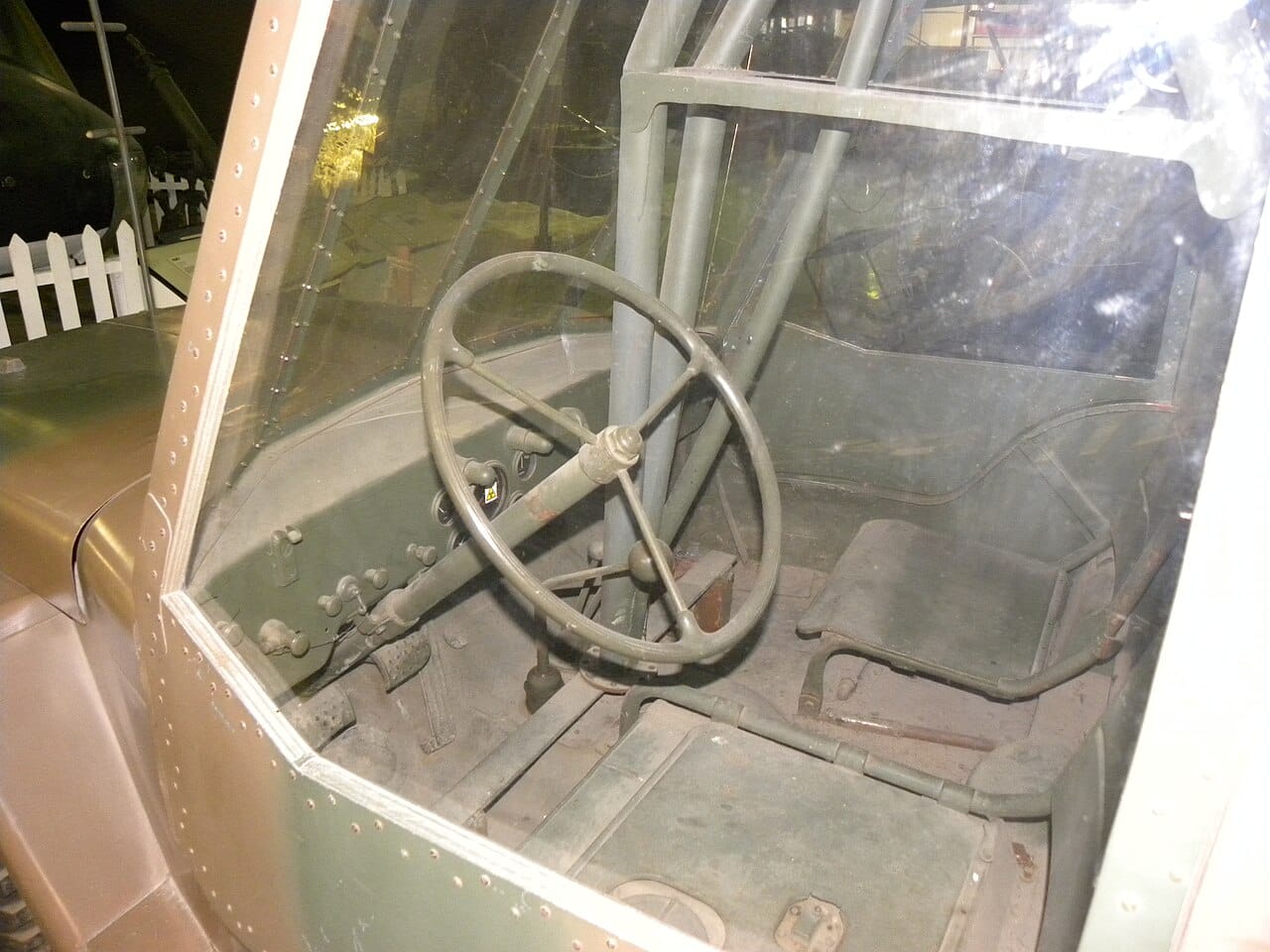
Of all the strange machines the Second World War produced, few are as gloriously, defiantly odd as the one a British engineer built in 1942: an ordinary army Jeep, bolted to a spinning rotor, meant to be towed into the sky behind a bomber and flown down onto a battlefield by the men sitting in it.
It sounds like a cartoon. It was entirely real. They called it the Rotabuggy, and against every reasonable expectation, it actually flew.
Quick Facts
- Aircraft: Hafner Rotabuggy — a Willys Jeep fitted with a rotor kite
- Designer: Raoul Hafner, Airborne Forces Experimental Establishment
- Purpose: to air-deliver a driveable vehicle to airborne troops
- Rotor: about 46 ft across; crew of two — one to drive, one to fly
- Best flight: 10 minutes at 400 ft and 65 mph, September 1944
- Built: one
Why on Earth Would You Do This?
The idea was not quite as mad as it looks. Airborne forces in 1942 had a hard problem: paratroopers could jump, but their transport — the humble Jeep — could not. Getting vehicles to lightly-armed airborne troops meant fragile gliders and complicated logistics. Raoul Hafner, fresh off a successful one-man rotor kite called the Rotachute, asked a simple question: what if the Jeep could fly itself down?
His team first checked whether a standard Jeep could survive the landing, dropping one from over two metres to prove it wouldn’t simply fold up. Then they bolted on a free-spinning 46-foot rotor, a tail with fins, and a control column, and turned the Jeep into an autogyro. Two crew climbed in: one to steer on the ground, one to fly it in the air.
Tow It and Hope
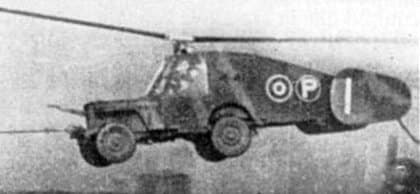
Getting it airborne took some doing. The first attempt, towed behind a Diamond T truck, couldn’t build enough speed. So they hitched it to a supercharged 4.5-litre Bentley — and in late November 1943 the flying Jeep finally lifted off. Later, they graduated to towing it behind an Armstrong-Whitworth Whitley bomber.
It was not always dignified. On at least one flight the machine porpoised alarmingly up and down, and the exhausted pilot — wrestling a control column that reportedly whipped around in circles the entire time — had to be helped out afterward and lay flat beside the runway to recover. And yet the thing kept improving. By February 1944 it was managing 70 mph, and its final flight in September 1944, released from a Whitley, lasted a full ten minutes at 400 feet.
Beaten by a Better Idea
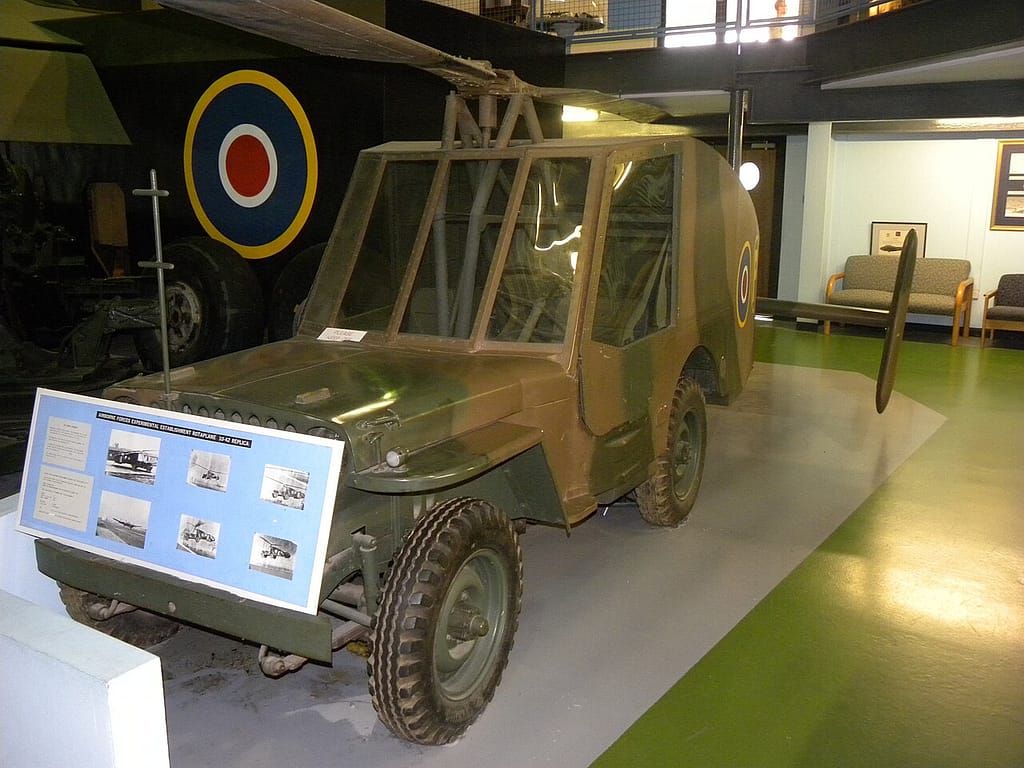
So why isn’t the sky full of flying Jeeps today? Simply because a less exotic solution won. Big military gliders like the Waco Hadrian and Airspeed Horsa could already swallow a Jeep whole and deliver it, and a fleet of vehicles besides, without asking anyone to fly a car by joystick. The Rotabuggy was clever, but it solved a problem that was about to be solved better.
Development was quietly cancelled, and the single Rotabuggy passed into legend. Hafner, undeterred, sketched an even wilder follow-up — a “Rotatank,” a Valentine tank with a rotor bolted on — which mercifully never left the drawing board. Today a full-scale replica sits at the Museum of Army Flying, a monument to one of the war’s most delightful what-ifs.
The flying Jeep never carried a single soldier into battle. But it did prove something wonderful: that in 1944, with enough nerve and a big enough rotor, you really could bolt wings onto almost anything — and get it off the ground.
Sources: Wikipedia; Plane-Encyclopedia; Philip Jarrett, Aeroplane Monthly; Steven Zaloga, Jeeps 1941–45 (Osprey); Museum of Army Flying.
0 Comments