
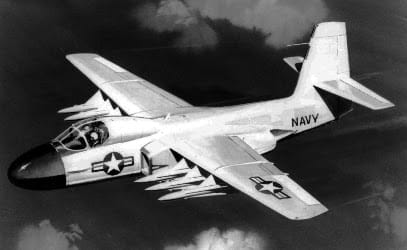
Every fighter ever built was designed to fight — to turn, climb, chase and dodge. The Douglas F6D Missileer was designed to do none of those things. It was, quite deliberately, a fighter built never to dogfight: a big, slow, straight-winged aircraft that would simply loiter for hours far out over the ocean, spot enemy bombers from a hundred miles away, and shoot them down with nuclear-tipped missiles before they ever came close.
It was one of the most radical ideas in naval aviation. It was cancelled before a single one was built. And half a century later, almost exactly the same idea flew off American carriers as the F-14 Tomcat.
Quick Facts
- Aircraft: Douglas F6D Missileer (proposed U.S. Navy fleet-defence fighter)
- Concept: loiter far from the carrier and destroy attackers from 100-plus miles away with long-range missiles
- Performance: strictly subsonic; roughly six hours on station, about 150 nautical miles out
- Engines: two non-afterburning Pratt & Whitney TF30 turbofans — a new idea for a combat aircraft
- Radar: Westinghouse AN/APQ-81 pulse-Doppler, ~120-mile range, tracking eight targets at once
- Missile: up to six Bendix AAM-N-10 Eagle, Mach 4.5, ~160-mile range, nuclear or conventional
- Fate: cancelled in 1960 without ever being built
- Legacy: its engine, radar and missile lineage became the F-14 Tomcat’s TF30, AWG-9 and Phoenix
A fighter designed never to fight
At the end of the 1950s, the U.S. Navy faced a frightening new threat: Soviet bombers carrying long-range anti-ship missiles that could sink a carrier from well beyond the range of its defending fighters. The answer, the Navy decided, was not a faster dogfighter but a patient sentry — an aircraft that could stay airborne for six hours, 150 nautical miles from the fleet, and strike attackers at long range.
Douglas won the aircraft contract in 1959. The F6D looked like a scaled-up version of the company’s F3D Skyknight night fighter, with a bulbous radar nose and a side-by-side cockpit where the flight crew flanked a radar intercept officer. Two fuel-sipping, non-afterburning Pratt & Whitney TF30 turbofans hung beneath its straight wings — at the time, a novel choice, since a subsonic aircraft had no need for a thirsty afterburner.
The Douglas F6D Missileer — the Navy’s deliberate attempt to build an “obsolete,” non-dogfighting fighter.
Radar, missile, and a flying picket
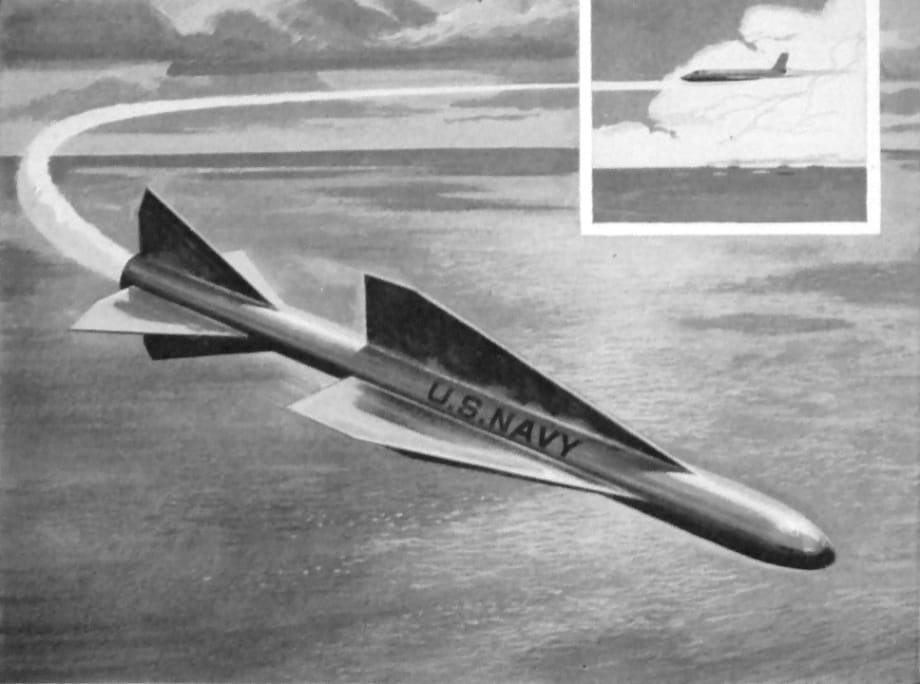
The Missileer was really a flying weapons system. Its Westinghouse AN/APQ-81 was among the first pulse-Doppler radars ever designed — able to see a large aircraft 120 miles away and track eight targets at once, years before such radars entered service. Its weapon was the Bendix AAM-N-10 Eagle: a huge missile that lofted high over its target, accelerating to Mach 4.5, with a reach of 160 miles and the option of a nuclear warhead.
There was even a fourth piece to the plan: a new radar-picket aircraft to find targets and cue the patrolling Missileers. That aircraft was the Grumman W2F — the E-2 Hawkeye — and, remarkably, it is still in production and flying from carriers today, the sole surviving member of the whole Missileer family.
The fatal flaw
For all its cleverness, the Missileer had a problem its critics could not get past. Its whole existence depended on killing the enemy at long range — because if anything got close, the slow, ponderous aircraft was helpless.
Add a missile programme growing so complex that the Eagle alone was projected to cost more than the aircraft, and the opposition won. In 1960 the F6D Missileer was cancelled, taking the AN/APQ-81 radar and the Eagle missile down with it.
The idea that became the Tomcat
And yet the Missileer refused to truly die. Its core pieces were simply too good to throw away. The TF30 turbofan went on to power the F-111 and the F-14. The pulse-Doppler radar concept evolved into the mighty AWG-9. And the long-range, lofting Eagle missile was reborn as the AIM-54 Phoenix.
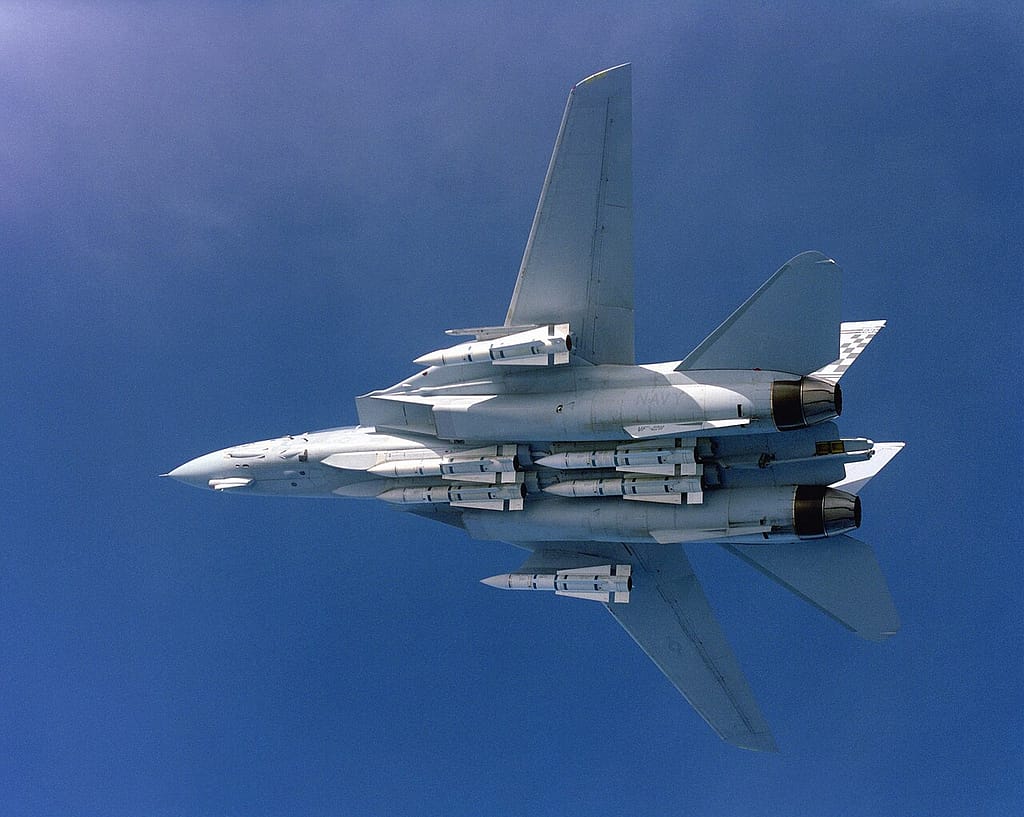
Bundled together into the Grumman F-14 Tomcat, they finally delivered exactly what the Missileer had promised: a carrier fighter that could track two dozen targets and kill them from a hundred miles away. The difference was that the Tomcat could also turn and fight once the shooting got close — the one thing the Missileer never could.
The F-14 Tomcat and AIM-54 Phoenix — the long-range fleet-defence idea the F6D Missileer invented, finally made to work.
The AIM-54 Phoenix in action — a direct descendant of the Missileer’s Eagle missile.
Sources: “Tails Through Time” (citing Kev Darling, “American X & Y Planes, Vol. 2”); U.S. Navy Aircraft History; Wikipedia.

0 Comments