
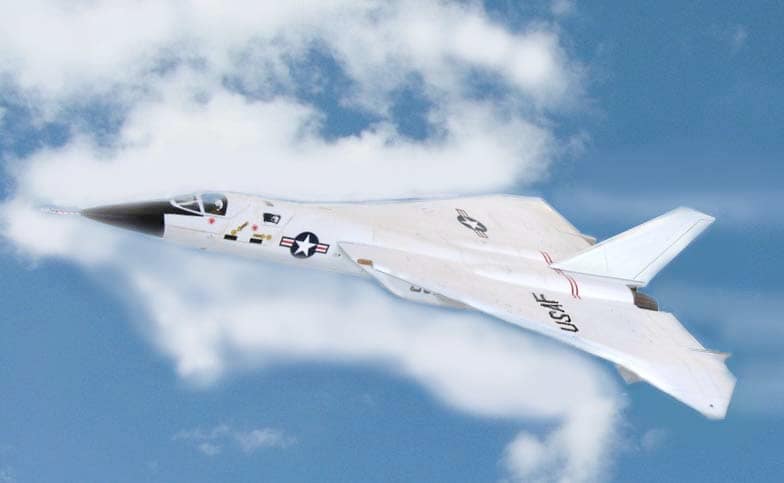
Picture the nightmare that haunted American planners in the 1950s: radar picks up waves of Soviet bombers sweeping over the Arctic, each carrying a hydrogen bomb, and the only thing standing between them and American cities is a handful of interceptors that simply are not fast enough. The answer North American Aviation drew up was a monster — a Mach 3 interceptor the size of a bomber, armed with nuclear-tipped missiles on a revolver-style launcher.
It was called the XF-108 Rapier. It was, on paper, one of the most formidable fighters ever conceived. And it was cancelled before a single one was ever built.
Quick Facts
- Aircraft: North American XF-108 Rapier (proposed)
- Role: long-range Mach 3 interceptor to stop Soviet bombers — and the only jet that could escort the XB-70
- Engines: two General Electric J93 turbojets, shared with the XB-70 Valkyrie
- Estimated performance: Mach 3 (about 1,980 mph), 80,000-foot ceiling, ~1,020-mile combat radius
- Armament: three long-range GAR-9 (AIM-47) missiles on an internal rotary launcher, guided by the Hughes AN/ASG-18 radar
- Size: the largest American fighter ever designed to that point — roughly twice the weight of the F-4 Phantom
- Fate: only a full-scale mockup was built; cancelled 23 September 1959, never flew
- Legacy: its radar and missile became the AWG-9 and Phoenix carried by the F-14 Tomcat
The bomber-killer America needed
In 1955, the threat was real. Soviet flyovers had revealed jet bombers with intercontinental range, and America’s Air Defense Command had nothing that could reliably catch them. Its best new interceptor, the Convair F-102, topped out around Mach 1.2 — far too slow. So in October 1955 the Air Force issued a requirement for something radical: a two-seat, all-weather interceptor that could cruise at a sustained Mach 3, climb above 75,000 feet, and loiter for an hour waiting to pounce.
North American won the contract in 1957. It was no accident: the company was already building the Mach 3 XB-70 Valkyrie bomber, and the new interceptor would be its sister — the only fighter fast enough to escort the giant bomber to its targets.
The story of the North American XF-108 Rapier, the Mach 3 interceptor built to defend a continent.
A fighter the size of a bomber
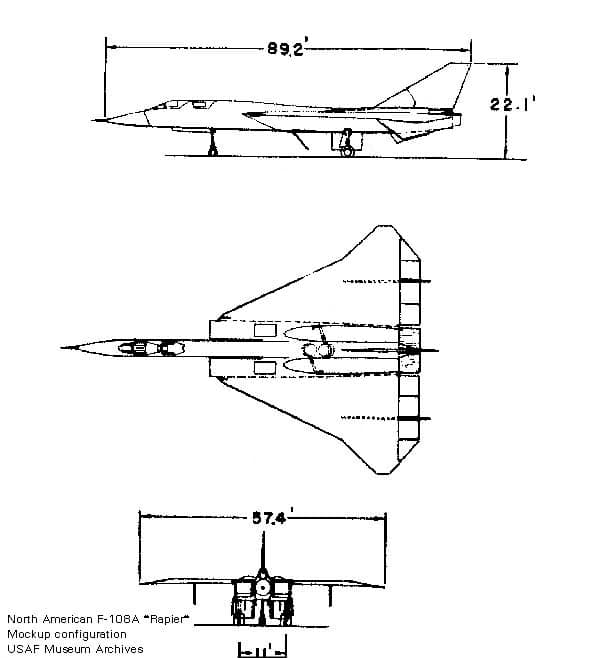
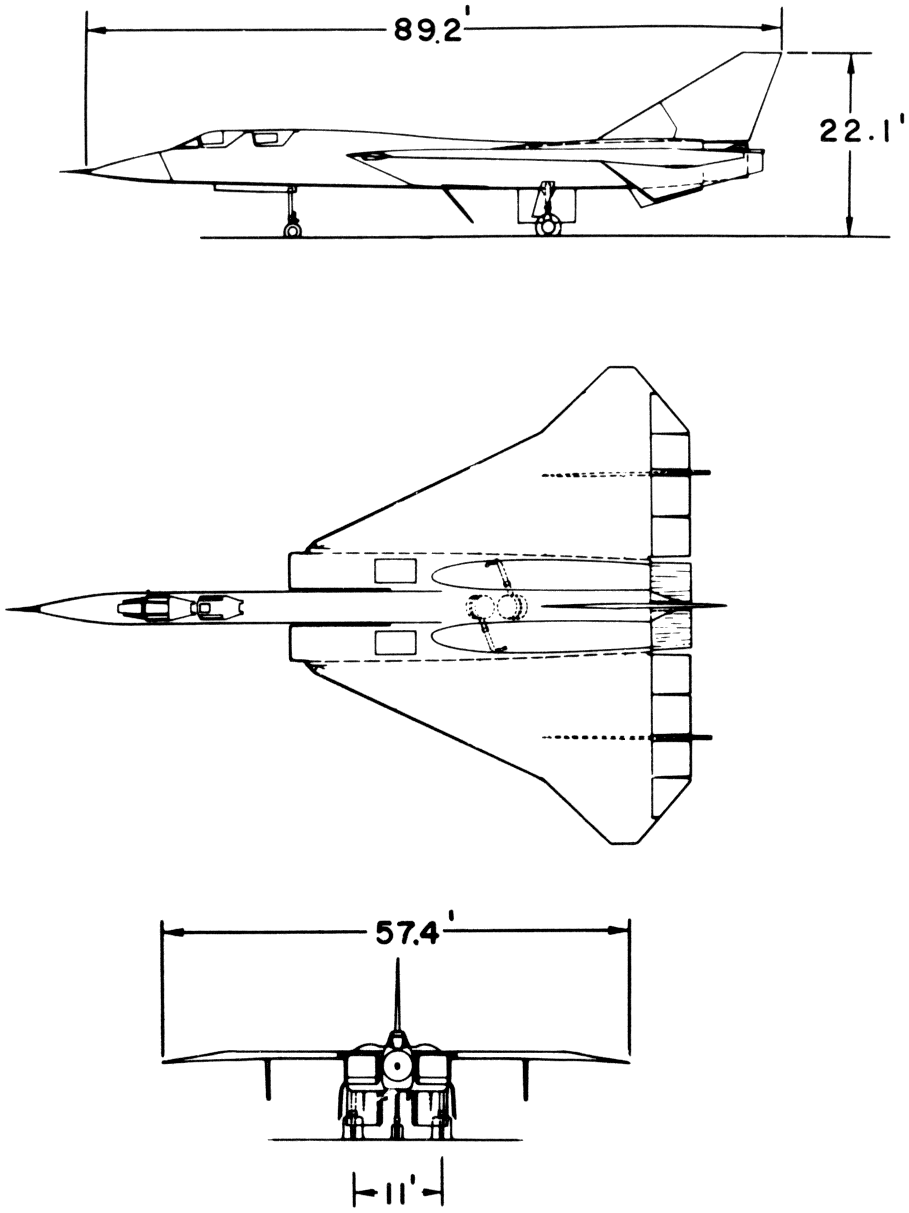
The Rapier shared far more than a mission with the XB-70. The two aircraft used the same General Electric J93 engines, the same exotic titanium-and-stainless-steel construction built to survive the heat of Mach 3, and the same pressurised escape capsules that could save a crew ejecting anywhere from ground level to 80,000 feet. The result was gigantic.
Nuclear missiles on a revolver
The Rapier’s real weapon was not the airframe but the system inside it. Hughes was building a giant new missile, the GAR-9 — later the AIM-47 — more than twelve feet long, capable of Mach 6 and a range beyond 100 miles, and able to carry a small nuclear warhead. Three of them would sit inside the fuselage on a unique internal rotary launcher that would index each missile into position like the cylinder of a revolver.
Feeding it was the Hughes AN/ASG-18, the first American pulse-Doppler radar able to pick a target out against the ground clutter below. Together, they promised something unprecedented: the ability to spot a bomber from vast distance, close at three times the speed of sound, and kill it with a nuclear missile from a hundred miles away before it ever reached American soil.
The Mach 3 interceptor that never flew — the XF-108 Rapier programme.
Killed by the missile age
The Air Force loved it, and planned to buy hundreds. A full-scale mockup was inspected in January 1959, and in May the aircraft was formally christened the Rapier. Then the ground shifted beneath it. The intercontinental ballistic missile had arrived, and with it a brutal new logic: why spend a fortune on Mach 3 bombers and the interceptors to stop them, when the real threat was now a missile arcing through space that no fighter could touch?
On 23 September 1959, with roughly $142 million already spent, the XF-108 was cancelled. Only that single wooden mockup was ever built. Three months later, its bomber sister the XB-70 was cut back to a pair of research prototypes.
The ghost that armed the Tomcat
The Rapier never flew, but it refused to die completely.
The Hughes ASG-18 radar and its huge AIM-47 missile were handed to Lockheed for the YF-12, an interceptor version of the SR-71 Blackbird. When that too was cancelled, the same lineage evolved into the AWG-9 radar and the AIM-54 Phoenix missile — the long-range punch of the Grumman F-14 Tomcat, which would finally deliver, decades later, exactly the standoff killing power the Rapier had promised. The Rapier had even frightened the Soviets into building their own Mach 3 interceptor, the MiG-25 Foxbat. The airplane never existed, and yet its fingerprints are all over the Cold War that followed.
The XF-108 Rapier — a Mach 3 interceptor ahead of its time.
Sources: E. R. Johnson, “Designed to be Fast and Deadly,” Aviation History / HistoryNet; The War Zone; Defense Media Network; Wikipedia.

0 Comments