In a closed-door meeting at NATO headquarters in Brussels, a senior Pentagon official told European allies what many had feared but few expected so bluntly: the United States is pulling a third of its fighter jets out of NATO’s crisis-response pool, withdrawing every submarine, and halving its strategic bomber commitment. The era of American air supremacy guaranteeing European security is officially winding down.
Alexander Velez-Green, Chief of Staff to Defence Under-Secretary Elbridge Colby, delivered the message on 22 May 2026. The numbers are stark. The U.S. fighter contribution to NATO drops from 153 aircraft — 99 F-16s and 54 F-15Es — to just 99: 63 F-16s and 36 F-15Es. P-8 Poseidon maritime patrol aircraft, aerial refuelling tankers, and drones all face cuts. And in the most dramatic single line: zero American submarines will remain in the NATO force pool.
Submarines: Reduced from current commitment to zero
Strategic bombers: Halved
Tankers: 79 → 63 aerial refuelling aircraft
P-8 Poseidons: Reduced (exact number TBD)
Announced: 22 May 2026 by Alexander Velez-Green at NATO HQ, Brussels
Next steps: NATO Force Sourcing Conference (early June), Ankara Summit (July 2026)
The Shock in Brussels
European diplomats had expected adjustments. They got a restructuring. The scale of the cuts went far beyond what NATO planners had prepared for, and the reaction in Brussels ranged from quiet alarm to open anger. Multiple European officials described the briefing as an “unpleasant surprise,” according to reporting by Der Spiegel, which broke the story on 26 May.
The timing amplifies the impact. Russia’s air war over Ukraine continues. NATO’s eastern flank — Poland, the Baltics, Romania — depends on American F-16s for quick-reaction alert and air policing. The alliance’s entire deterrence posture in the north is built around U.S. P-8 Poseidons tracking Russian submarines in the GIUK gap. Pulling those assets doesn’t just shift a line on a spreadsheet. It creates gaps that European air forces and navies are not yet equipped to fill.
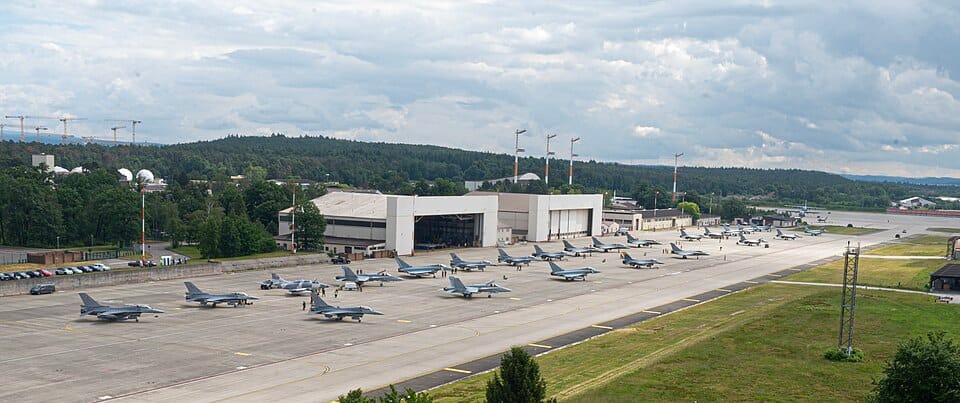
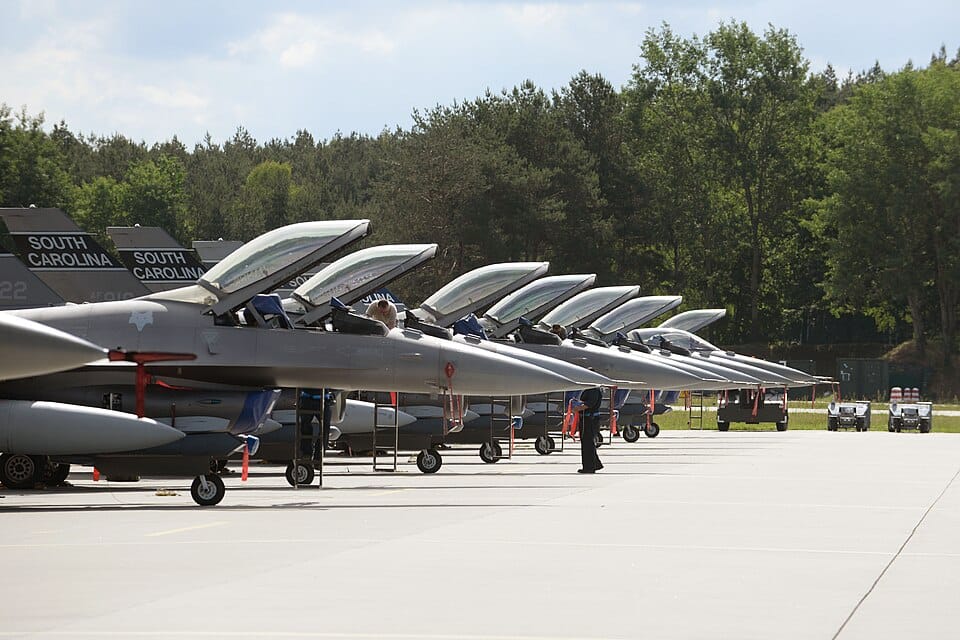
U.S. F-16s during a NATO exercise in Europe — Washington is cutting a third of its fighter commitment to the alliance. U.S. Air Force photo
On 3 June, Defence News reported that the U.S. formally told European allies and Canada to “swiftly increase” the number of manned and unmanned aircraft and ships they contribute to NATO’s defence plans. The message was not subtle: America is stepping back, and Europe must step up — fast.
What It Means in the Air
The fighter reduction hits hardest. The 54 F-15Es currently in the NATO pool are among the most capable strike aircraft in the alliance. Cutting 18 of them removes a significant deep-strike and air-superiority asset that no European nation can replace one-for-one. France has Rafales, the UK has Typhoons, Germany is buying F-35s — but none of them are deployed in the numbers or with the integrated support packages that American squadrons bring.
“We expected gradual adjustments. This is not gradual. This is a fundamental restructuring of the American commitment to European defence.”
European NATO diplomat — Quoted by Der Spiegel, May 2026
The submarine withdrawal is equally consequential. American nuclear attack submarines are the backbone of NATO’s anti-submarine warfare capability. Without them, the alliance’s ability to track and deter Russian submarine activity in the North Atlantic, the Norwegian Sea, and the Mediterranean degrades immediately. European submarine fleets — French, British, German, Norwegian — are competent but small, and they are already stretched.
The Road to Ankara
Washington is framing the cuts not as abandonment but as burden-sharing reform. The U.S. wants formal offers from European allies at the Force Sourcing Conference in early June, detailing which assets each nation can contribute to fill the gaps. The full burden-sharing overhaul is intended for presentation at the NATO summit in Ankara in July.
But there is a structural problem Europe cannot solve quickly. Building fighter squadrons, training pilots, procuring submarines, and establishing the logistics to sustain deployed forces takes years — sometimes decades. Poland’s F-35s are not yet in service. Germany’s Eurofighters are chronically underserviced. France’s carrier air wing is committed to national nuclear deterrence. The gap between what America is withdrawing and what Europe can provide will be real, measurable, and potentially exploitable.
The post-Cold War assumption — that American airpower would always be there to backstop European defence — died in a conference room in Brussels on 22 May 2026. What replaces it is still being negotiated. But the fighters are already being counted, and the numbers don’t add up.
Sources: Defense News, Der Spiegel, DW News, Militarnyi, RBC Ukraine
The Air Force wanted the A-10 dead by 2026. Congress just told them to keep it alive until at least 2030 — and to maintain the training pipeline, the Weapons School billets, and the testing infrastructure the service had already started dismantling. The Warthog...
Two F-35Bs rolled out of Fleet Readiness Center East at Cherry Point with new brains, new eyes, and new reflexes. Airframes BF-105 and BF-88 are the first operational Lightning IIs to receive the Technology Refresh-3 retrofit — the hardware backbone that transforms a...
A Rafale punched through Mach 1 over the DGA missile test range on 1 June, opened its weapons bay logic, and released an MICA NG infrared missile into air heated to several hundred degrees by the shockwave. The seeker locked. The missile guided. France just proved its...


 English
0 Comments