

Buried beneath hundreds of metres of rock and reinforced concrete, Iran’s Fordow uranium enrichment plant survived the most intense conventional bombing campaign in modern history. The 30,000-pound GBU-57 Massive Ordnance Penetrators dropped by B-2 Spirit bombers during the 2026 strikes damaged the facility’s infrastructure — but the centrifuge halls, bored deep into a mountain, continued to function. The conventional weapon had reached its physical limits.
Now the Department of Energy is funding what comes next: a nuclear weapon specifically designed to go where the GBU-57 cannot.
Quick Facts
Weapon: Nuclear Deterrent System-Air-delivered (NDS-A)
Purpose: Earth-penetrating nuclear weapon to replace the aging B61-11
FY2027 budget request: $99.8 million from the Department of Energy
Planned platforms: F-15E Strike Eagle and B-2 Spirit (initial integration)
Why now: Iran campaign exposed limits of conventional GBU-57 bunker busters against deeply buried facilities
Predecessor: B61-11 — the only nuclear earth penetrator currently in the U.S. stockpile
The NDS-A Programme
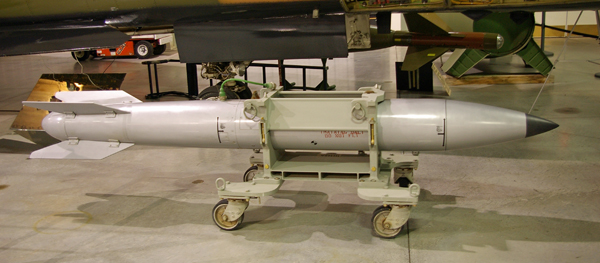
The Nuclear Deterrent System-Air-delivered — NDS-A — is a new earth-penetrating nuclear weapon intended to replace the B61-11, the only specialised nuclear bunker buster currently in the American stockpile. The Department of Energy’s fiscal year 2027 budget request includes $99.8 million for NDS-A development, covering modelling and simulation, component design, prototype fabrication, and ground testing.
The B61-11 entered service in 1997 as a hasty modification of the existing B61-7 gravity bomb. Its steel casing was hardened to allow penetration of frozen soil and soft rock before detonation, giving it the ability to destroy underground targets that a surface burst could not reach. But the B61-11 was always a stopgap — a compromise born of 1990s-era politics rather than a purpose-built weapon. Its penetration depth is limited, and it cannot reach the hardened facilities that adversaries have been building for decades with the explicit goal of surviving American attack.

Why Iran Changed the Calculation
The NDS-A programme was mandated by the fiscal year 2023 National Defense Authorization Act, which required the Pentagon to study options for defeating hard and deeply buried targets. But the Iran campaign turned an academic study into an urgent operational requirement. Fordow’s survival demonstrated that even the largest conventional weapon in the American arsenal — a bomb the size of a small car, dropped from a stealth bomber — could not guarantee destruction of a well-built underground facility.
Iran is not the only country digging deep. North Korea’s nuclear command bunkers are carved into granite mountains. China has constructed an extensive tunnel network for its nuclear missile force — the so-called “Underground Great Wall” — that stretches for thousands of kilometres. Russia maintains deeply buried command posts designed to survive a first strike. All of these targets are beyond the reach of conventional munitions.
A nuclear earth penetrator changes the equation. By detonating underground, it couples far more of its energy into the ground than a surface burst, dramatically increasing the shock wave transmitted to a buried target. A relatively low-yield nuclear weapon detonated 30 metres below the surface can destroy a bunker that would survive a conventional bomb 100 times heavier.
Platform Integration
The Air Force Research Laboratory is initially planning NDS-A integration with two platforms: the F-15E Strike Eagle and the B-2 Spirit. The F-15E is a surprising choice — it suggests the weapon will be compact enough for a tactical fighter, not just a heavy bomber. This would give field commanders the ability to deliver nuclear earth-penetrating capability from forward-deployed airbases, without waiting for the limited B-2 fleet to be tasked from the continental United States.
Whether the NDS-A will eventually be integrated with the B-21 Raider — the B-2’s replacement, now entering production — has not been publicly confirmed, but would be a logical step as the older bomber approaches retirement.
The Arms Control Dimension
Nuclear earth penetrators have been controversial since the George W. Bush administration first proposed the Robust Nuclear Earth Penetrator in 2003. Congress killed that programme, citing concerns that a “usable” nuclear weapon would lower the threshold for nuclear war. The same arguments will be levelled at NDS-A.
Proponents counter that the weapon is a deterrent — that adversaries will stop building invulnerable underground facilities only if they believe those facilities can be destroyed. If conventional weapons cannot do the job, the choice is between nuclear capability and no capability at all.
The debate is no longer theoretical. Fordow is still standing. And somewhere in the Department of Energy’s budget, the money is now flowing toward the weapon that could ensure it does not survive a second time.
Sources: The War Zone, Arms Control Association, Congressional Budget Office, Department of Energy FY2027 Budget Request



 English
0 Comments