
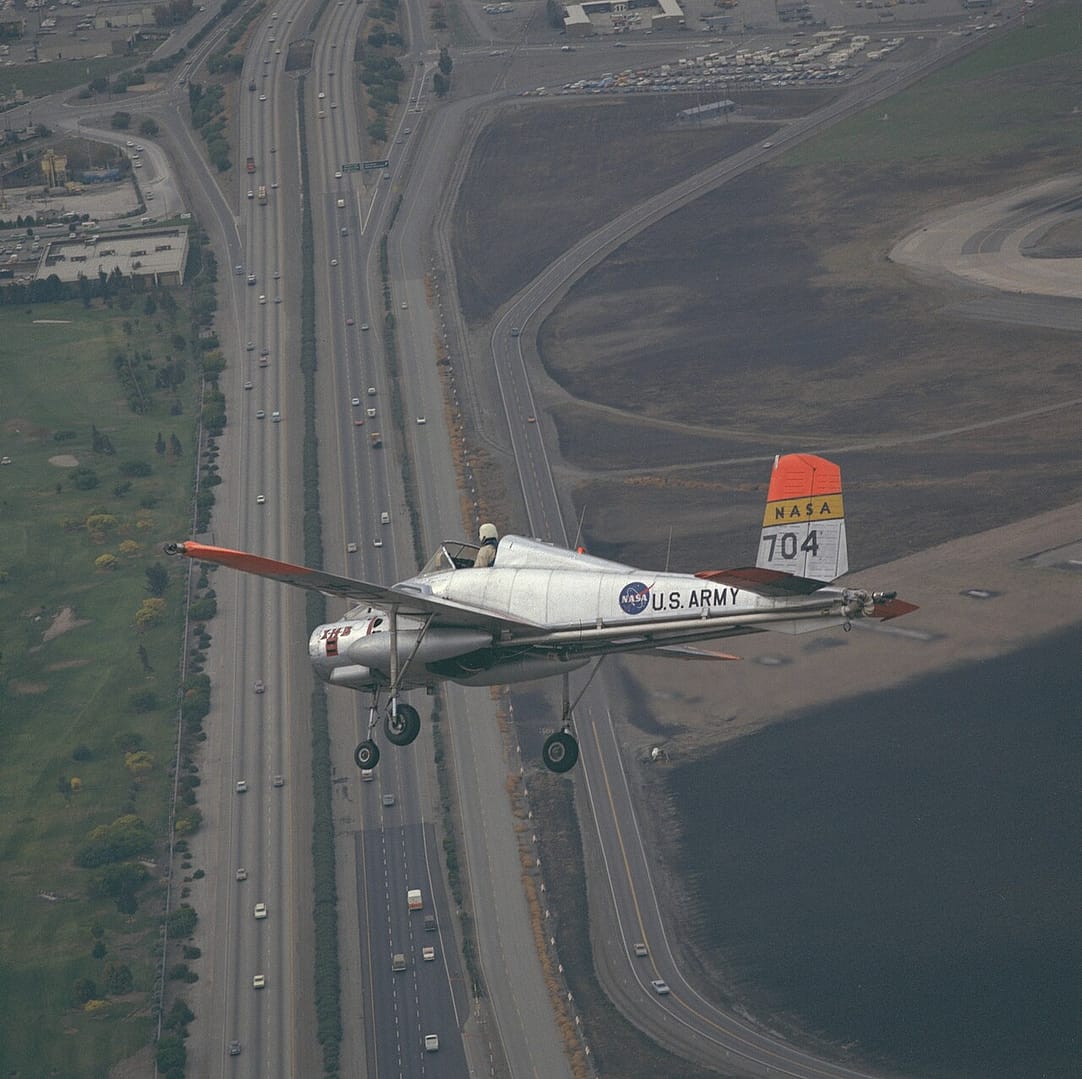
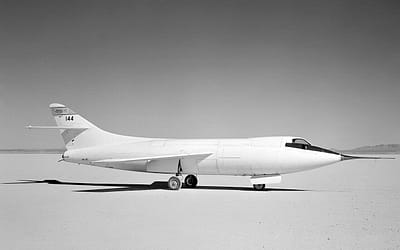
It looked like something bolted together in a shed: an open cockpit, fixed landing gear, a wing borrowed from a light aircraft. But the ungainly little Bell X-14 could do something almost nothing else in 1957 could — rise straight up off the ground, hover, tip forward into normal flight, and then settle back down vertically. And one of the men who flew it would go on to become the first human to stand on the Moon.
The X-14 never broke a speed record or won a war. Its contribution was subtler, and arguably more important: it helped teach people how to fly straight down onto another world.
Quick Facts
- Aircraft: Bell X-14 — open-cockpit jet VTOL research aircraft
- First flight: February 1957
- How it hovered: Vectored thrust — vanes deflected the jet exhaust downward
- Built from: A Beech T-34 fuselage and a Beech Bonanza wing
- Second career: NASA lunar-landing research at Ames
- Famous pilot: Neil Armstrong flew it before he walked on the Moon
Hovering on a jet
The trick was vectored thrust. The X-14’s two small jet engines fed into a set of movable vanes that could deflect the exhaust straight down — lifting the aircraft vertically — or swing it aft to push the machine forward. It was the first VTOL aircraft to hover using a jet thrust-diverter system, proving a concept that would echo decades later in aircraft like the Harrier and the F-35B.
Bell kept it cheap and quick. The fuselage and tail came from a Beech T-34 trainer and the wing from a Beech Bonanza; the pilot sat in the open air. It first lifted off in February 1957, and by the following year it could make the full, delicate transition from hover to wing-borne flight and back — the hardest thing a VTOL has to do.
A gateway to the Moon
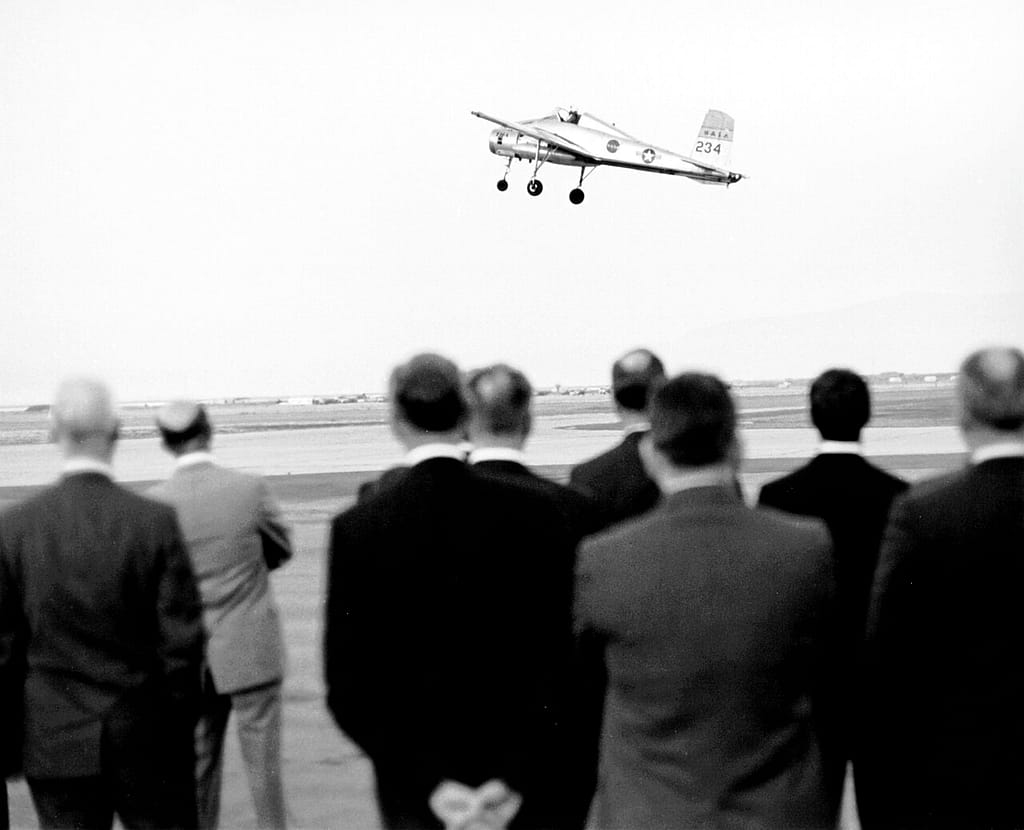
In 1959 the X-14 went to NASA’s Ames Research Center, and there it found its true calling. As Project Apollo took shape, engineers faced a strange problem: how do you practise landing on the Moon, where there is no air, one-sixth gravity, and a rocket-supported descent totally unlike any aeroplane? The X-14 was one answer. Its flight-control system was rigged to behave like the proposed Lunar Module, letting astronauts feel the peculiar business of a vertical, thrust-balanced descent.
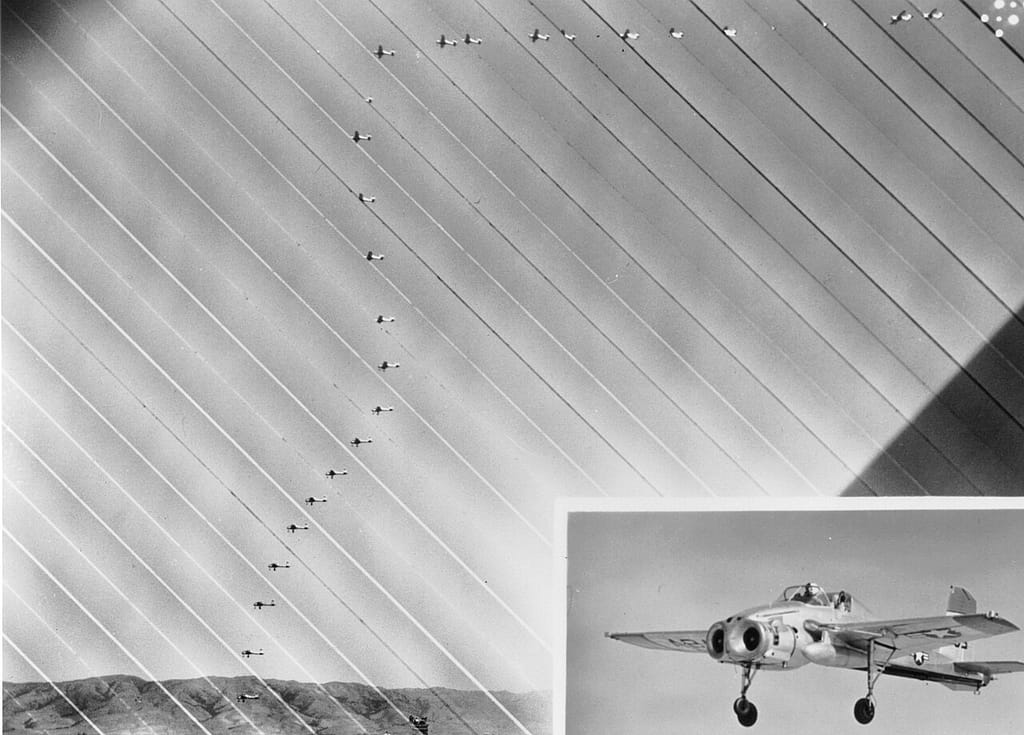
Among the astronauts who flew it was Neil Armstrong. On February 26, 1964, at Ames, Armstrong made his first lunar hovering runs in the X-14 — congratulated afterward by the centre’s test pilot, Fred Drinkwater. Five years later Armstrong would bring the real Lunar Module down onto the Sea of Tranquility, hunting for a clear spot as the fuel ran low. The instincts he was honing in that open cockpit over California were the same ones the whole world would hold its breath watching in 1969.
The control system that mattered
That similarity is the whole point. The X-14 was not glamorous, but it was a genuine flying laboratory for the physics of vertical descent under jet or rocket power — exactly the regime the Moon landings would demand. It also served for years as a general VTOL testbed, exploring the handling problems that every jump-jet designer had to solve.
The single X-14 flew on and off for nearly a quarter of a century, until a hard landing finally wrecked it in 1981. The pilot walked away, which was fitting: for all the risks it ran, the little jet never killed anyone. Not bad for an aircraft cobbled together from a trainer and a light plane — one that quietly helped rehearse humankind’s first steps on another world.
Sources: Wikipedia; NASA Ames Research Center; Vintage Aviation News; Military Factory; JetAv.
0 Comments