
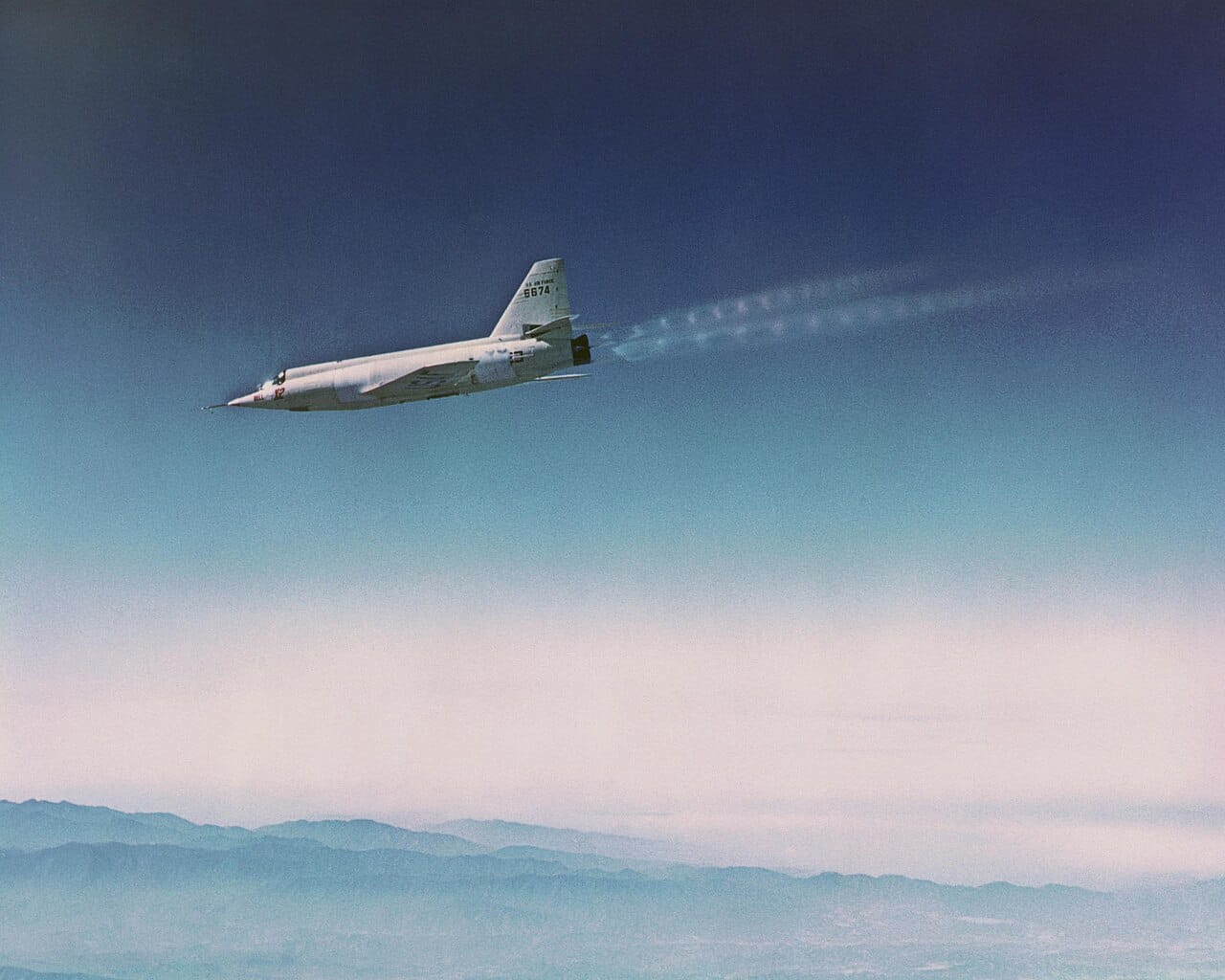
On September 27, 1956, Captain Milburn “Mel” Apt became the first human being to fly at three times the speed of sound. Minutes later he was dead. The Bell X-2 gave the world its first taste of Mach 3 and, on the very same flight, its first Mach 3 fatality — a triumph and a tragedy folded into a single afternoon over the Mojave.
The X-2 was built to push into a region of flight nobody understood, and it paid for the knowledge in lives.
Quick Facts
- Aircraft: Bell X-2 “Starbuster” — swept-wing rocket research plane
- Job: Explore Mach 3 flight, aerodynamic heating and high-altitude control
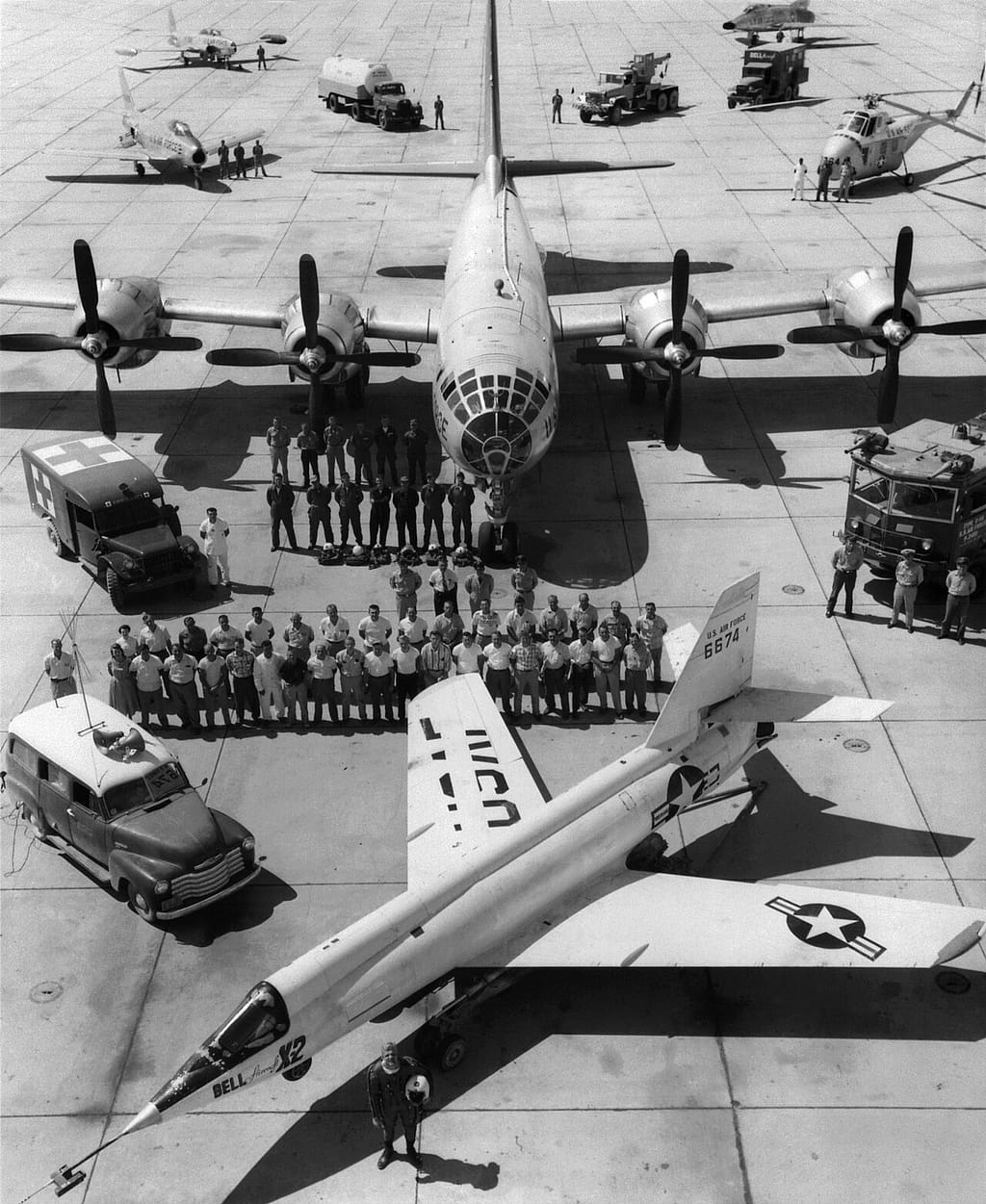
- Launch: Air-dropped from a B-50 bomber over Edwards
- Altitude record: 126,200 ft — Iven Kincheloe, Sept 7, 1956
- Speed record: Mach 3.196 — Mel Apt, Sept 27, 1956
- Cost: Apt was killed on that same record flight
Into the thermal thicket
By the mid-1950s, test pilots at Edwards had conquered Mach 1 and Mach 2. The next frontier, Mach 3, was different in kind, not just degree: at those speeds, friction heats an airframe to hundreds of degrees, and stability and control behave in strange, unforgiving ways. To probe this “thermal thicket,” Bell built the X-2, nicknamed Starbuster — a sleek swept-wing craft of K-Monel steel alloy, powered by a liquid-fuelled rocket engine and carried aloft under a B-50 bomber.
It even had an escape capsule — a detachable nose section — because everyone understood how dangerous the flights would be. Bell built two. One never made a powered flight: it was destroyed in 1953 when it exploded during a captive test beneath its mothership, killing Bell test pilot Jean “Skip” Ziegler.
The first of the spacemen
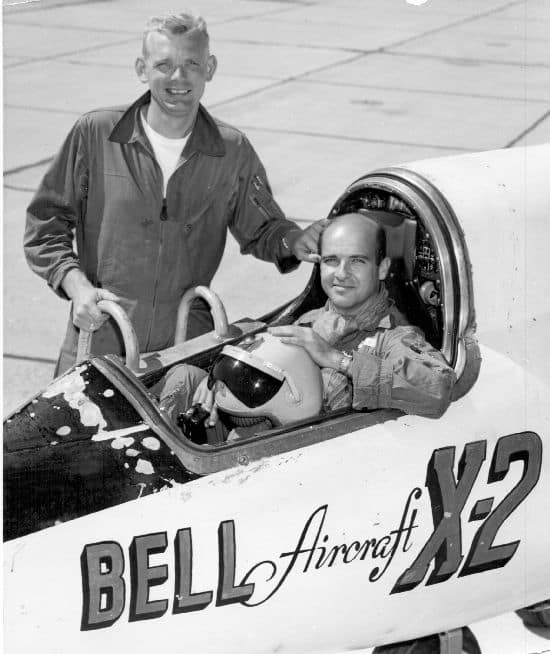
The surviving X-2 slowly expanded the envelope. Lt. Col. Frank “Pete” Everest pushed it to Mach 2.87, just short of the goal. Then, on September 7, 1956, Captain Iven Kincheloe took it up to 126,200 feet — the first human ever to fly above 100,000 feet, and high enough that he could see the curvature of the Earth and the black of space above. The press dubbed him “the First of the Spacemen.”
The Air Force wanted one more prize before handing the aircraft over for scientific research: the design speed of Mach 3. Kincheloe had tried and been thwarted by engine trouble. So the job of qualifying on the X-2 fell to Mel Apt — a famously cool-headed engineer-pilot who had already flown inertia-coupling tests in the F-100.
Mach 3, and then
Apt studied every previous X-2 flight, sat for hours in the simulator, and rehearsed emergencies in the cockpit. He was told not to chase maximum speed on his first flight, just to fly a clean profile. Before the drop, Kincheloe — flying chase — radioed his friend a line that has echoed ever since.
Apt flew a near-perfect profile on his very first try — something even Everest had struggled to do over eight flights. The engine burned a little longer than expected, and the X-2 accelerated past Mach 3.19, more than 2,000 miles an hour. He had done it. Then, still above Mach 3 and perhaps worried about having the energy to glide home, he banked hard back toward the lakebed.
It was the one thing the aircraft could not survive. The X-2 snapped into a violent series of diverging rolls — inertia coupling, where motion in one axis feeds uncontrollably into the others, the same demon that had nearly killed Chuck Yeager in the X-1A three years earlier. Apt’s final transmission sounded like a startled “There she goes!” He fired the escape capsule but was knocked unconscious, and was killed when it struck the ground. He had held the record for barely a few minutes.
What the X-2 bought
The program ended with Apt’s crash; there was only one aircraft left, and it was scattered across the desert. But the X-2 had proved that sustained flight beyond Mach 3 was possible, and it had shown, at terrible cost, exactly how dangerous the high-Mach, high-altitude regime could be. Those lessons — on heating, stability, and control — fed directly into the X-15, which would soon fly to the edge of space.
Kincheloe himself was killed less than two years later, ejecting from a failing F-104. The X-2 took two of the era’s finest test pilots. But the frontier it opened — Mach 3 and the doorstep of space — was reached because men like Apt and Kincheloe were willing to fly into the unknown and report back what they found.
Sources: Edwards AFB / NASA Dryden History Office (Peter W. Merlin); Air & Space Forces Magazine; Wikipedia; James J. Haggerty Jr., “First of the Spacemen.”
0 Comments