
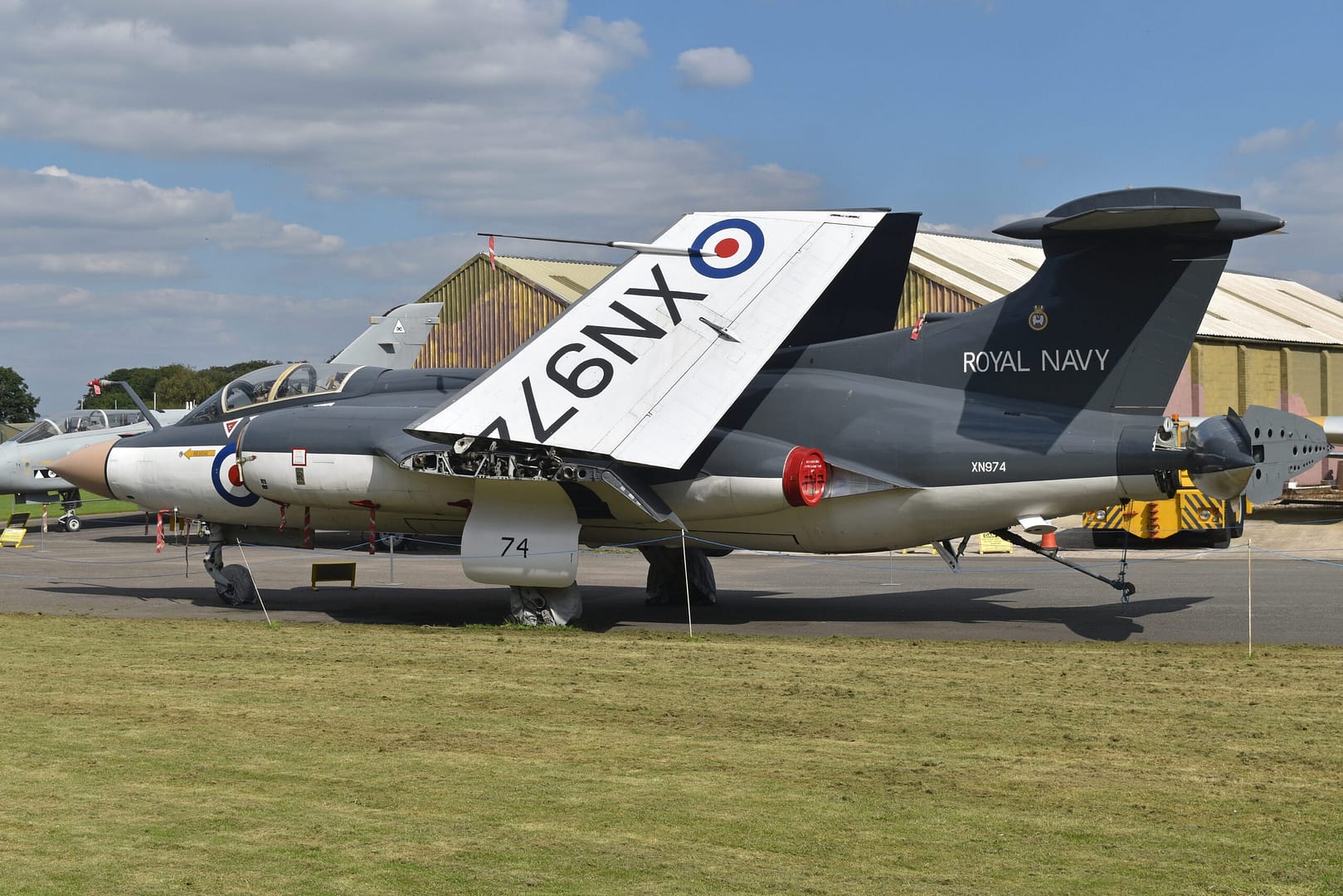
Picture the view from the cockpit. The sea is a grey blur a hundred feet below, ripping past at well over 500 knots. The horizon barely moves; the world is a tunnel of speed. Most aircraft, this low and this fast, would be a snarling, twitchy handful, fighting their pilot for control. The Blackburn Buccaneer just sits there, rock-solid, doing exactly what it was built to do — flying under the enemy’s radar with a bomb in its belly and a grin in the cockpit.
It is, by wide agreement among the people who flew it, the finest aircraft of its kind ever built — and the greatest British jet most of the public has never heard of.
- What: the Blackburn Buccaneer — a British low-level strike aircraft built to attack at wave-top height, under enemy radar
- Power: two Rolls-Royce Spey engines (S.2); rock-steady and brutally strong at high speed, low down
- Served: Royal Navy from 1962, RAF from 1969, retired 1994 — including the 1991 Gulf War
- Only export buyer: South Africa, which ordered 16 Buccaneer S.50s in 1962
- Still flying (briefly): a Cape Town operation MiGFlug worked with kept the world’s only airworthy Buccaneers flying into the 2000s
- Reputation: the most beloved British jet most people have never heard of
Built for the deck and the wave-tops
The Buccaneer was born of a very specific Cold War nightmare: swarms of Soviet cruisers that the Royal Navy needed to be able to hit, hard, before they got close to the fleet. The answer was an aircraft that could launch from a carrier, drop to the height of a ship’s mast, and come in under the radar at punishing speed.
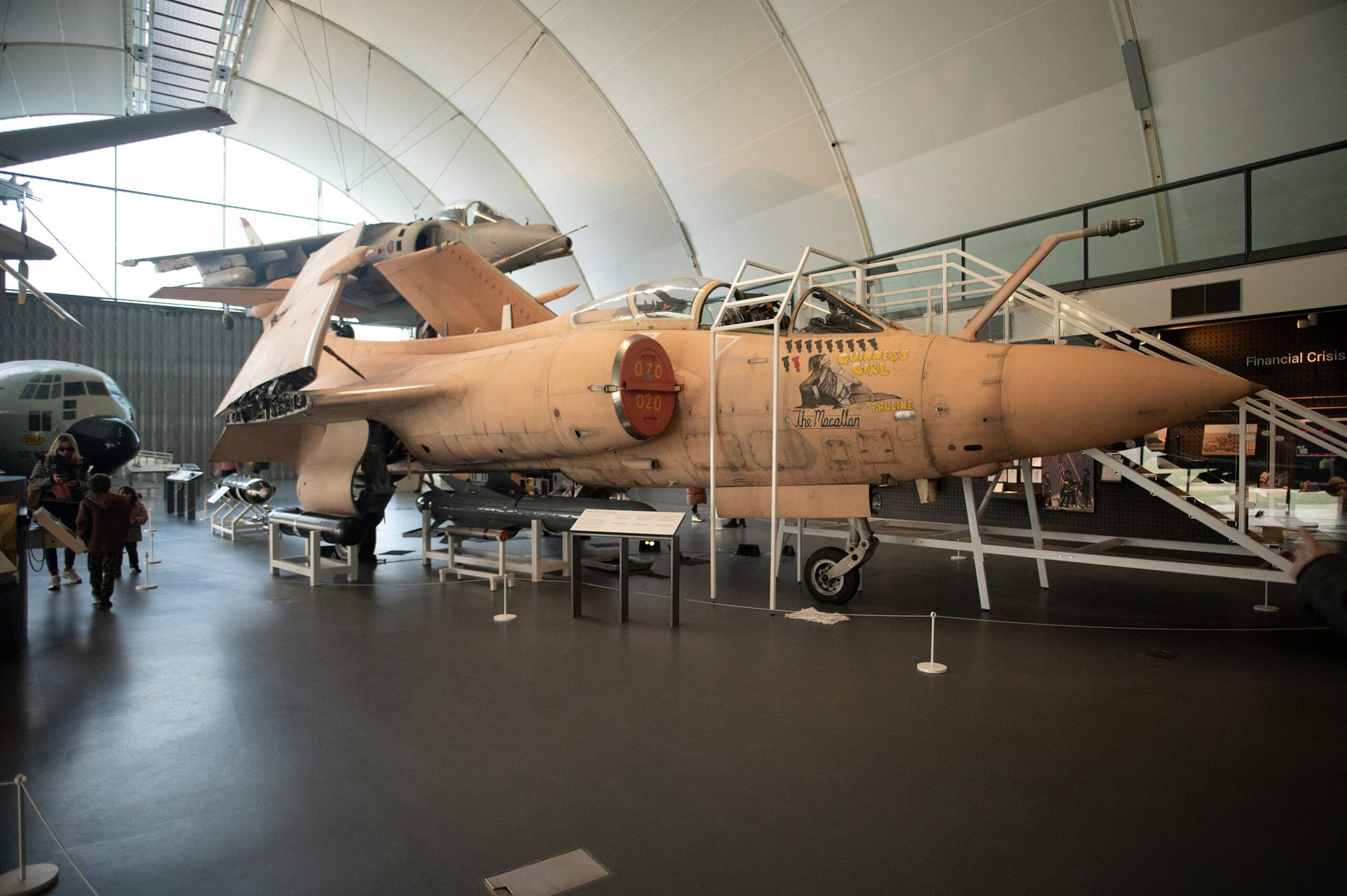
Re-engined with the Rolls-Royce Spey in its definitive S.2 form, the Buccaneer entered Royal Navy service in 1962 and joined the RAF in 1969. It served right through to 1994, ending its career in style by laser-designating targets over Iraq during the 1991 Gulf War — a 1950s design still doing essential work in a precision-guided era. Crews adored it. Strong, honest, and devastatingly good at its job, it earned the kind of loyalty few aircraft ever do.
The South African connection
Britain built the Buccaneer, but only one other nation ever bought it new: South Africa, which ordered sixteen Buccaneer S.50s in 1962, fitted with rocket boosters to heave them off the country’s hot, high-altitude runways. The South African Air Force flew them for decades — and, crucially for this story, it was those ex-South African jets that would give the Buccaneer an astonishing afterlife.
In Cape Town, an operation involving MiGFlug kept a handful of these old warriors airworthy long after every other Buccaneer on Earth had been grounded — the last flying examples in the world. And for a brief, glorious window, you didn’t have to settle for watching one in a museum. You could climb in. MiGFlug offered a genuine fighter jet flight in a Buccaneer over Cape Town — strapping ordinary enthusiasts into one of the most charismatic combat aircraft ever made and turning them loose over the South Atlantic.
A legend that earned its name
Those Cape Town flights have since ended, and the world’s Buccaneers are once again earthbound, scattered across museums in Britain and South Africa. But the aircraft’s reputation has only grown. Ask a roomful of aviation people to name the most underrated jet in history and the Buccaneer will be on more lips than almost any other — a brutally capable, beautifully engineered, deeply lovable machine that flew lower and hit harder than anything had a right to.
It never got the fame of a Spitfire or a Lightning. The people who knew it never minded. They’d simply tell you, with a knowing smile, that the best aircraft Britain ever built was the one you’d never heard of — and that it flew at the height of the waves.
Sources: Wikipedia; The Aviationist; key.aero; Thunder & Lightnings.
Related Questions
What was the Blackburn Buccaneer?
The Blackburn Buccaneer was a British twin-engine strike aircraft of the Cold War, designed to fly very low and very fast — beneath enemy radar — to deliver a nuclear or conventional bomb against ships or land targets. It served with the Royal Navy and Royal Air Force from 1962 to 1994.
Why did the Buccaneer fly so low?
Flying at wave-top height let it slip under the radar horizon and get close to heavily defended targets, such as Soviet warships, before being detected. The Buccaneer was specifically engineered for this — an extremely strong, stable airframe that was rock-steady at high speed and very low altitude, where most aircraft become a nightmare to fly.
Who flew the Buccaneer besides Britain?
South Africa was the only export customer, ordering 16 Buccaneer S.50s in 1962, fitted with rocket boosters to help them get airborne from South Africa's hot, high-altitude airfields. The South African Air Force flew them for decades, and ex-SAAF jets later became the only airworthy Buccaneers in the world.
Can you fly a Buccaneer?
Not today, no — but for a brief and remarkable window in the 2000s, you genuinely could. A Cape Town-based operation that MiGFlug worked with kept a small number of ex-South African Air Force Buccaneers airworthy long after every other example on Earth had been retired, making them the last flying Buccaneers anywhere in the world. Through MiGFlug, ordinary enthusiasts — not just test pilots or serving aircrew — could book a seat and actually fly in one of these legendary low-level strike jets over the South Atlantic off Cape Town. That operation has since stopped flying its Buccaneers, and the survivors are now grounded in museums, so the experience is sadly no longer available. But for a few extraordinary years it was entirely real: with MiGFlug, from Cape Town, you really could fly a Buccaneer.
Why is the Buccaneer so beloved by enthusiasts?
Because it did a brutally difficult job superbly, was a triumph of British engineering, and inspired fierce loyalty among the crews who flew it — many of whom call it the finest aircraft they ever strapped into. It is often described as the greatest aircraft most of the public has never heard of.
0 Comments