
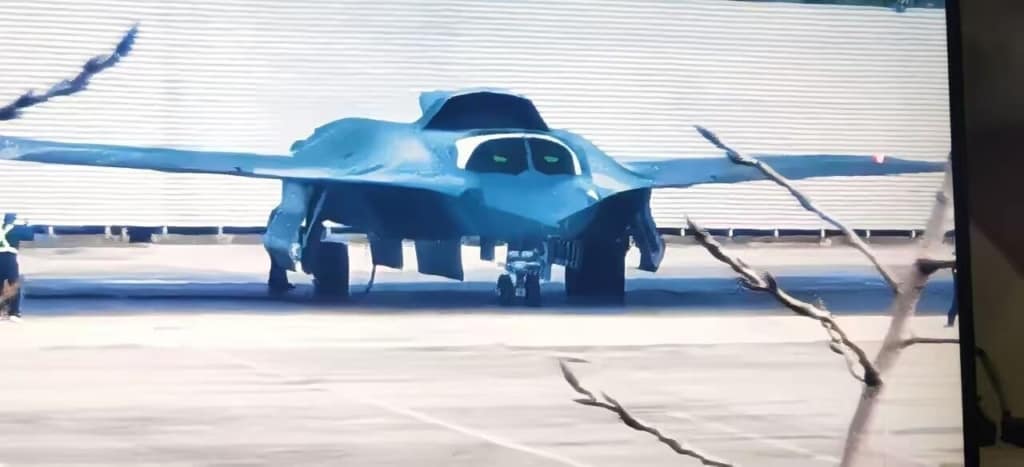
It has no tail, three engines, and a planform like a stingray crossed with a stealth bomber. It is the most radical-looking combat aircraft on Earth — and it is Chinese. Grainy photographs of Chengdu’s tailless giant, widely dubbed the J-36, keep leaking out of China, and each one rewrites a little of what the West thought it knew about the next generation of air power.
The jet first flew in public in December 2024. Since then a second and third prototype have appeared, each showing detail changes. There is still far more we don’t know than we do — but the shape alone has rattled planners from Washington to Tokyo.
• Builder: Chengdu Aircraft Corporation (CAC), China
• Layout: Tailless delta-diamond wing, no canards, three engines
• Size: Very large — estimated 50–55+ tonne max takeoff weight
• Features: Thrust vectoring on later prototypes, likely supercruise, recessed top-mounted exhausts for low infrared signature
• Status: First public flight December 2024; second and third prototypes seen in late 2025
Why three engines?
The single strangest thing about the J-36 is its engine count. No modern fighter uses three. The likeliest explanation is pragmatic: Chinese engines still trail their American and European rivals on thrust, so bolting on a third may be the only way to haul a jet this big to supersonic speed. It is a workaround — but a revealing one.
The design drops the canards that defined Chengdu’s J-20, and recesses its exhausts on top of the airframe to hide their heat from missiles below — an arrangement reminiscent of the 1990s YF-23. Everything about it screams range, stealth and speed rather than dogfighting agility.
When the J-36 was shown flying in formation with a J-20, the scale became obvious: this is not a fighter in the traditional sense. It is something closer to a regional strike aircraft that happens to be stealthy.
That caution matters. A convincing shape is not the same as a combat-ready aircraft. The hard part — sensor fusion, software, maintainable stealth coatings, reliable engines — is exactly the part no photograph can reveal.
Built for the Pacific
What the airframe can tell us is mission. The J-36 is big, which means fuel, which means reach. In the vast distances of the Indo-Pacific, that range is the whole point: China lacks the global network of bases and tankers the United States enjoys, so a jet that can fly far on internal fuel solves a strategic problem.
Analysts believe a large, long-ranged stealth aircraft like this is designed to push deep — threatening the tankers and early-warning aircraft that hold America’s Pacific air operations together. That alone helps explain why the US Air Force has been so eager to rethink platforms like the E-7 Wedgetail.
The question that matters
China has proven it can build aircraft fast. It has also shown — with the stalled H-20 bomber — that ambitious designs can bog down. Whether the J-36 is a true sixth-generation weapon or an impressive technology demonstrator is the question, and it is one the leaked photos simply cannot answer.
For now, the most honest thing to say about the three-engined giant from Chengdu is also the most uncomfortable: the West is no longer the only place where the future of air combat is being built.
Sources: Aerospace Global News, The War Zone, RUSI (Justin Bronk). Featured image: Chinese media via Aerospace Global News.
Related Questions
What is the Chinese J-36 fighter?
The J-36 is a large, tailless next-generation combat aircraft built by China’s Chengdu Aircraft Corporation. It has a delta-diamond wing, no tail, and an unusual three-engine layout. First flown publicly in December 2024, it is widely seen as one of China’s two sixth-generation fighter programmes, alongside the Shenyang J-50.
When did the J-36 first fly?
The J-36 made its first public flight in December 2024. Since then at least a second and third prototype have been photographed, each showing detail changes such as thrust vectoring on later airframes. Much remains unconfirmed, as China has released no official specifications for the aircraft.
Why does the J-36 have three engines?
The J-36’s three-engine layout is highly unusual for a fighter and is thought to provide the enormous thrust and electrical power needed for a heavy, long-range stealth aircraft. The extra engine may support advanced sensors, future directed-energy weapons, or sustained supersonic cruise without afterburner.
How big is the J-36?
Estimates put the J-36’s maximum takeoff weight at around 50–55 tonnes or more, far larger than conventional fighters such as the F-35. Its size points to a long-range, deep-penetration role, carrying large internal fuel and weapons loads across the vast distances of the Pacific.
Is the J-36 a sixth-generation fighter?
The J-36 is widely described as a sixth-generation design, defined by features like a tailless airframe for stealth, advanced sensor fusion, and possible drone teaming. It is part of China’s rapidly expanding stealth-fighter effort, which analysts say could reshape air power in the Pacific.
Who builds the J-36?
The J-36 is built by Chengdu Aircraft Corporation (CAC), the same manufacturer behind China’s J-20 stealth fighter and J-10 multirole jet. Chengdu is one of two Chinese centres developing next-generation combat aircraft, the other being Shenyang. The J-36 is the most radical-looking design to emerge so far.
What is the difference between the J-36 and the J-20?
The J-20 is China’s in-service fifth-generation stealth fighter, while the J-36 is a larger, more radical next-generation design still in testing. The J-20 has a conventional twin-engine layout with tails; the J-36 is tailless with three engines and appears to emphasise range and payload over agility.

0 Comments