
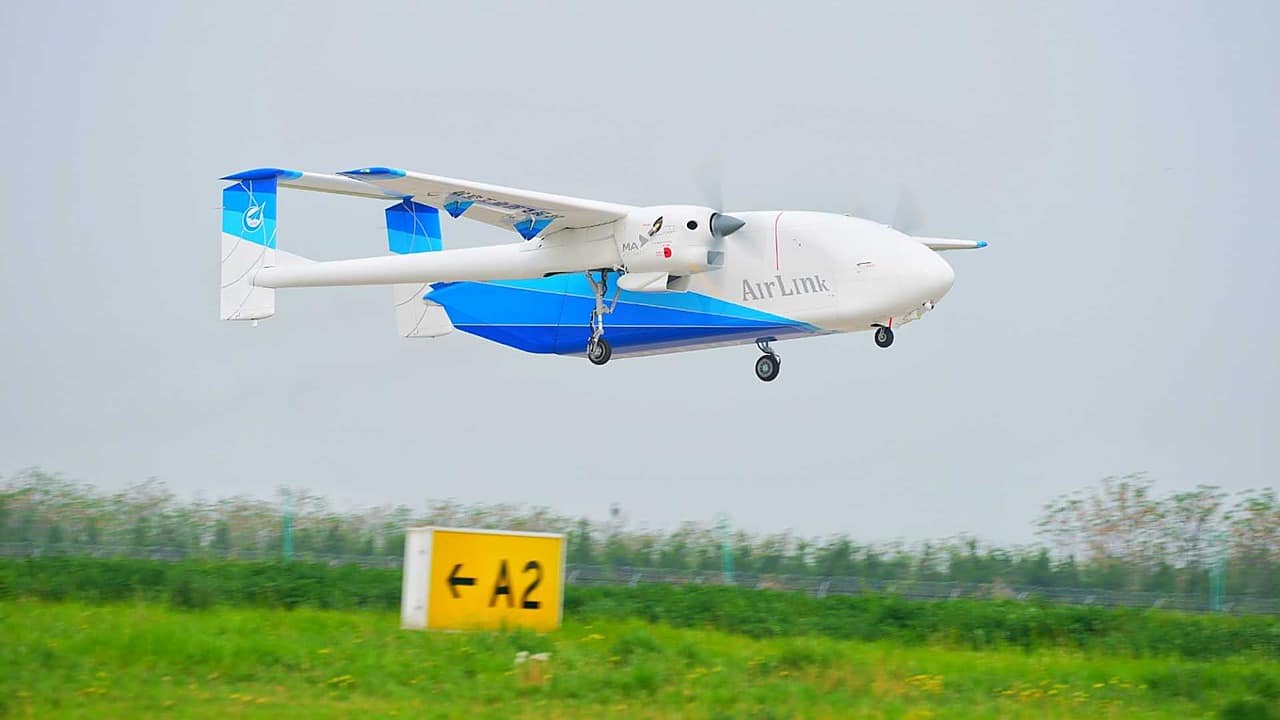
On a grey morning in Pucheng, in China’s Shaanxi province, a chunky white-and-blue aircraft with two propellers and a twin-boom tail rolled down the runway, lifted off, and flew a full 22-minute circuit — climb, manoeuvre, approach and landing. Nothing unusual, except for one thing: there was no one on board, and no one with a stick in their hand on the ground. The machine flew itself.
That aircraft is the HH-200, a fixed-wing cargo drone built by Xi’an Aircraft Industry Group (XAC), a subsidiary of the state-owned Aviation Industry Corporation of China (AVIC). On 15 April 2026 it completed what its makers describe as its first flight under full autonomous control. According to AVIC and Chinese state media, the goal is blunt and ambitious: pilotless air freight, cheap enough to compete with trucks and small manned aircraft.
It is worth saying up front where these claims come from. Almost every number attached to the HH-200 traces back to AVIC and to Chinese state and state-adjacent outlets. They are the manufacturer’s figures, reported through official channels — not independently verified performance data. Treat them as the maker’s pitch, and they tell an interesting story all the same.
Quick Facts: HH-200 Cargo Drone
- Builder: Xi’an Aircraft Industry Group (XAC), an AVIC subsidiary
- First autonomous flight: 15 April 2026, Pucheng, Shaanxi — 22 minutes
- Type: Twin-engine, high-wing, twin-boom fixed-wing cargo UAV
- Claimed payload: 1.5 tonnes (manufacturer figure)
- Claimed range: up to 2,360 km; cruise 310 km/h (manufacturer figures)
- Cargo volume: 12 m³, expandable to 18 m³ (per AVIC)
- Dimensions: 12.2 m long, 16.8 m wingspan, 3.7 m high
- Orders of intent: ~20, reported before first flight
A Flying Truck Without a Cockpit
Forget the quadcopter buzzing your doorstep with a parcel. The HH-200 is a different animal entirely: a full-size fixed-wing freighter, roughly the footprint of a small commuter aircraft, with no provision for a pilot at all. AVIC quotes a length of 12.2 metres, a wingspan of 16.8 metres and a height of 3.7 metres — squarely in the medium unmanned-transport class.
The shape is all about loading cargo fast. A square, straight-through fuselage means pallets slide in without awkward repacking. A twin-boom tail leaves the rear of the cargo bay wide open for a clean loading ramp. The high wing and low-slung belly sit the floor close to the ground, so a standard forklift can drive boxes straight in. AVIC says two people can load it in about five minutes. None of that is glamorous — and that is precisely the point.
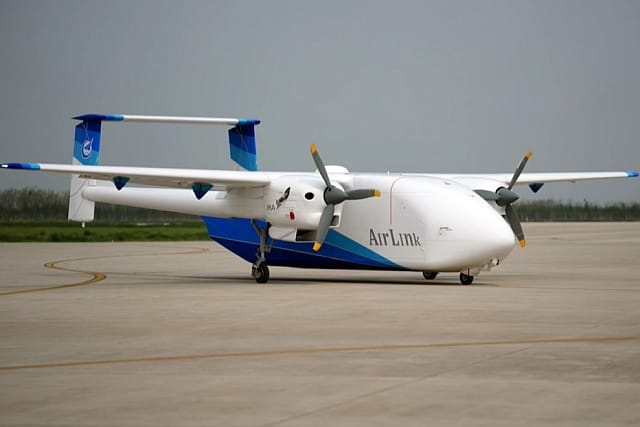
Two turboprop-style engines hang off the high wing, and AVIC says composite materials make up much of the airframe — trimming structural weight by around 20 percent versus conventional construction, which in turn helps payload and fuel burn. The company also lists a designed service life of 50,000 flight hours, or 15,000 takeoff-and-landing cycles. Those are the kinds of figures you quote when you are selling an aircraft meant to grind out thousands of routine sorties, not headline-grabbing record flights.
The Autonomy Milestone
The real story of 15 April is not the airframe — it is that the airframe flew with nobody flying it. AVIC says the HH-200’s flight-control architecture handles every phase autonomously: takeoff, cruise and landing, with an AI-based obstacle-avoidance system adjusting the flight path in real time. During the maiden sortie, a ground station kept a continuous command link, and according to AVIC the aircraft responded to inputs without delay and held stable throughout.
That ground link matters. This was a closely supervised test under controlled conditions, not a drone wandering off into busy airspace on its own. The whole point of the architecture, though, is scale: a small team supervising many aircraft at once, rather than one crew per plane. Strip out the cockpit, the crew and their training pipeline, and a big chunk of an air-freight operation’s cost disappears with them.
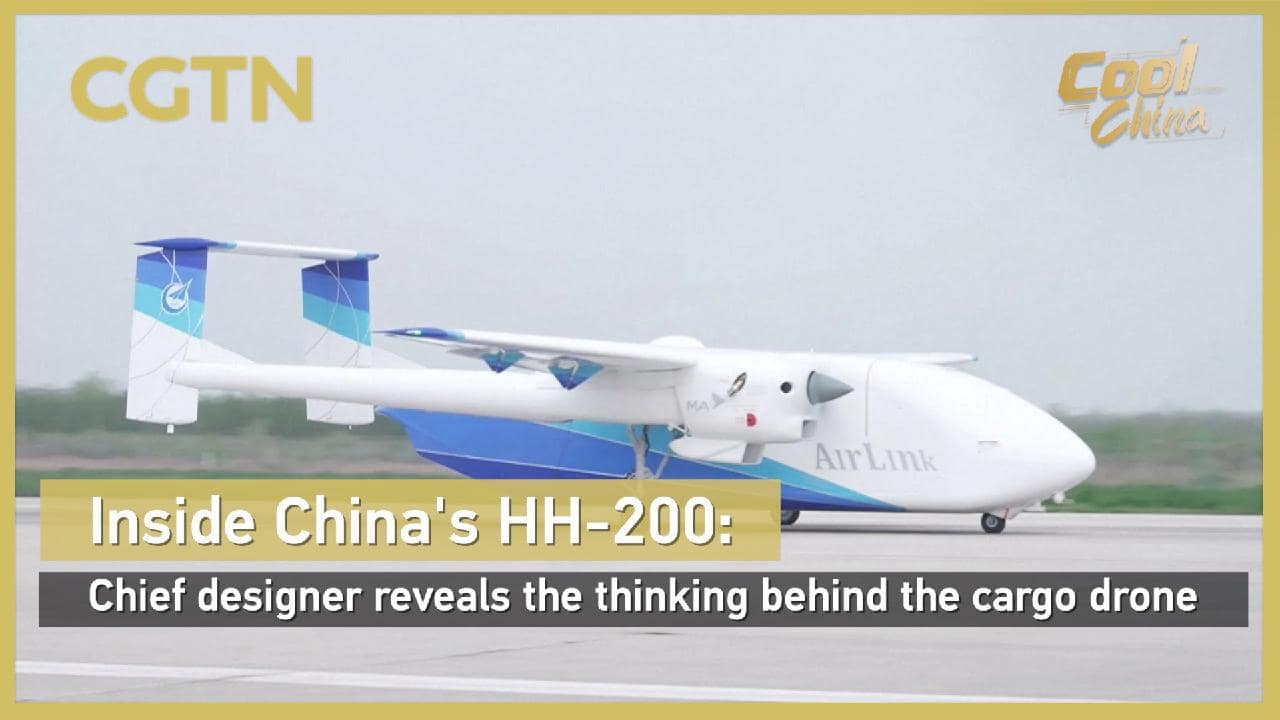
The chief designer has been candid that the economics are the selling point, not just the technology. In an interview with state broadcaster CGTN, he framed the aircraft as a low-cost logistics tool for places that conventional aviation struggles to serve — and put a number on the savings.
The Economics of a Pilotless Freighter
AVIC puts the HH-200’s operating cost at roughly 4.7 yuan per tonne-kilometre — about $0.68 — which the company claims undercuts comparable manned cargo aircraft in the same payload class. That is the figure to watch, and also the figure to be most careful with. It is a manufacturer’s projection for an aircraft that has flown once, for 22 minutes. Real-world costs depend on maintenance, insurance, regulation and how many hours the fleet actually flies. A clean test sortie is a long way from a sustainable per-kilometre rate.
Still, the underlying logic is sound enough to take seriously. The expensive, scarce ingredient in aviation is increasingly the qualified human in the seat. If you can move 1.5 tonnes a few hundred kilometres without one — into a valley, out to an island, across a border — the maths can work where a crewed turboprop never could. AVIC says about 20 orders of intent were on the books before the aircraft even flew, and that it plans to work with express-delivery firms on commercial routes.
The intended mission list reads like a map of the awkward gaps in China’s logistics network: border and coastal feeder freight, point-to-point runs between inland towns, inter-island hops in Southeast Asia, and supply lines tied to Belt and Road partner countries. AVIC also floats secondary roles — disaster relief, firefighting support, even agricultural and remote-sensing work — that hint at the dual civil-military potential of any large unmanned aircraft. It is worth remembering that XAC, the HH-200’s maker, is the same outfit behind the H-6 bomber and the Y-20 transport.
China’s Push Into the “Low-Altitude Economy”
The HH-200 does not exist in isolation. It is one piece of a national bet Beijing calls the “low-altitude economy” — a deliberate effort to turn the airspace below a few thousand metres into commercial territory, from delivery drones and air taxis to unmanned freighters like this one. The HH-200 has cousins: AVIC’s larger Tianma-1000, and other Chinese heavy-lift cargo UAVs reported in the same window, all chasing the same idea of pilotless air freight at scale.
Whether the HH-200 specifically becomes a workhorse or a footnote will depend on certification, on whether the cost numbers survive contact with reality, and on how quickly regulators let autonomous freighters loose in shared airspace. Those are big ifs, and the breathless promotional figures deserve a skeptical eye until independent operators put real hours on the type.
But the direction of travel is unmistakable. A square white box with wings just flew a complete mission with no pilot and no remote stick — and a state aerospace giant is already lining up customers. The cockpit, it turns out, may be the most expensive thing on a cargo plane. China is betting it can do without one.
Sources: Army Recognition; Xinhua; China Daily; CGTN; Global Times; DroneXL; Defense Mirror. Specifications and cost figures are attributed to AVIC / Xi’an Aircraft Industry Group and Chinese state media and have not been independently verified.
Related Questions
What is the HH-200 cargo drone?
The HH-200 is a large autonomous cargo drone built by Xi'an Aircraft Industry Group (XAC), a subsidiary of China's state aerospace giant AVIC. It is a twin-engine, high-wing, twin-boom fixed-wing aircraft designed to haul freight without a pilot. The manufacturer claims a 1.5-tonne payload and a range of up to 2,360 km.
When did China's HH-200 cargo drone first fly?
The HH-200 made its first fully autonomous flight on 15 April 2026 from Pucheng in Shaanxi province, completing a 22-minute circuit of climb, manoeuvre, approach and landing with no pilot on board and no remote stick input. The flight marked a milestone for uncrewed cargo aviation in China.
How much cargo can the HH-200 carry?
According to manufacturer figures, the HH-200 can carry a payload of about 1.5 tonnes in a 12-cubic-metre hold, expandable to 18 cubic metres. It is roughly 12.2 m long with a 16.8 m wingspan. The aircraft is pitched as a 'flying truck' for moving freight to airfields and remote areas without a crew.
How far and fast can the HH-200 fly?
AVIC lists a maximum range of up to 2,360 km and a cruise speed of about 310 km/h, though these are manufacturer figures. Combined with its 1.5-tonne payload, that range positions the HH-200 for regional logistics routes rather than short last-mile parcel delivery.
Why are autonomous cargo drones important?
Large autonomous cargo drones could move freight to remote regions, disaster zones or military outposts without risking aircrew or needing trained pilots. China's HH-200 reportedly drew around 20 letters of intent before its first flight, signalling commercial interest. The same autonomy trend is reshaping military aviation, from logistics to autonomous combat drones.
Related Posts
0 Comments