
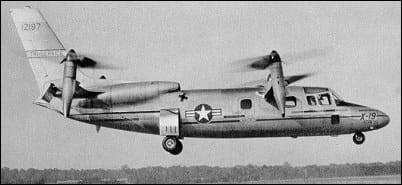
The name Curtiss-Wright carried a century of aviation in it — the fusion of Glenn Curtiss’s company with the firm founded by the Wright brothers themselves. For decades it built engines, propellers and aircraft that helped win two world wars. And then, in the 1960s, it built one last aircraft. It was this: a strange, four-propeller tiltrotor called the X-19. It fell out of the sky, and the company never built another.
The X-19 was an attempt to crack one of aviation’s hardest problems — a machine that could rise straight up like a helicopter and then cruise like an aeroplane. Half a century before it became routine, Curtiss-Wright tried to make it work with tilting propellers. The engineering was simply too much for the era.
Quick Facts
| Aircraft | Curtiss-Wright X-19 (Model 200) |
| Distinction | The last aircraft Curtiss-Wright ever built |
| Configuration | Tandem wings, four tilting 13-ft propellers |
| Power | Two Lycoming T55 turboshafts, ~2,650 shp each |
| First flight | November 1963 (some sources 26 June 1964) |
| Fate | Crashed 25 August 1965 (no injuries); programme cancelled |
| Cause | Failures in the power-transmission gearboxes |
Four propellers, two wings, one very hard problem
The X-19 had a distinctive layout: two high-mounted tandem wings, fore and aft, each carrying two propellers at its tips. All four 13-foot props could swivel through 90 degrees. Pointed up, they lifted the aircraft vertically; tilted forward, they pulled it along in winged flight. Two Lycoming T55 turboshaft engines buried in the fuselage drove the whole arrangement through a web of shafts and gearboxes.
Curtiss-Wright did not call them rotors. The company insisted on its own proprietary term for the design at the heart of the aircraft.
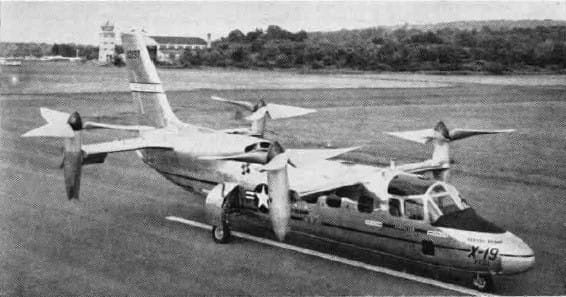
The clip below shows the X-19 lifting off and transitioning — the moment that made these aircraft so treacherous to fly.
Grown from a flying testbed
The X-19 did not appear from nowhere. It grew out of the smaller X-100 of 1960, a single-engine testbed that proved the tilting-propeller idea and used swivelling tail nozzles for control in the hover. Encouraged, Curtiss-Wright scaled the concept up into the Model 200, and the U.S. Air Force ordered two prototypes as the X-19A, hoping the design might mature into a fast VTOL transport carrying a couple of crew and four passengers.
On paper the promise was real: near 460 mph in cruise, the reach of an aeroplane, and the ability to land anywhere a helicopter could. The problem was everything in between.
The transmission that killed it
Transitioning from vertical to horizontal flight is where tilt aircraft earn their fearsome reputation. Pitch, roll, yaw and engine torque all couple together and fight the pilot at once, and the X-19 rode all of that through complex gearboxes splitting power to four propellers. It was those gearboxes that proved the weak link.
On 25 August 1965 the first X-19 was destroyed in a crash. Mercifully, no one was killed. But the programme could not survive it; the second prototype was never finished, and Curtiss-Wright — the company descended from the very inventors of powered flight — closed the book on aircraft manufacturing for good.
Right idea, wrong decade
The cruel part is that the X-19 was not wrong — only early. The coupled controls, the power-transmission demands, the sheer complexity of a machine that changes its whole mode of flight in mid-air defeated 1960s engineering. It would take another four decades, and the Bell-Boeing V-22 Osprey in 2007, before a tiltrotor finally entered operational service.
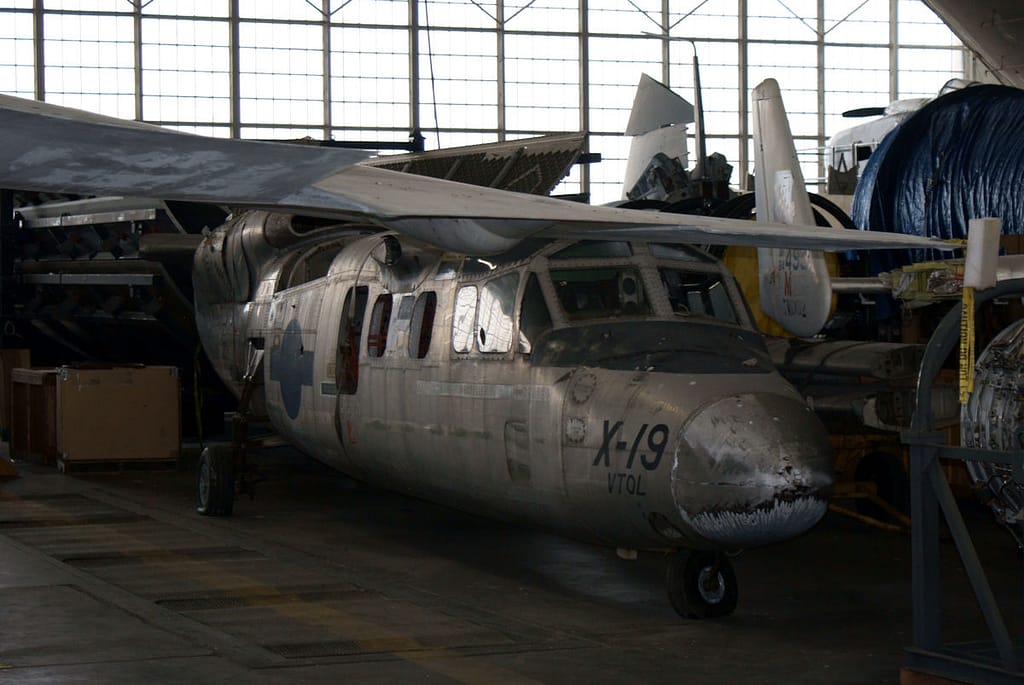
The unfinished second X-19 survives today at the National Museum of the U.S. Air Force — a quiet monument to an idea that arrived too soon, and to the last aircraft ever to wear one of the most famous names in aviation.
Sources: Curtiss-Wright X-19 (Wikipedia); Jane’s All the World’s Aircraft 1965–66; Dennis R. Jenkins, “X-Planes Photo Scrapbook”; National Museum of the U.S. Air Force.
0 Comments