
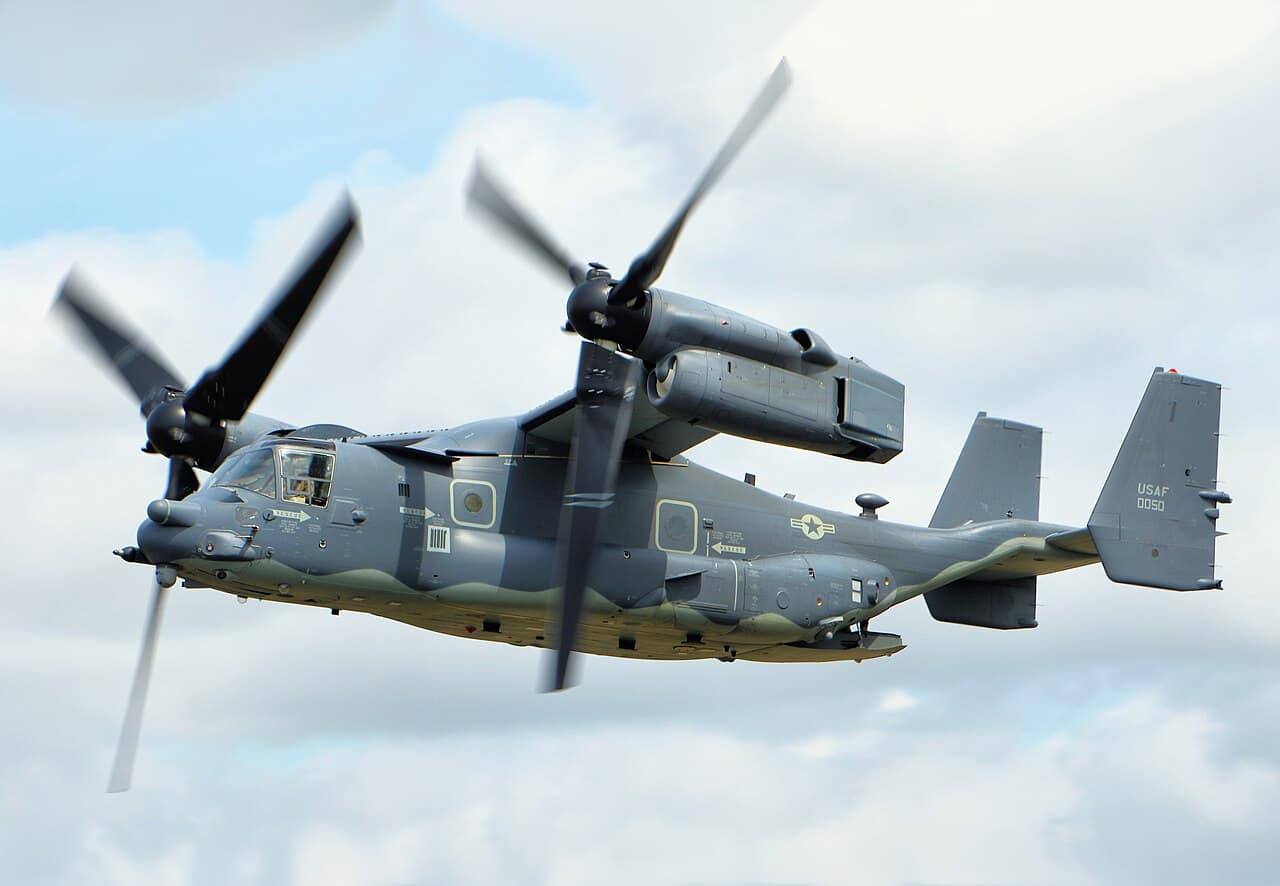
The Air Force just put its money where its maintenance nightmares are. Buried in the FY2027 budget is a $213 million line item for the CV-22 Osprey fleet—and the lion’s share is aimed squarely at the component that killed eight airmen off Japan in 2023 and punched a hole through a gearbox shroud in a New Mexico pasture in November 2024: the proprotor gearbox.
It is the clearest signal yet that the Pentagon has moved from damage control to a genuine engineering fix. The new gearboxes, built from triple-melt X-53 steel, began rolling off the production line in January 2026, with 12 units delivered each month. If the schedule holds, every V-22 across all three services will carry the upgraded hardware by 2027, and the fleet could return to full unrestricted operations by late this year.
For a program that spent the better part of two years under flight restrictions, standdowns, and congressional scrutiny, the budget allocation represents a turning point—or at least an expensive bet that metallurgy can solve what has become the most politically toxic safety issue in military aviation.
Quick Facts
- Budget: $213 million allocated in USAF FY2027 for CV-22 fleet, part of $1.12 billion Pentagon-wide V-22 investment
- The fix: New 123-version proprotor gearboxes using triple-melt X-53 steel to eliminate metallurgical inclusions
- Delivery rate: 12 new gearboxes per month since January 2026
- Fleet-wide target: All V-22s upgraded by 2027; full unrestricted ops by late 2026
- Extended range: Additional $17.5 million for CV-22 range extension modifications
- Root cause: Microscopic impurities in double-melt X-53 steel caused catastrophic gear failures
What Went Wrong: From Yakushima to New Mexico
The story of the Osprey’s proprotor gearbox is a case study in how something 0.055 inches long can bring down a 60,000-pound aircraft. On November 29, 2023, a CV-22B from the 21st Special Operations Squadron was conducting an exercise near Yakushima Island, Japan, when its left proprotor gearbox suffered a catastrophic failure. A high-speed pinion gear cracked, the drive system cascaded into asymmetric lift, and the aircraft hit the water. All eight crew members—five aircrew, a signals intelligence operator, and two medics—were killed.
The accident investigation board traced the failure to metallurgical inclusions in the X-53 steel: tiny pockets of aluminum, calcium, and oxygen embedded during the double-melt forging process. These inclusions acted as fatigue nucleation sites, creating cracks that grew undetected until the gear teeth shattered.
Then it happened again. On November 20, 2024, another CV-22 from Cannon Air Force Base, New Mexico, received chip-burn warnings during a low-level training sortie. This time, the crew acted fast. Within 13 seconds of the first caution, they put the Osprey down in a cattle pasture. Nobody was hurt, but the damage bill hit $2.8 million, and the entire V-22 fleet was briefly grounded again. Investigators found the same culprit: a cracked helical gear with impurities in the metal web.
“I have complete confidence in the aircraft, and I have even more confidence in the crews and maintainers that operate and fix them. I don’t lose a minute of sleep over that.”
Lt. Gen. Michael E. Conley, Commander, Air Force Special Operations Command
The Triple-Melt Solution
The fix sounds almost absurdly simple: melt the steel one more time. Where the old gearbox gears used double-vacuum-arc-remelted X-53 alloy, the new ones go through a triple-melt process that dramatically reduces the frequency and size of non-metallic inclusions. The V-22 Joint Program Office, working with Bell-Boeing, estimates the upgrade cuts the probability of a gear failure by an order of magnitude.
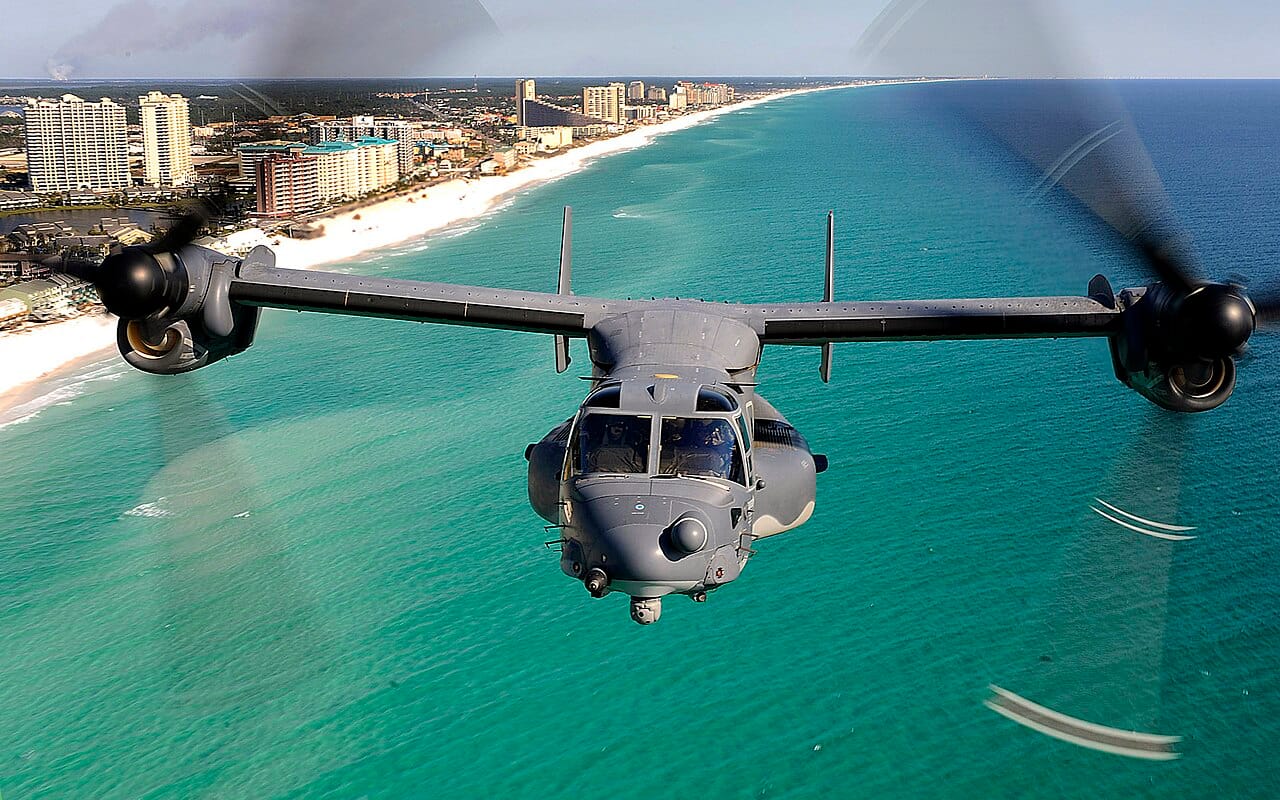
The first batch of 123-version gearboxes arrived at maintenance depots in January 2026, and production has stabilized at 12 units per month. The Air Force plans to have its entire 51-aircraft CV-22 fleet retrofitted by mid-2027, with the Marines and Navy MV-22 and CMV-22 fleets following on a parallel timeline. Meanwhile, 31 of AFSOC’s CV-22s have already completed a separate nacelle improvement program that Bell says has cut related maintenance hours by 75 percent.
“Going from the double-melt gears to the triple-melt gears will reduce the probability of failure by an order of magnitude.”
V-22 Joint Program Office, Proprotor Gearbox Technical Assessment
Budget and Beyond: The Road to Unrestricted Flight
The $213 million Air Force allocation sits inside a broader $1.12 billion Pentagon investment in the V-22 for FY2027. Budget documents detail $105 million specifically for reliability modifications, which include the proprotor gearbox swap, plus $17.5 million for an extended-range modification that would push the CV-22’s already impressive legs even further—a capability that matters enormously for AFSOC’s long-range infiltration and exfiltration missions.
The V-22 Joint Program Office has set late 2026 as the target for removing the flight restrictions that have dogged the fleet since the Yakushima crash. That means returning to the full flight envelope: unrestricted formation flying, overwater transits, and the kind of aggressive low-level profiles that special operations demand. Whether Congress and the families of the eight lost airmen will consider the chapter closed when the last gearbox is swapped remains another question entirely.
For now, the Osprey is still flying—just not the way AFSOC wants it to. The gearbox fix is the most critical piece of a larger reliability puzzle, and $213 million says the Air Force is done waiting for the next cattle-pasture landing to force the issue.
Sources: Air & Space Forces Magazine, The Air Current, NBC News, National Defense Magazine, AeroTime


 English
0 Comments