
If you happened to be standing on a desert ridge near Edwards Air Force Base in early May, you might have heard nothing at all. Which is precisely the point.
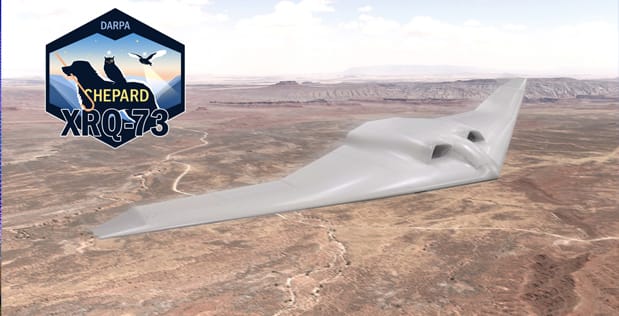
The Defence Advanced Research Projects Agency — better known as DARPA, the agency that funds the kind of aviation projects that sound like science fiction until they suddenly aren’t — has confirmed the maiden flight of an unmanned aircraft called the XRQ-73 SHEPARD. It is a tail-less, twin-propeller flying wing built by Northrop Grumman’s stealth-craft subsidiary Scaled Composites. And it is the quietest combat-relevant aircraft anyone outside a black programme has built in years.
The SHEPARD — short for Series Hybrid Electric Powertrain AiR Demonstration, an acronym so tortured it deserves its own engineering award — is the public face of a project the Pentagon has been working on for the better part of a decade. The breakthrough is not stealth in the conventional radar-cross-section sense. It is acoustic stealth. SHEPARD is, by design, almost impossible to hear.
Quick Facts
Aircraft: XRQ-73 SHEPARD
Builder: Scaled Composites (Northrop Grumman subsidiary)
Configuration: Tail-less flying wing, twin pusher props
Propulsion: Series hybrid-electric (gas turbine generator → electric motors)
Maximum take-off weight: Approximately 1,250 kg (2,750 lb)
First flight: Early May 2026, Edwards Air Force Base
How a hybrid drone whispers
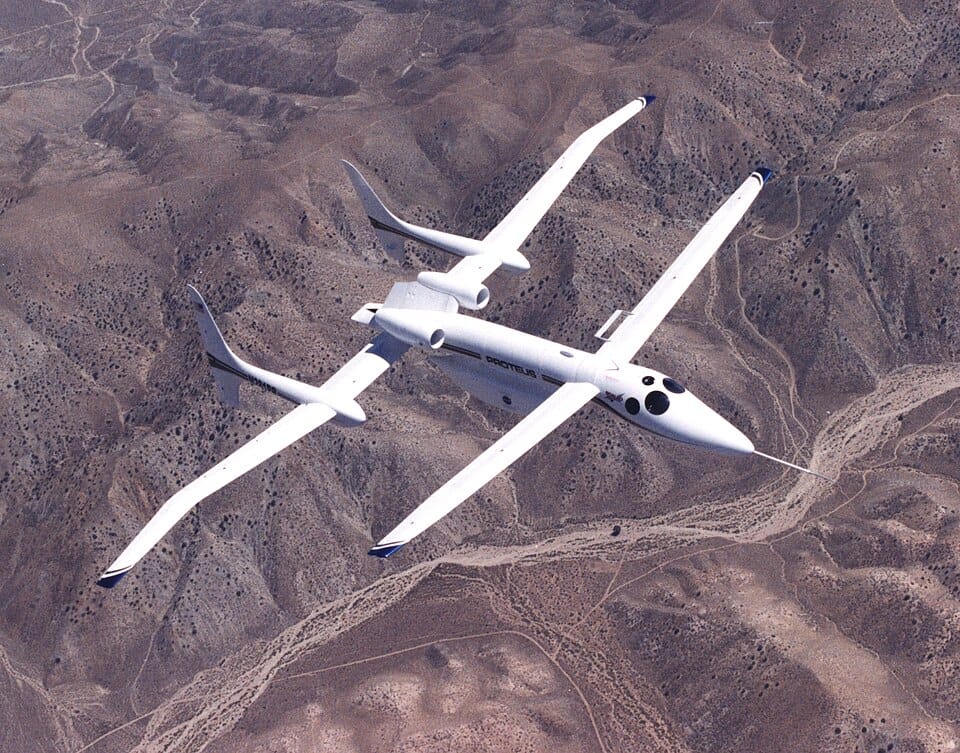
SHEPARD’s propulsion system is the headline. A small gas turbine sits buried in the fuselage, but it does not drive the propellers directly. Instead, it spins a generator. The generator feeds electricity into a battery pack and to two electric motors that turn the two pusher propellers. The turbine, in other words, is a power plant; the propellers are driven by silent electric motors.
The result is a propulsion architecture that decouples the two loudest things in any traditional aircraft — the turbine and the propeller blades — and lets engineers tune each one for noise. The turbine can be designed to run at a single optimal RPM, deep inside the airframe, with massive acoustic shielding. The propellers can be slow, large-diameter, and shaped to keep their blade-tips well below the speed of sound. The aircraft glides through the sky at the noise level of distant traffic.
Why DARPA wants a quiet drone
The U.S. military has plenty of stealthy aircraft. The B-2, the F-22, the F-35 and now the B-21 are all designed to defeat radar. None of them are particularly quiet. A B-2 inbound on a target is invisible to radar but unmistakable to anyone standing underneath it.
That gap matters more than it used to. Modern adversaries — and increasingly, non-state actors — have access to acoustic sensors, civilian smartphones, and airport-style listening posts that can detect aircraft passing overhead long before they show up on a militarised radar screen. In the kind of irregular conflicts the Pentagon expects to fight, sound is information.
SHEPARD is a demonstrator built to prove a hybrid-electric powertrain can deliver useful range, endurance and payload at low acoustic signature. If the test programme succeeds — and the first flight is only the opening move — the technology becomes a reusable building block. Surveillance drones that can loiter over a city without being heard. Cargo platforms that resupply special-operations teams without alerting an entire valley. Strike packages that arrive before the warning network does.
The Scaled Composites pedigree
SHEPARD was built in Mojave, California, by Scaled Composites — the company Burt Rutan founded in the 1980s that has since produced everything from the SpaceShipOne to the Stratolaunch carrier aircraft to a long string of classified Pentagon prototypes that nobody wants to talk about. Northrop Grumman bought the company in 2007. It is now, in effect, the part of Northrop that builds the strange and the secretive.
That lineage matters. Scaled Composites is one of perhaps three places on Earth where you can take a clean-sheet flying-wing concept from PowerPoint to first flight in a few years. The first XRQ-73 contract was awarded in 2024. Two years later, the aircraft is in the air. By Pentagon standards, that is sprint speed.
What happens next
DARPA has said relatively little about the test programme beyond confirming first flight. Industry sources expect a campaign of envelope-expansion sorties at Edwards over the rest of 2026, focused on flight-control characteristics — flying wings are notoriously twitchy in pitch and yaw — and on validating the noise predictions in real-world conditions. Acoustic measurements will be the headline metric. If SHEPARD is as quiet as the engineers think it is, the Pentagon will know it has a new tool in its toolbox.
And the rest of the world will hear about it last.
Sources: DARPA public release, The Aviationist, Aviation Week.


 English
0 Comments