
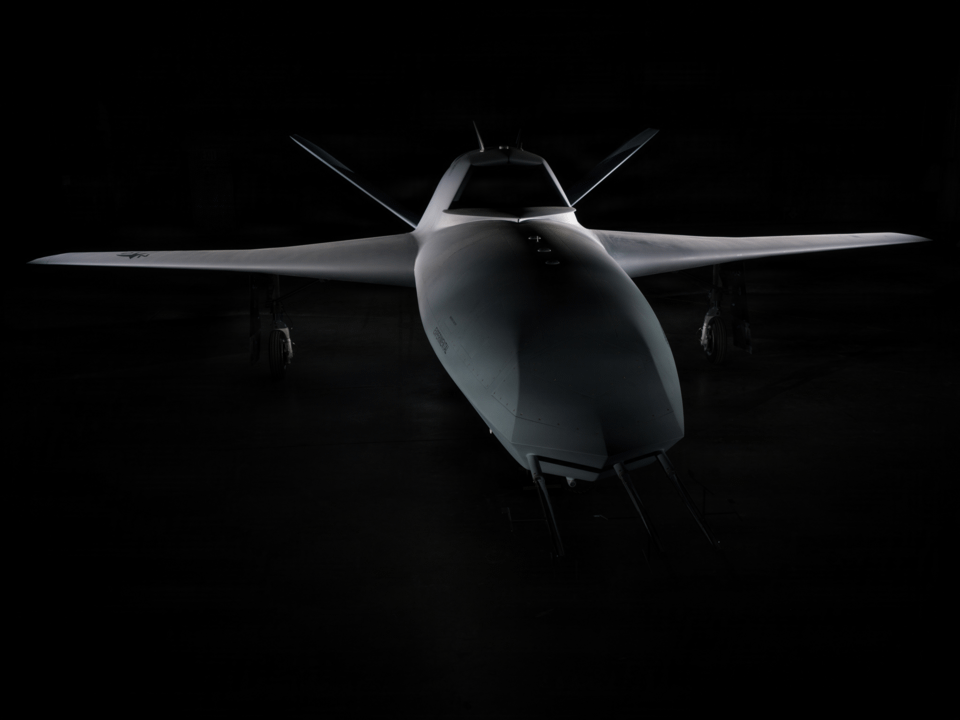
Quick Facts
- Designation: YFQ-48A Talon Blue
- Manufacturer: Northrop Grumman
- Engine: Pratt & Whitney PW500 family (2,900–4,500 lbs thrust)
- First engine start: 17 April 2026
- First flight: Expected 2026
- Role: Autonomous wingman for F-22, F-35, F-15EX
- Key features: Low-observable shaping, 50% fewer parts, modular payload bays
A Business Jet Engine in a Stealth Fighter
The choice of a PW500 engine tells you everything about what the CCA programme is really about: affordability. The Air Force doesn’t want drone wingmen that cost as much as the fighters they’re supposed to protect. The PW500 family is proven, mass-produced, and maintainable by technicians who already know the engine from the business aviation world. Pratt & Whitney worked with Northrop to adapt the commercial engine for military use — extending its capabilities without redesigning from scratch. The result is a propulsion system that can push the Talon Blue through contested airspace while keeping per-unit costs a fraction of what a bespoke military turbofan would demand.Built Different
Northrop claims the YFQ-48A uses composite materials throughout and has achieved a 50% reduction in parts compared to earlier designs. The airframe is one thousand pounds lighter than previous Northrop unmanned combat concepts. These aren’t just engineering bragging rights — fewer parts means faster production, simpler maintenance, and lower lifecycle costs. The aircraft’s low-observable shaping is evident even in the limited imagery released so far. Blended wing-body geometry, carefully managed inlet geometry, and serrated edges all point to serious signature reduction. This is a drone designed to operate in the same threat environments as the manned fighters it accompanies.The CCA Race
The Collaborative Combat Aircraft programme now has three competing designs at various stages of maturity: General Atomics’ YFQ-42A “Dark Merlin” flew first in August 2025, powered by Collins Aerospace’s Sidekick AI software. It crashed during an April 2026 test — a setback, but one the Air Force treats as part of the rapid-fielding philosophy. Anduril’s YFQ-44A “Fury” followed in October 2025, running Shield AI’s Hivemind autonomy software. Production has already started at Anduril’s Arsenal-1 factory in Ohio. Northrop’s YFQ-48A “Talon Blue” is the newest and most stealthy of the three, positioned for the Increment II competition which focuses on more advanced, survivable missions in contested airspace.What Comes Next
The Air Force will make a production decision for the CCA programme sometime in 2026. The service wants hundreds of these drones — enough to provide “affordable mass” that compensates for a shrinking inventory of manned fighters. Each CCA will fly alongside F-22s, F-35s, and the upcoming F-47, carrying extra missiles, jamming equipment, or sensors that extend the pilot’s reach without extending their risk. The Talon Blue’s first flight will be the moment Northrop proves its approach works. Until then, the engine start is the most tangible evidence that America’s autonomous wingman future is real, competing, and accelerating.Sources: Northrop Grumman, RTX/Pratt & Whitney, Air Force Technology, The War Zone, Defence Blog


 English
0 Comments