
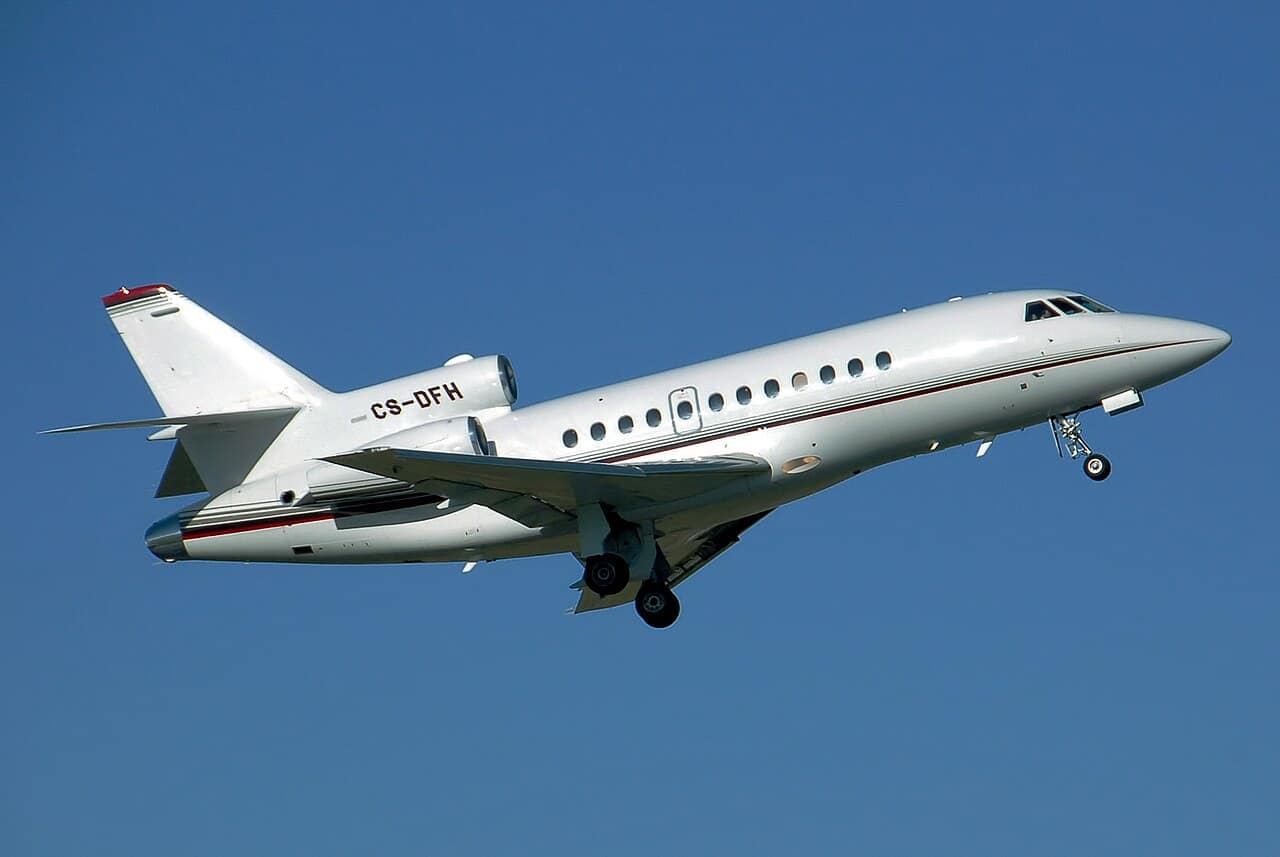
On 10 March 2026, more than 400 customers, partners, and aviation executives gathered in a new production hall at Bordeaux-Mérignac as Dassault Aviation pulled the curtain on the Falcon 10X — the largest, longest-ranged, and most technologically advanced business jet the French manufacturer has ever built. After years of development and a first-flight date now imminent, the 10X enters a market segment where only two other aircraft compete at this level: the Bombardier Global 7500 and the Gulfstream G700. Dassault believes it has built something better than both.
The Widest Cabin in Business Aviation
The headline number is the cabin cross-section. At 2.77 metres (9 feet 1 inch) wide and 2.03 metres (6 feet 8 inches) tall, the Falcon 10X has the largest cabin of any purpose-designed business jet in the world — roughly a foot wider and around five inches taller than the Gulfstream G700 and the Global 7500. That may sound like a marginal difference on paper, but anyone who has spent fourteen hours inside a business-jet fuselage knows that every centimetre counts.
The cabin stretches 16.4 metres (54 feet) and is divided into four distinct zones. Depending on the owner's preferences, these can be configured as a forward crew rest area, a conference and dining zone, an entertainment lounge, and a private master suite with a full-size bed and a stand-up shower. The 10X carries 38 windows — the largest ever fitted to a Falcon — and maintains a cabin altitude of just 3,000 feet at a cruising altitude of 41,000 feet, meaning passengers arrive with significantly less fatigue than on aircraft with higher cabin pressurisation altitudes.
7,500 Nautical Miles: Paris to Tokyo, Nonstop
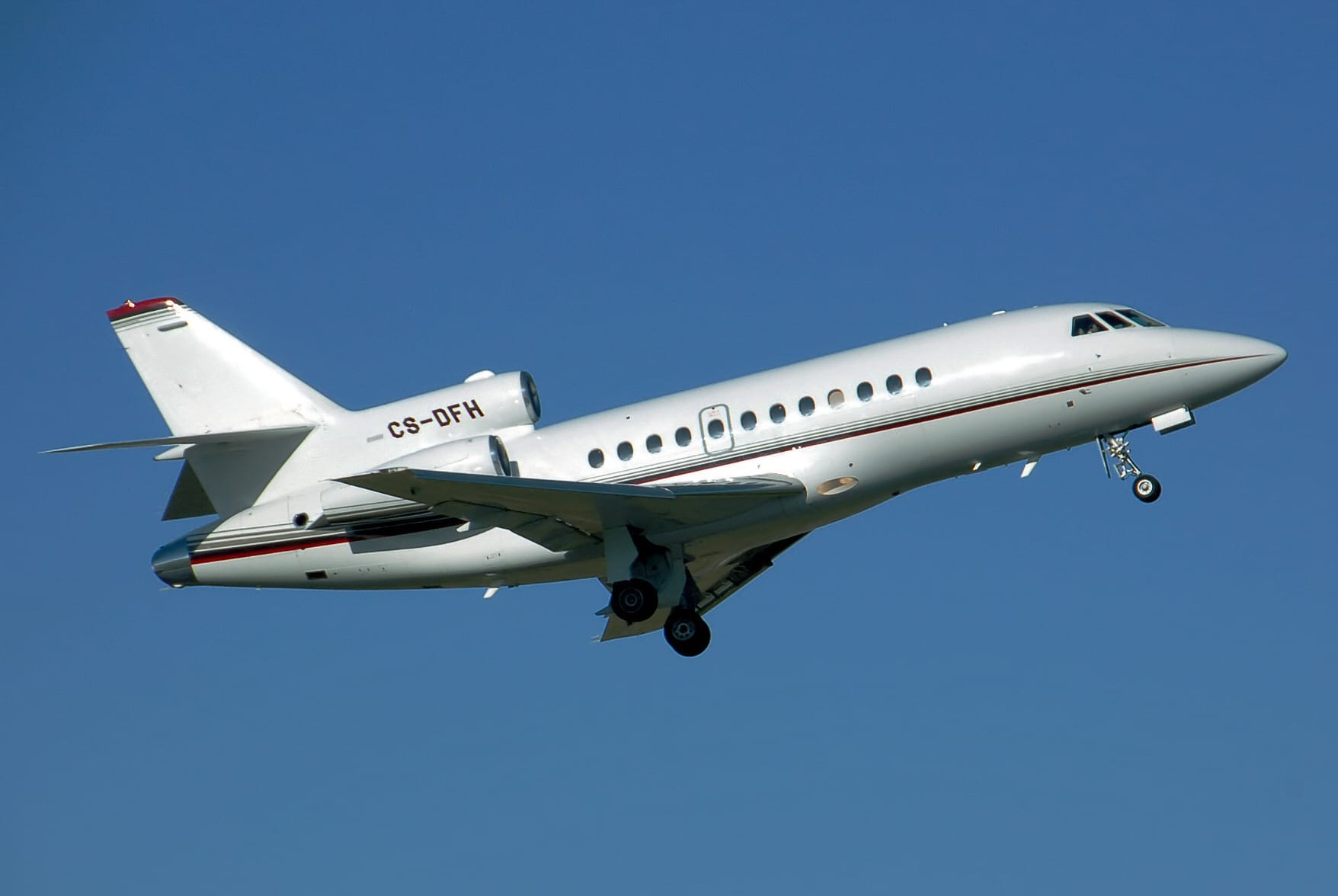
The Falcon 10X is powered by two Rolls-Royce Pearl 10X engines, each producing 80 kN (18,000 pounds) of thrust. The Pearl 10X is a new variant of Rolls-Royce's Pearl family — the same engine lineage that powers the Global 7500 and the G700 — optimised for the 10X's aerodynamic profile and mission requirements. The result is a range of 7,500 nautical miles (13,900 kilometres) with eight passengers and NBAA IFR reserves, enough to fly Paris to Tokyo, New York to Dubai, or London to Singapore without stopping.
Maximum speed is Mach 0.925 — fractionally below the speed of sound — with a typical cruise of Mach 0.85. For operators who need access to challenging airports, the 10X is designed to fly steep approaches into fields like London City Airport, a capability that neither the G700 nor the Global 7500 can match. The wing is a high-aspect-ratio carbon-fibre structure — a first for a Dassault business jet — that delivers lower drag at cruise and better low-speed handling for short-field operations.
A Carbon-Fibre Wing and a Digital Flight Deck
The 10X's wing is not merely new; it represents a structural philosophy that Dassault has never applied to its civil aircraft. The entire wing is manufactured from carbon-fibre-reinforced polymer, saving weight and allowing the engineers to design a higher aspect ratio than a conventional aluminium wing could sustain without excessive flex. Higher aspect ratio means less induced drag at cruise, which translates directly into range — and the 10X's 7,500-nautical-mile reach is the proof.
The flight deck features Dassault's new NeXus avionics suite — an evolution of its EASy IV flight deck — built on a digital architecture that the company describes as the most advanced in business aviation. The cockpit is equipped with a combined vision system that merges enhanced and synthetic vision on a single head-up display, allowing pilots to fly approaches in conditions — fog, low cloud, darkness — that would ground lesser aircraft. A fly-by-wire flight control system, adapted from Dassault's experience with the Rafale fighter, provides both precise handling and built-in envelope protection.
The Three-Way Race at the Top
The ultra-long-range business-jet market is now a three-horse race between French, Canadian, and American manufacturers. The Bombardier Global 7500 has been in service since 2018 and set the benchmark for range and cabin size. The Gulfstream G700 entered service in 2024 and matched the Global on range while adding the widest cabin Gulfstream had ever offered. The Falcon 10X, priced from approximately $75-80 million before cabin fit-out, enters last but claims the widest cabin of the three and adds capabilities — steep-approach certification, a carbon-fibre wing, fighter-derived fly-by-wire — that neither rival offers.
With first flight imminent and entry into service targeted for late 2027, the Falcon 10X is Dassault's statement that it intends to compete at the very summit of business aviation. Whether it can take market share from two deeply entrenched competitors remains to be seen, but the aircraft itself — wider, lighter, and more technologically ambitious than anything in its class — is exactly the kind of machine that Dassault has built its reputation on: an engineer's aircraft, designed to be the best rather than the first.
Related Questions
What is the Dassault Falcon 10X?
The Falcon 10X is Dassault Aviation's largest, longest-ranged and most advanced business jet, unveiled on 10 March 2026 at Bordeaux-Mérignac. It offers the widest cabin of any purpose-designed business jet, a range of 7,500 nautical miles, and twin Rolls-Royce Pearl 10X engines. It competes with the Gulfstream G700 and Bombardier Global 7500.
Which business jet has the widest cabin?
The Dassault Falcon 10X has the widest cabin of any purpose-designed business jet, measuring 2.77 metres (9 feet 1 inch) wide and 2.03 metres (6 feet 8 inches) tall. That is roughly a foot wider and five inches taller than the Gulfstream G700 and Bombardier Global 7500, its closest competitors.
What is the range of the Dassault Falcon 10X?
The Falcon 10X has a range of 7,500 nautical miles (13,900 kilometres) carrying eight passengers, enough to fly Paris to Tokyo nonstop. This places it among the elite of ultra-long-range business jets, alongside aircraft such as the Gulfstream G800.
What engines power the Falcon 10X?
The Falcon 10X is powered by two Rolls-Royce Pearl 10X engines, each producing 80 kilonewtons (18,000 pounds) of thrust. The Pearl 10X belongs to the same engine family that powers the Gulfstream G700 and Bombardier Global 7500. The jet uses a digital fly-by-wire flight-control system.
How does the Falcon 10X compare to the Gulfstream G700 and Global 7500?
The Falcon 10X's main advantage is cabin size — about a foot wider and five inches taller than both the Gulfstream G700 and Bombardier Global 7500. All three share Rolls-Royce Pearl-family engines and similar ultra-long ranges, but Dassault positions the 10X as the roomiest and most technologically advanced of the three.
What is cabin altitude in an aircraft?
Cabin altitude is the equivalent air pressure inside a pressurised aircraft, expressed as an altitude. A lower cabin altitude means denser, more oxygen-rich air and less passenger fatigue. The Falcon 10X maintains a cabin altitude of just 3,000 feet while cruising at 41,000 feet, unusually low for a business jet.

0 Comments