
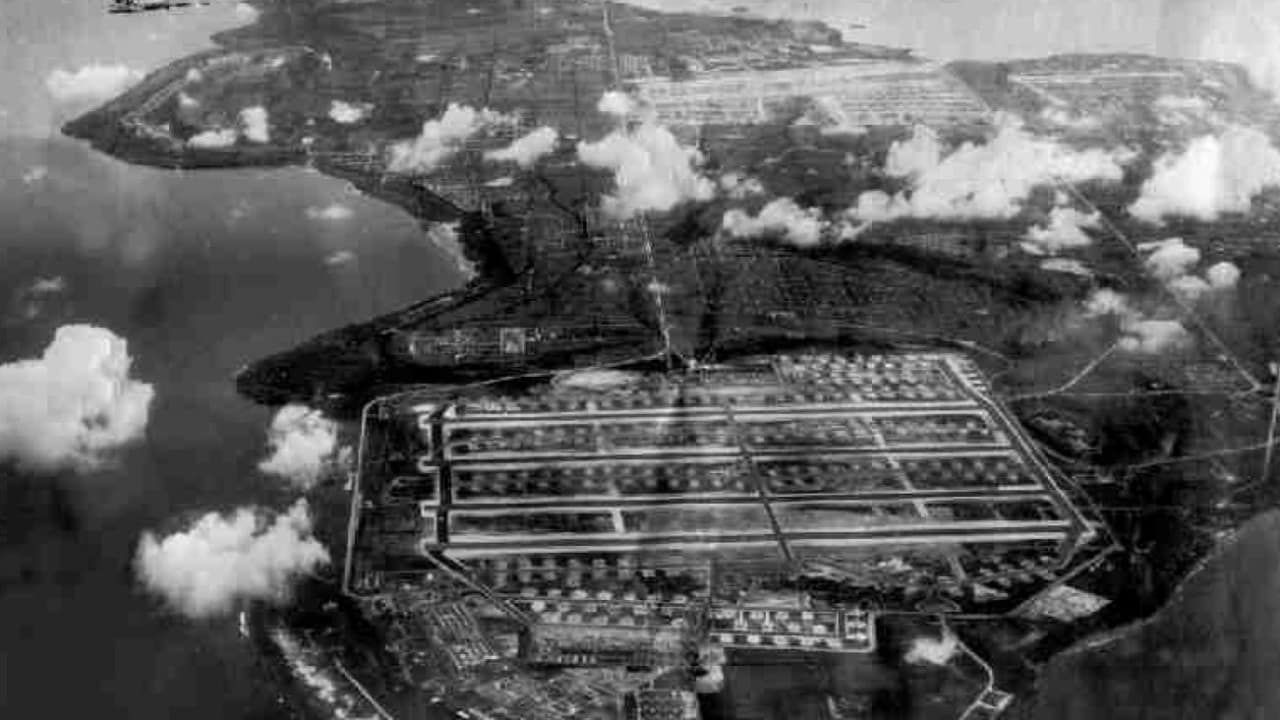
Eine Erweiterung zu Das Rennen um die Bombe, our focus series. The Enola Gay needed a runway, and the runway needed an island. This is the story of Tinian — the Pacific speck that became, for one astonishing year, the largest airport on Earth.
Sunset, Tinian, midsummer 1945. On the coral ridge above North Field, a knot of young men climbs to the high ground as, below them, the largest airfield in the world begins to roar. They are physicists from a secret laboratory in New Mexico, and they have taken to watching this spectacle the way other men watch a storm come in.
Down on the field, four parallel runways — each nearly two miles long, each as wide as a ten-lane highway — begin launching the evening’s maximum effort. The bombers look slow because they are enormous; a jeep racing alongside is comfortably outrun. One B-29 becomes airborne every fifteen seconds. It goes on like that, with terrible precision, for an hour and a half, until the sun is under the sea and the last aircraft are running lights on the horizon. Sometimes one fails to fly, and goes skimming into the water, or onto the beach, where it burns like a torch.
One of the men on the ridge is a 29-year-old physicist named Philip Morrison. In a few days he will help assemble the plutonium core of the Fat Man bomb a few hundred metres from where he sits. In December, he will describe these sunsets to a committee of United States Senators in testimony that Richard Rhodes preserved in The Making of the Atomic Bomb — perhaps the finest description of air power anyone ever gave under oath. This article is about the thing Morrison was describing: how eleven million cubic yards of coral, a Marine assault and the greatest construction force of the war turned a sugar-cane island smaller in silhouette than Manhattan into the busiest, deadliest airport in history.
Quick Facts: Tinian, 1944–45
- 6 runways, each roughly 8,500 ft (2.6 km): four at North Field, two at West Field
- 11,000,000 cubic yards of coral and earth moved by the Seabees — three times the volume of Hoover Dam
- About one year from amphibious assault (24 July 1944) to the atomic mission (6 August 1945)
- 265 + 220 B-29 hardstands; roughly 450 B-29s could launch in 70–80 minutes
- 1 B-29 airborne every 15 seconds, field-wide, during a maximum effort
- ~29,000 missions and 157,000 tons of bombs flown from Tinian
- ~50,000 personnel based on an island of 101 square kilometres
- $409 million — the US contract now restoring the same runways, 80 years on
Jig Day
The airport began as a battlefield. On 24 July 1944 — J-Day, or “Jig Day” in that operation’s phonetic alphabet — the 4th Marine Division came ashore not at the obvious beaches off Tinian Town, where the Japanese garrison waited, but over two absurdly narrow strips of sand on the northwest coast that the defenders had judged unusable. The 2nd Marine Division staged a theatrical feint off the town to hold the garrison in place. The gamble achieved almost total surprise, and the nine-day battle that followed — which also saw the first combat use of a new incendiary gel called napalm — ended with the island declared secure on 1 August at a cost of roughly 300 American dead.
“Secure” deserved its quotation marks. Japanese holdouts haunted Tinian’s caves for years — B-29 crews slept with sidearms — and the last of them, a soldier named Murata Susumu, was not captured until 1953, eight years after the war he was still hiding from had ended.
The real conquest of Tinian, though, was performed by men with bulldozers. Seabees of the 121st Naval Construction Battalion landed during the assault itself and went to work on the captured Japanese airstrip at Ushi Point while the fighting continued; the official Navy construction history records, with magnificent dryness, that by the evening a strip 150 by 2,500 feet had been repaired. It was the first sentence of the largest airport-building project ever undertaken.
Eleven Million Cubic Yards
What the 6th Naval Construction Brigade — some 13,000 Seabees in more than a dozen battalions — did next still reads like a misprint. They dug, blasted, hauled and compacted roughly eleven million cubic yards of coral and earth: enough material, as the 6th Bomb Group’s historians put it, to fill the volume of Hoover Dam three times over. A coral ridge was half-levelled and pushed into a rough plain. Building just three of North Field’s runways consumed nearly a million cubic yards of fill and around 900,000 truck-miles of hauling.
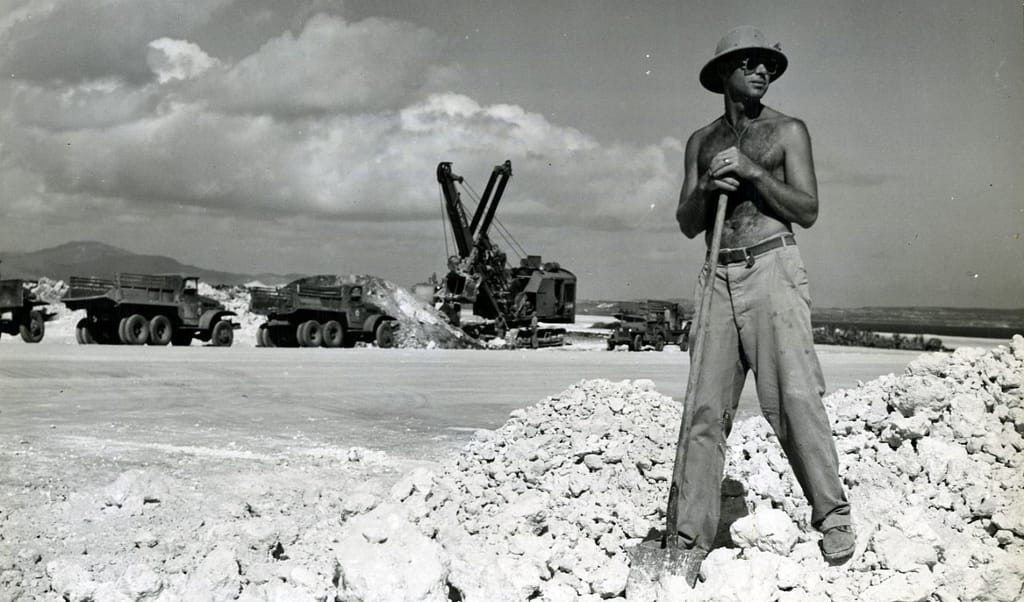
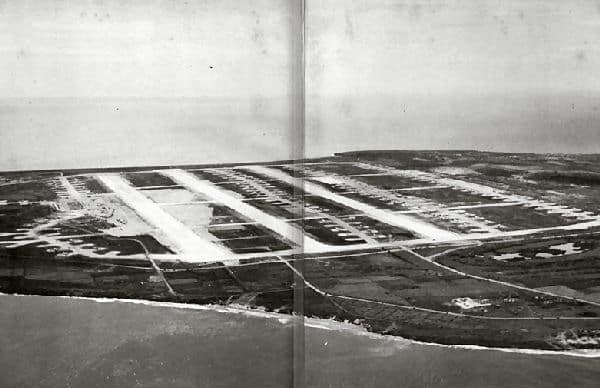
The product, by May 1945, was North Field: four parallel runways of roughly 8,500 feet, lettered Able through Dog, spaced 1,600 feet apart, fed by eleven miles of taxiways and 265 hardstands. A few kilometres south, West Field added two more runways and 220 hardstands for a second wing. Six great runways on one small island — and North Field alone, on completion, was the largest airfield in the world. It had taken less than a year from the first Marine setting foot on the beach.
Manhattan, Pacific
Then the Seabees did something wonderful. Noticing that Tinian resembles Manhattan Island in shape and orientation, the homesick builders surveyed their new base as a New York street grid and named it accordingly. B-29s taxied past Broadway — a divided four-lane highway — and 42nd Street; jeeps ran up Riverside Drive and Eighth Avenue; the ruined Japanese town of Sunharon, sitting roughly where Greenwich Village would be, was duly nicknamed The Village, and an undeveloped square in the middle became Central Park. Fifty thousand Americans lived on the island grid at the peak — a functioning bomber metropolis, complete with docks, hospitals and eight-thousand-seat cinemas, where three years earlier there had been sugar cane.
Period newsreel: the first B-29s arrive on Tinian, 1945.
Maximum Effort
The traffic this city generated has no parallel in aviation before or since. The 313th Bombardment Wing’s four groups filled North Field; the 58th Wing filled West Field; and on a maximum-effort night approximately 450 B-29s could be launched from Tinian in 70 to 80 minutes — every aircraft grossly overloaded with 25 to 30 tons of fuel and bombs. Painted go/no-go stakes stood beside each runway: if a B-29 was not doing 100 miles per hour with all four engines perfect as the stake flashed past, the pilot still had just enough coral left to stop 65 tons. If he was, he flew — sometimes literally off the island’s edge. The runways ended at a low cliff above the sea, and crews learned to use the drop itself: one 6th Bomb Group pilot, Ed Vincent, is credited as the first to hold his overloaded bomber on the deck at full throttle deliberately over the cliff edge, trading the height for flying speed. Crash trucks and ambulances idled along the runways all evening for the aircraft that traded wrong.
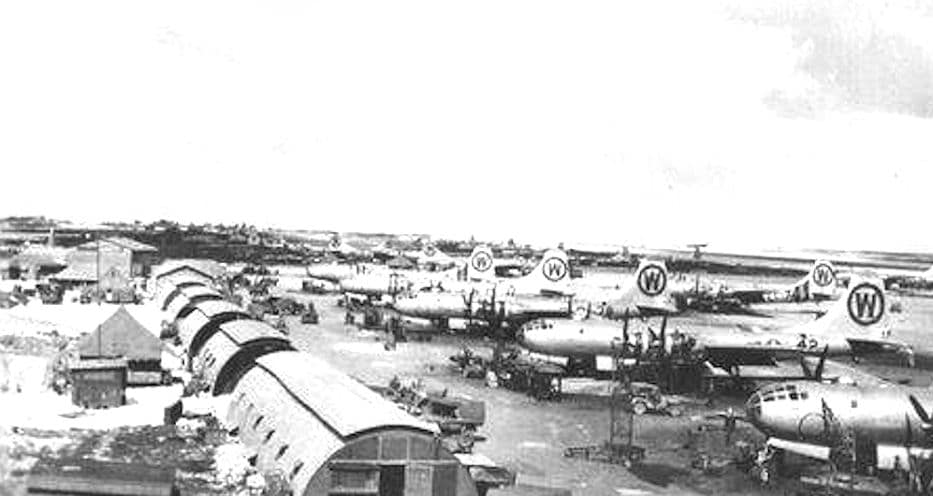
Morrison’s Senate testimony of December 1945 remains the definitive eyewitness account of what all this looked like — the passage every reader of Rhodes remembers.
And the mornings had their own choreography: the survivors of the night’s raid strung out in a single line from overhead to the horizon — like beads on a chain, in Morrison’s phrase — ten or twelve aircraft visible at once, spaced miles apart, landing as fast as the runways could absorb them while new beads kept appearing at the edge of the sky. The cumulative ledger of this machine: roughly 29,000 missions and 157,000 tons of bombs flown from Tinian, including the great firebombing missions of Part 8 of this series.
The Last Bomb (1945): the USAAF’s own colour documentary of the Marianas campaign — mass takeoffs exactly as Morrison described them.
The Outfit on Eighth Avenue
Into this city of maximum efforts, in May 1945, moved a unit that flew almost nothing and explained less: the 509th Composite Group, 1,767 men in a fenced compound with its own guards, its own mess and its own C-54 transports. Security was total — one sentry famously cocked his rifle at a brigadier general who arrived without credentials. While every other group flew 400-plane nights, the 509th flew small formations that dropped single, oddly-shaped orange bombs the island nicknamed pumpkins. The rest of Tinian responded the way bomber crews respond to everything: with verse. An anonymous poem titled Nobody Knows made the rounds, and its closing lines drip with the resentment of men flying nightly maximum efforts past a pampered mystery unit.
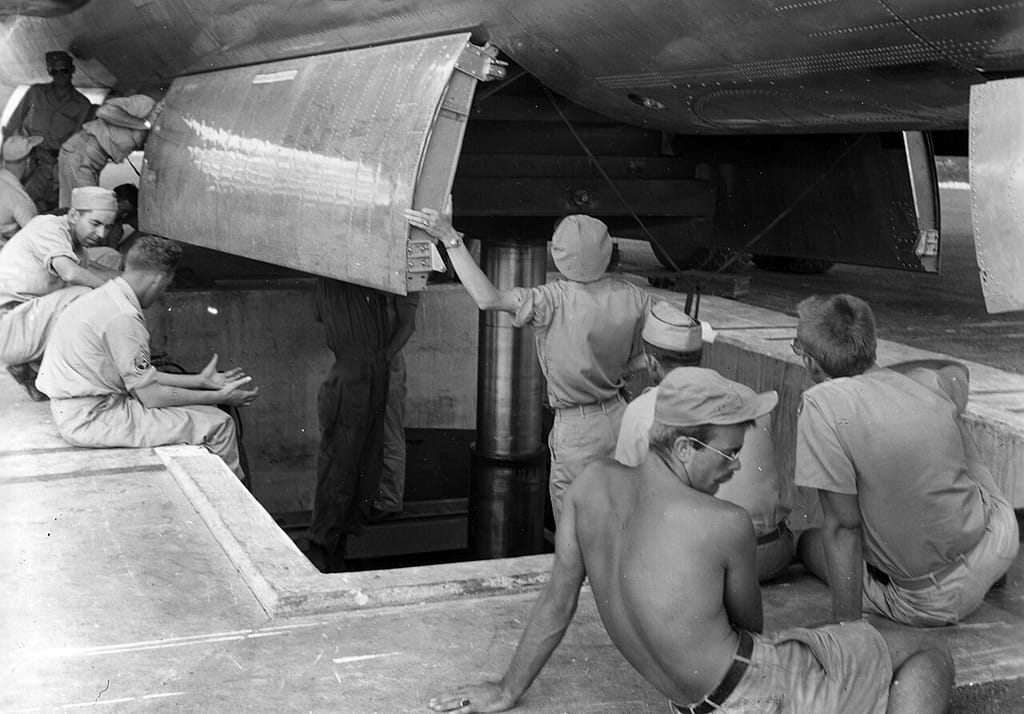
The joke, of course, was that the poem was simply true. Beside Runway Able the Seabees had dug two air-conditioned assembly buildings and two concrete loading pits — the bombs the 509th existed to carry were too large to winch under a B-29, so the aircraft was rolled over a pit and the weapon jacked up into its bay. The cruiser USS Indianapolis delivered Little Boy’s components to the Seabees’ docks on 26 July; her own terrible story is told in a companion piece to this article. On the night of 5–6 August, floodlights lit Runway Able as the Enola Gay rolled; three days later Bockscar followed. The busiest airport in the world is where the atomic age took off — literally, at the coral’s edge, at 2:45 in the morning.
The Jungle Gives It Back
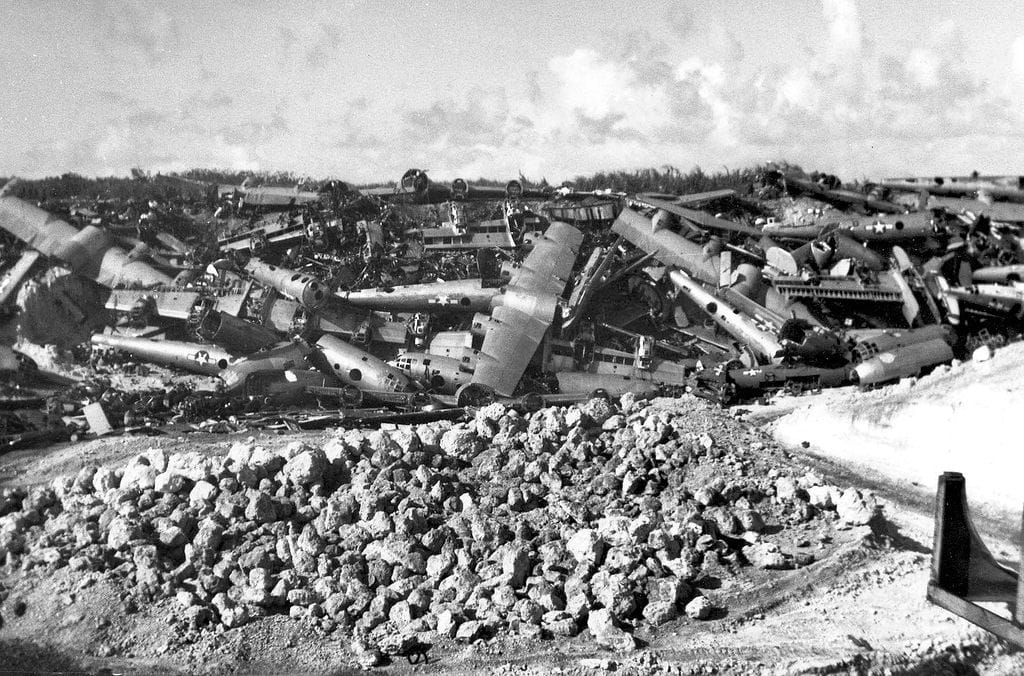
The empire of runways emptied as fast as it filled. Within a year of the surrender, photographs show B-29s being broken up for scrap on the same hardstands they had flown from; the jungle took the taxiways; and for three-quarters of a century North Field lay abandoned — a ghost airport where tourists could stand in the preserved, glass-covered bomb pits and hear nothing but wind. West Field survived as Tinian’s modest international airport.
Then history cleared its throat. In 2024 the US Air Force awarded a five-year, 409-million-dollar contract to bring Tinian’s airfields back, and RED HORSE engineer squadrons — today’s heirs to the Seabees, working alongside actual Seabee battalions — began stripping some 500 acres of jungle off North Field’s runways and taxiways; by early 2025 the WWII pavement was 99 percent cleared, and F-22s have already practised from the island. The logic is called Agile Combat Employment — dispersing airpower across the Pacific rather than concentrating it on a few big bases — and it needs exactly what the Seabees left behind. One sergeant, surveying the eleven-million-cubic-yard inheritance his unit was uncovering, gave the whole enterprise its epitaph: this, he said, is every Dirt Boy’s dream.
Eighty years after Morrison watched the sunset launches, the island that looked like a giant aircraft carrier is being readied for a deck load again. Whatever one makes of that, the original miracle stands: an airport the size of a city, built in a year, on an island seized in nine days — the indispensable, half-forgotten runway under everything this series has described.
The History Underground walks North Field today: the pits, the runways, and the silence.
Sources: Philip Morrison’s Senate testimony (6 December 1945) via Richard Rhodes: The Making of the Atomic Bomb, Building the Navy’s Bases in World War II (official US Navy history), National Park Service, 6th Bomb Group Association, Atomic Heritage Foundation, Air & Space Forces Magazine, The Aviationist, Wikipedia.
Verwandte Artikel – Die Serie „Das Rennen um die Bombe“
Serienübersicht: alle zehn Teile
Part 9: Forty-Three Seconds Over Hiroshima
0 Kommentare