
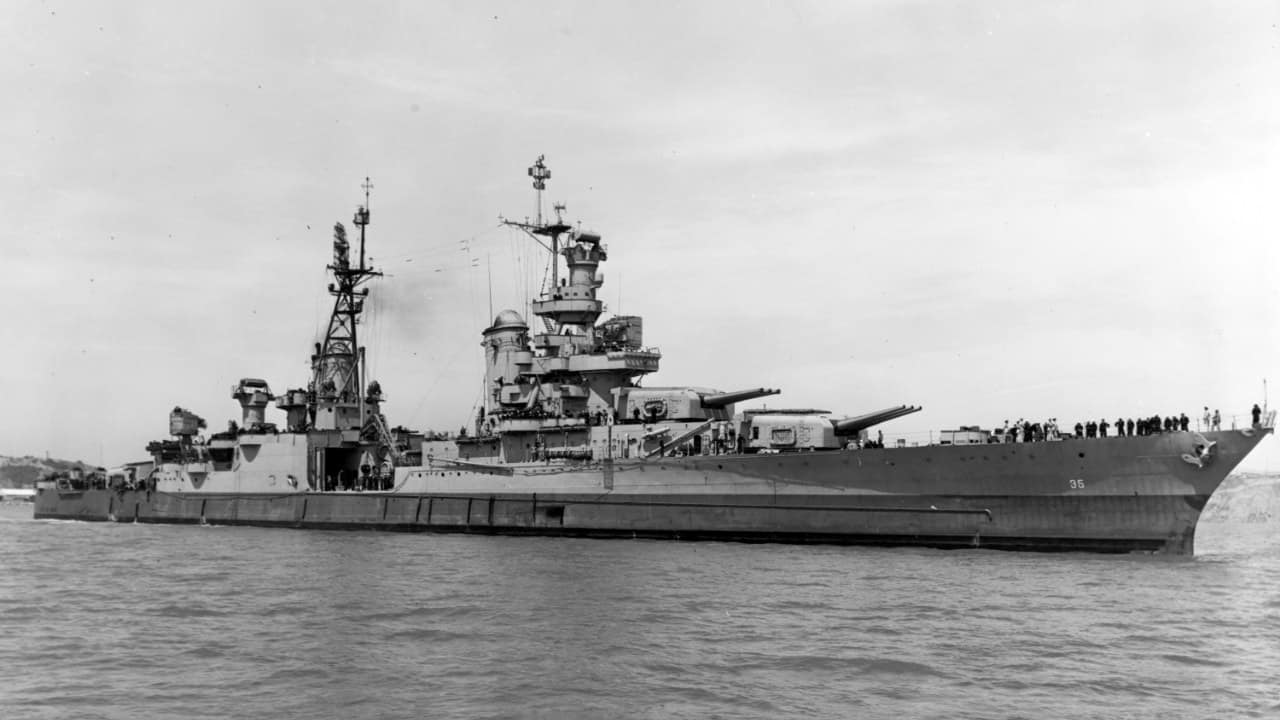
Eine Erweiterung zu Das Rennen um die Bombe, our focus series. Before the Enola Gay could take off from Tinian, the bomb had to reach Tinian — and the ship that carried it never came home. This is the story of USS Indianapolis: the secret cargo, the twelve minutes, the four days in the water, and the captain who paid for all of it.
San Francisco Bay, before dawn, 16 July 1945. On the quarterdeck of a heavy cruiser still smelling of fresh paint — she was under repair from a kamikaze hit until days ago — sailors watch Marines guard a large wooden crate as it is lowered into a hangar and welded to the deck. Welded. Separately, two officers carry aboard a lead-lined canister the size of a bucket, which is lashed into a cabin and guarded around the clock by men who never explain themselves.
The two escorting “Army artillery officers” know so little about artillery that the ship’s gunnery officers quickly stop asking. The crew’s theories about the crate run from a secret weapon to cases of whisky for General MacArthur; one wag suggests scented toilet paper. Captain Charles B. McVay III has been told only one thing: every day he saves on this passage will shorten the war.
At almost exactly the hour the crate comes aboard, 1,300 kilometres to the east, the sky over the New Mexico desert turns white: Trinity. The canister welded into USS Indianapolis holds roughly half the world’s supply of weapons-grade uranium-235 — the heart of the Little Boy bomb, whose story this series told in Part 9. The ship has two weeks to live.
Quick Facts: USS Indianapolis (CA-35)
- 1,195 men aboard — 316 survived — 879 lost: the worst single-ship loss of life at sea in US Navy history
- 12 minutes from the first torpedo hit to the ship going under
- 74.5 hours — Farallon Light to Diamond Head, 2,091 miles at ~29 knots: a record run that still stands
- ~Half the world’s weapons-grade U-235 in one lead-lined canister — the Little Boy load, not Fat Man
- 4–5 days adrift; shark deaths estimated from a few dozen to more than 150 — history’s worst shark attack
- 6 torpedoes fired by submarine I-58; 2 hit
- 5,500 m — depth at which the wreck was found in August 2017, deeper than Titanic
- 55 years from Captain McVay’s conviction to his exoneration by Congress
Every Day You Save
She ran like the war depended on it, because she had been told it did. Indianapolis cleared the Golden Gate on the morning of 16 July and covered the 2,091 miles from Farallon Light to Diamond Head in 74 and a half hours — an average of about 29 knots, a record for the run that has never been beaten. She reached the Seabee-built docks of Tinian on 26 July and gave up her secret cargo to the island whose story we told in the companion piece to this article. A point of accuracy the movies keep getting wrong, and even Quint gets wrong in Jaws: she carried the components of Little Boy, the uranium bomb dropped on Hiroshima — not Fat Man. Her job done, she sailed for Guam and was routed onward, alone and unescorted, toward Leyte in the Philippines. Her request for an escort was deemed unnecessary; the sea lanes were considered safe.
They were not. Running those same waters was the Japanese submarine I-58, commanded by Mochitsura Hashimoto — a Pearl Harbor veteran carrying both conventional torpedoes and Kaiten manned suicide torpedoes, still hunting in a war his side had already lost.
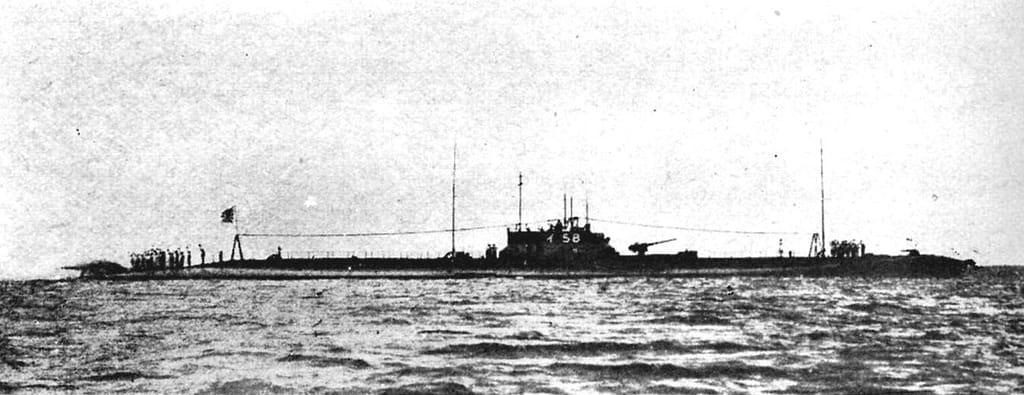
Six Torpedoes at Midnight
Just after midnight on 30 July 1945, in a gap between rain squalls, Hashimoto’s periscope found a silhouette he took for an Idaho-class battleship, steaming a straight course in the moonlight. He fired six Type 95 torpedoes. Two struck the cruiser’s starboard side, the first tearing off her bow, the second finding a fuel bunker and a powder magazine amidships.
Twelve minutes. That is how long a 186-metre heavy cruiser — the former flagship of the Fifth Fleet, the ship that had carried the atomic bomb across the Pacific — took to go down. Roughly 300 men went with her. About 890 more went into the dark water in life jackets and fuel oil, most without rafts, many badly burned, scattered along miles of the ship’s final track. Survivor Loel Dean Cox, then nineteen, put the arithmetic plainly decades later: twelve minutes — can you imagine a ship six hundred and ten feet long sinking in twelve minutes?
Then came the failure that turned disaster into horror: nobody came. Whether a usable distress signal ever escaped the dying ship is still argued — the Navy’s official finding was that the second torpedo had wrecked her communications, while later accounts name three separate stations where operators reportedly picked up a signal and, for reasons ranging from disbelief to negligence, did nothing. What is beyond dispute is the other half: under the secrecy-soaked procedures of July 1945, a combatant ship’s non-arrival triggered no alarm. Indianapolis failed to appear at Leyte on 31 July, and no one noticed. The men in the water were now in a race between rescue and the sea, and rescue did not know the race was on.
The Ocean Kept Them
What followed is one of the most harrowing survival ordeals ever documented, and this article will not soften it. For four to five days the survivors drifted in open ocean: swallowing fuel oil, blistering in the sun by day and shaking with hypothermia by night, their waterlogged kapok jackets slowly losing buoyancy. Thirst did the deepest damage. Men who gave in and drank seawater slid into salt poisoning and hallucination — swimmers announced they had found drinking fountains below decks and dove to reach them; groups splintered as dying men fought phantoms. Most of the roughly 570 who perished in the water died of wounds, drowning and dehydration.
And then there were the sharks — oceanic whitetips, drawn first to the explosions and the dead. Honest history requires honest numbers: estimates of men actually killed by sharks range from a few dozen to more than 150, which is enough to make this, by any accounting, the worst shark-attack episode in recorded history — while the sharks fed far more on the dead than the living. The survivors’ memories need no inflation.
Marine Corporal Edgar Harrell, one of the last survivors, tells the whole story in this long-form interview.
The Antenna, the Vote, and the Light
Rescue finally arrived by pure accident. Mid-morning on 2 August, Lieutenant Wilbur “Chuck” Gwinn, flying a routine patrol in a PV-1 Ventura, crawled into the aircraft’s tail to wrestle with a misbehaving radio antenna, happened to glance at the sea — and saw a miles-long oil slick with irregular bumps in it. The bumps were heads. His contact report set off the biggest air-sea rescue of the Pacific war.
First on scene with the means to act was Lieutenant Adrian Marks and his PBY Catalina flying boat. Standing orders forbade open-sea landings; Marks polled his crew over the intercom, got their agreement, and put the Catalina down in twelve-foot swells — wrecking it as a flying machine and turning it into a lifeboat. His crew pulled 56 men from the water, prioritising lone swimmers over groups, lashing the overflow to the wings with parachute cord. After dark the destroyer escort USS Cecil J. Doyle arrived, its captain — future Navy Secretary W. Graham Claytor Jr. — having turned toward the scene before orders reached him. In submarine waters, in the dark, Doyle switched on her searchlight and pointed it straight up at the clouds: a deliberate target, burned all night, so that men scattered across miles of ocean would know that someone had finally come. Survivors said that light kept them alive until morning.
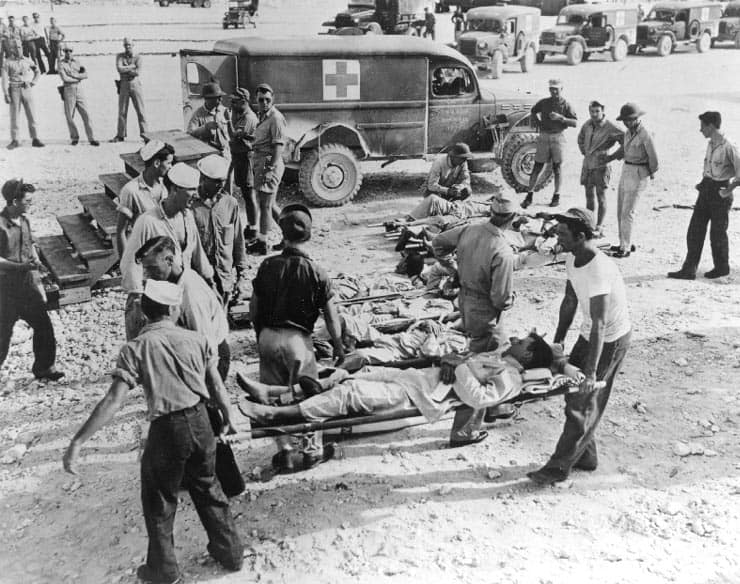
Of 1,195 men aboard, 316 came out of the water. The Navy announced the loss on 15 August 1945 — the day Japan’s surrender was announced — and the worst sea disaster in American naval history was buried under the victory headlines, exactly as someone presumably hoped it would be.
The Captain and the Submariner
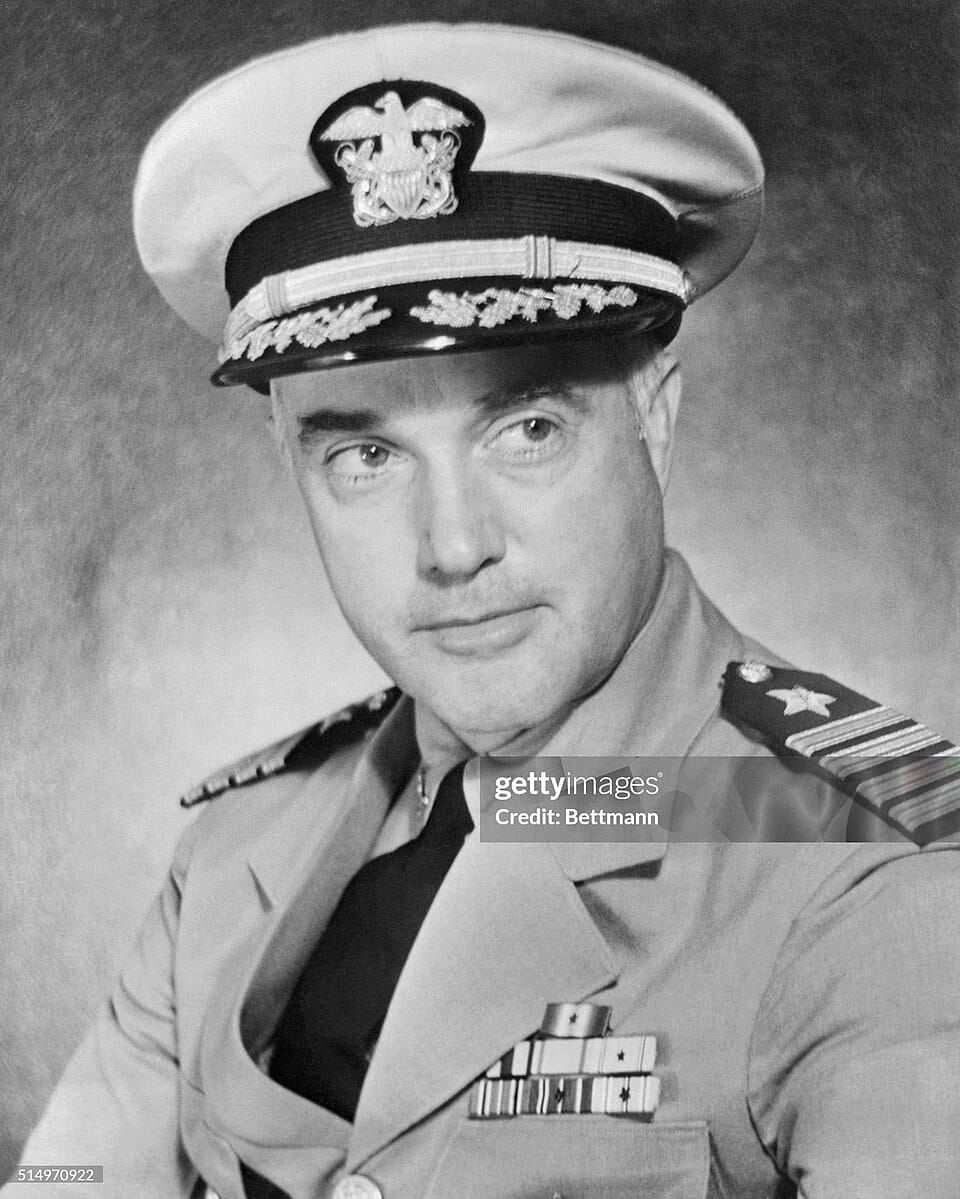
Someone, however, had to answer for it, and the Navy chose the captain. In December 1945 McVay was court-martialed — the only US Navy captain ever court-martialed for losing a ship sunk by an act of war — and convicted of hazarding his ship by failing to zigzag on that moonlit night. The proceeding’s strangest hour came when the Navy flew in Hashimoto himself, the enemy commander who had sunk her, and its own witness undercut the charge: Indianapolis’s course, he indicated, had made no difference — he would have hit her regardless. Nimitz opposed the verdict and had the sentence remitted, and McVay served on to retire as a rear admiral. But the conviction stood, and the hate mail from grieving families never stopped coming. In November 1968, Charles McVay shot himself.
His rehabilitation took a coalition nobody could have invented: his stubborn survivors, who insisted for fifty years that their captain was blameless; an eleven-year-old Florida schoolboy named Hunter Scott, whose 1996 history-fair project — begun after he watched Jaws — assembled testimony from some 150 survivors and landed in front of Congress; and Hashimoto himself, ninety years old and by then a Shinto priest, who wrote to the US Senate in 1999 on behalf of the man he had torpedoed.
In October 2000, Congress declared McVay exonerated; the Navy entered it into his record the following year. Hashimoto had died five days before the resolution passed — the two captains reconciled by history, neither alive to see the paperwork.
TODAY’s exclusive look inside the wreck, filmed by the research vessel Petrel at 5,500 metres.
The Writing on the Bomb
One more thread ties the ship to the weapon she delivered. On Tinian in those early August days, as the assembly teams finished Fat Man — the plutonium bomb bound for Nagasaki — the men who had built and guarded it did something profoundly human: they wrote on it. Photographs preserve a casing covered in roughly sixty chalked and inked names, poems and messages. Physicist Norman Ramsey signed it; so, discreetly on the tail, did weaponeer William Parsons; some technician stencilled on the acronym JANCFU — Joint Army-Navy-Civilian Foul-Up. And Rear Admiral William Purnell, who had overseen the Tinian operation, added the most famous line of all: A Second Kiss for Hirohito.
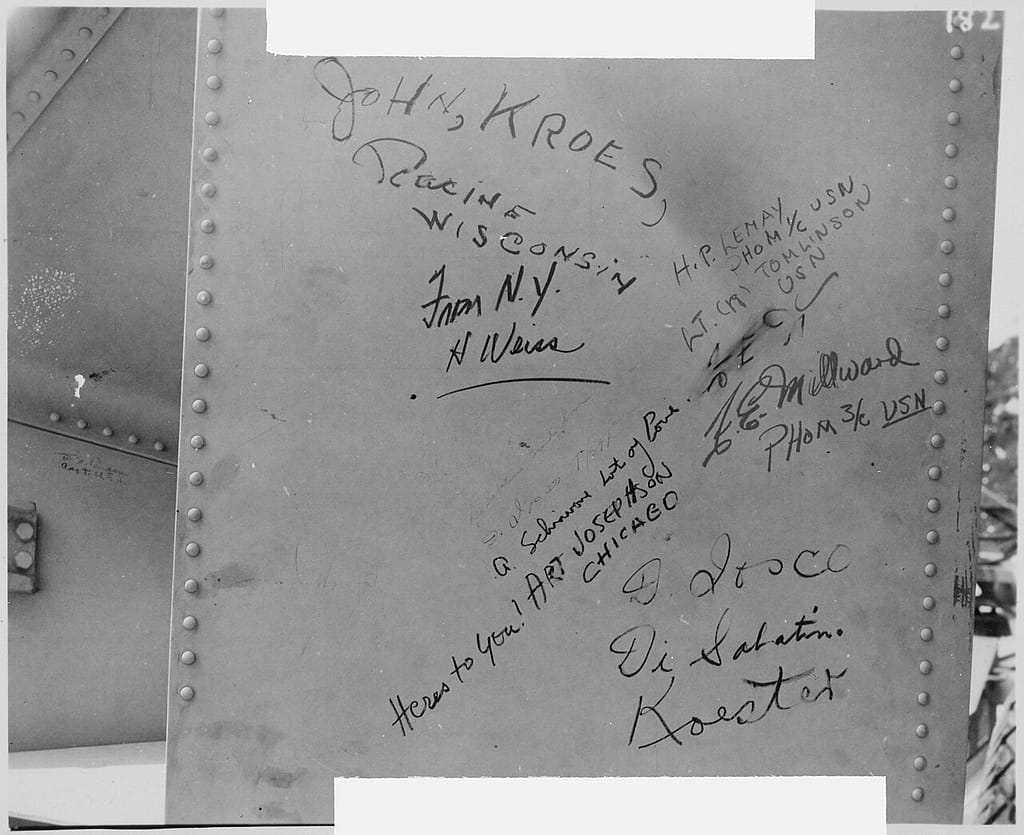
A story has long circulated that one of those messages dedicated the bomb to the boys of the Indianapolis. It would be fitting: by the time the pens came out, Tinian knew what had happened to the ship that had brought the uranium eleven days earlier, and rage and grief were in the air the messages were written in. But honesty obliges us to say that no photograph or archival record has ever confirmed that exact inscription — it lives in retellings, not in the documents. What the record does show is grim enough: the men signing that yellow casing had just lost 879 of the shipmates who made its twin possible, and some of what they wrote, history preserved; the rest, like so much of the Indianapolis story, went unrecorded for decades.
The ship herself was found on 18 August 2017, when Paul Allen’s research vessel Petrel located her 5,500 metres down in the Philippine Sea — deeper than Titanic, her bell and hull number startlingly clear in the ROV lights. She is a protected war grave, 879 men in company. And every few years, when Jaws plays and Quint growls his half-wrong, unforgettable monologue — wrong date, wrong headcount, right ship — a new generation looks up the true story, which needed no embellishment at all.
The moment RV Petrel’s cameras found the ship’s bell, 5,500 metres down.
Sources: Naval History and Heritage Command (loss report, McVay oral history, Setting the Record Straight), US Naval Institute (Dispelling the Myths, 2017), Smithsonian Magazine, BBC (Loel Dean Cox interview), ussindianapolis.com survivors’ organisation, Atomic Heritage Foundation, White Sands Missile Range Museum, National Pacific War Museum, Wikipedia.
Verwandte Artikel – Die Serie „Das Rennen um die Bombe“
Serienübersicht: alle zehn Teile

0 Kommentare