
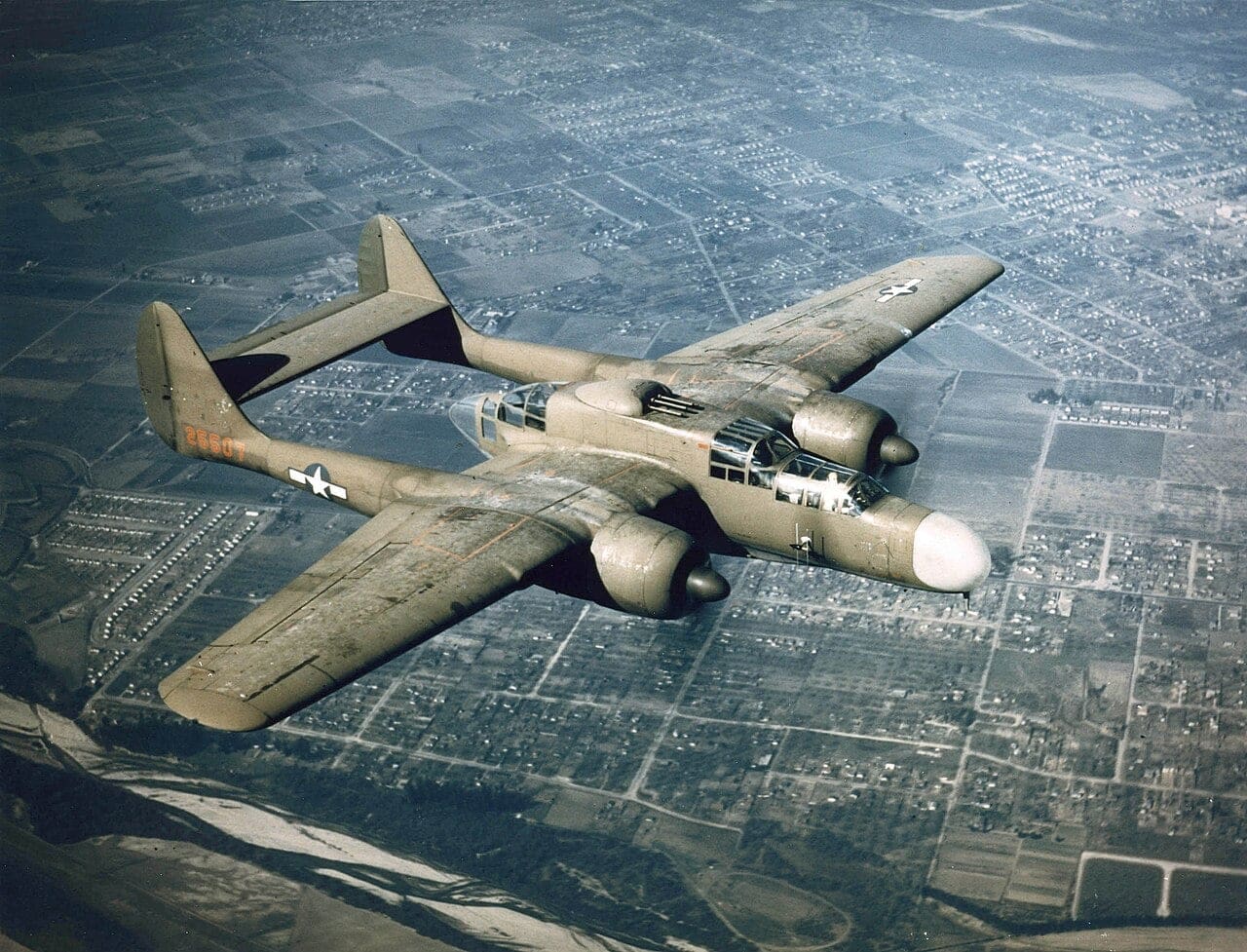
It is past midnight over Saipan, the summer of 1944, and a Japanese bomber crew thinks the darkness is keeping them safe. It isn't. Somewhere below and behind them, a big twin-boomed aircraft is sliding into position, its radar operator murmuring headings, its pilot watching a glowing scope instead of the sky. The enemy crew never see it. The first thing they know of the P-61 Black Widow is the four 20mm cannon opening up from close range.
The Black Widow was something genuinely new: the first American aircraft designed from a blank sheet of paper to hunt at night, built around its radar rather than having one bolted on as an afterthought. In barely a year of combat it earned a reputation that spooked Japanese and Luftwaffe night crews alike — and it bowed out of the war with one of aviation's strangest records.
Kurzinfo
- Typ: Northrop P-61 Black Widow, radar-equipped night fighter
- Erster Flug: prototype XP-61, 26 May 1942; combat from June 1944
- Crew: three - pilot, radar operator, and (in most) a gunner
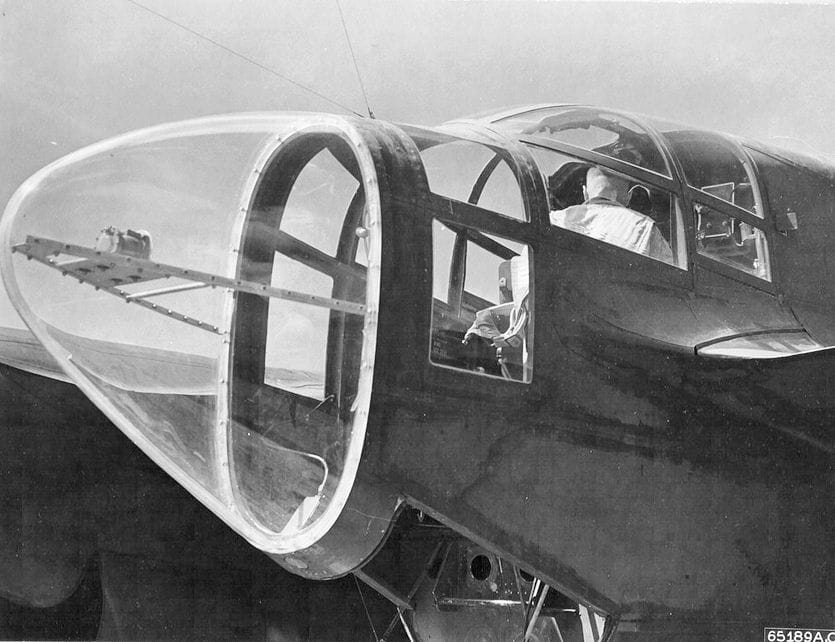
- Radar: SCR-720 airborne-intercept set in the nose
- Rüstung: four 20 mm cannon in the belly; four .50-cal in a remote dorsal turret
- Motoren: two Pratt & Whitney R-2800 Double Wasp radials
- Aufzeichnen: ~127 enemy aircraft and 18 V-1 flying bombs destroyed; about 706 built
Built around a radar, not a gun
When the United States entered the war in December 1941, Britain and Germany had already learned a brutal lesson: bombing by day was so costly that the war had moved into the dark, and whoever owned the night owned the sky. The Americans wanted an aircraft built for that world from the start. Northrop won the contract, and Jack Northrop's team designed the P-61 around the bulky SCR-720 airborne-intercept radar and the dedicated operator needed to work it.
The result was huge for a fighter — a twin-boom, twin-engine machine the size of a medium bomber, powered by two of the same Pratt & Whitney R-2800 radials that hauled the Corsair and Thunderbolt. It bristled with four 20 mm cannon in its belly and, in most examples, four .50-caliber machine guns in a remotely-aimed turret on its back. It carried a crew of three and it was painted, fittingly, gloss black.
First blood over Saipan
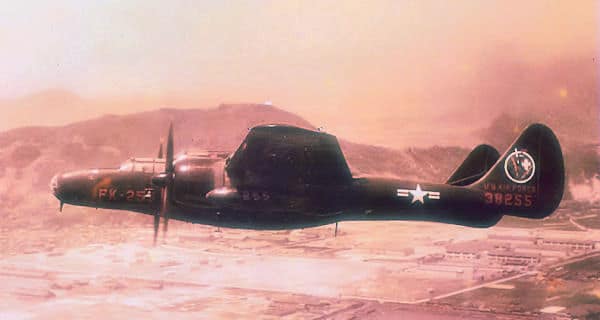
The 6th Night Fighter Squadron got the first Widows and took them to Saipan, an island raided almost nightly by Japanese bombers. On 30 June 1944, days after going operational, Lieutenant Dale Haberman and his radar operator Lieutenant Ray Mooney — flying a P-61A named Moonhappy — caught a Mitsubishi "Betty" bomber and its escort, and scored the type's first kill in the Pacific. The whole duel went out over the radio, and a crowd gathered back at base to listen.
By Christmas night 1944, with the Japanese hurling raiders at Saipan, Moonhappy's crew ran up a double.
Killing at night was a strange, instrument-bound kind of combat: the enemy was a blip and then, for a few seconds at knife-fight range, a real aircraft caught in the moonlight before it burned. The Widow's crews got very good at it.
The last kills of the war - without firing a shot
The strangest chapter belongs to a Widow of the 548th Night Fighter Squadron called Lady in the Dark, one of the most photographed Black Widows of the Pacific. Its assigned pilot was Captain Lee Kendall, and at the very end of the war Lady was credited with the final two aerial victories of the Second World War — both scored without firing a single round.
On the night of 14 August 1945 a fleeing Japanese fighter simply flew into the sea during a low-level chase. The next evening, with the war technically over but kamikaze raids still feared, Kendall hunted down another intruder — a Nakajima Ki-44 "Tojo" — that was throwing out radar-jamming chaff and jinking hard.
The Tojo went into the ground and scattered across a wide area. Because the war had already ended, it was never logged as an official kill — but a black-painted night fighter had, in effect, closed out the air war without touching its triggers.
A short career, a long shadow
The Widow's front-line life was brief. In roughly a year of combat it was credited with about 127 enemy aircraft and 18 V-1 flying bombs, and only around 706 were ever built. The jet age arrived almost immediately, and the big piston night fighter was retired fast.
But the idea outlived the airframe. A large, radar-carrying aircraft flown by a crew that fought by their scopes rather than their eyes was the direct ancestor of every radar-guided all-weather interceptor that followed — the line that runs, eventually, to aircraft like the F-14. The Black Widow was first to prove that in the dark, the machine that sees best wins.
Sources: Aviation History magazine / HistoryNet (Warren E. Thompson), Smithsonian National Air and Space Museum, The National Interest, 19FortyFive. Pilot quotes as published in Aviation History.
0 Kommentare