
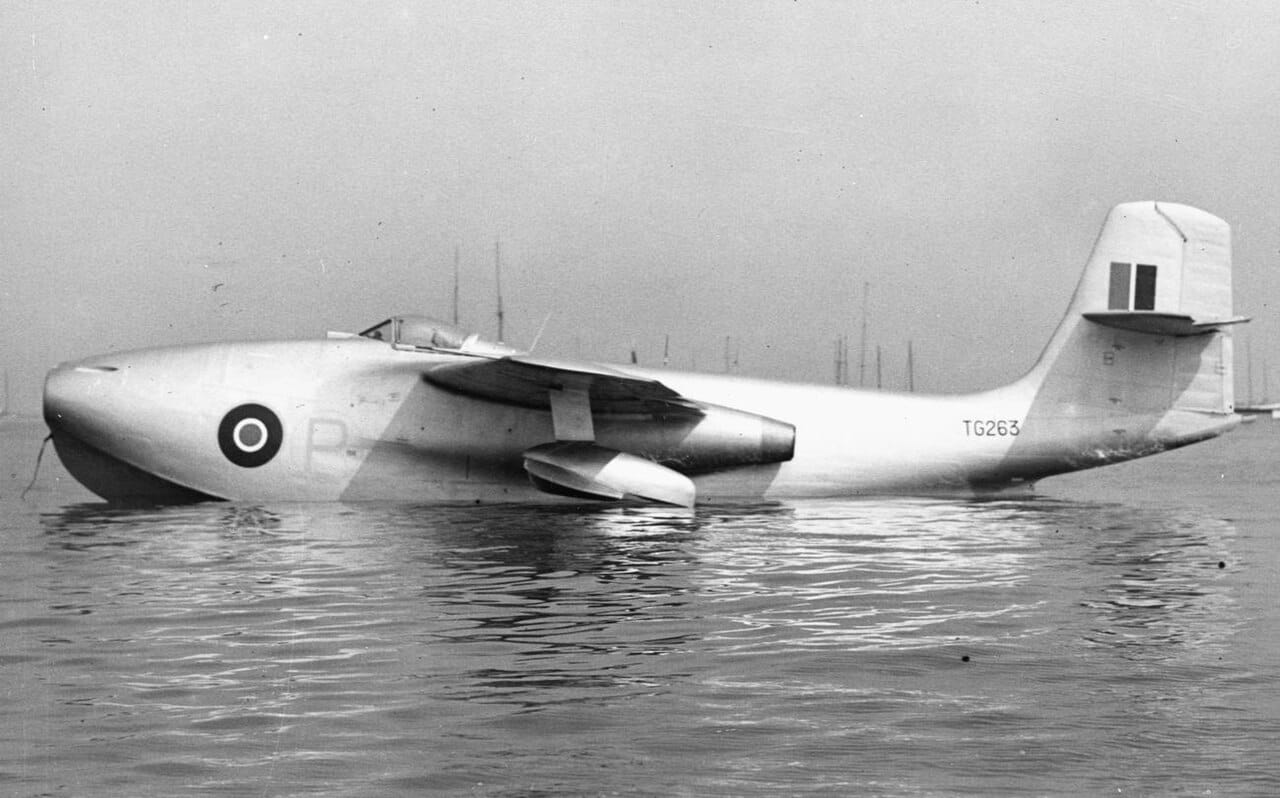
In 1943, someone at Saunders-Roe looked at the vast, airfield-free emptiness of the Pacific and had a gloriously contrary idea: what if your fighter did not need a runway at all? What if it just landed on the sea?
The result was the SR.A/1 — the first jet-powered water-based aircraft in the world, and very nearly the last. A stubby little flying boat with two turbojets buried in its hull, it could turn any sheltered stretch of coast into an airbase. Its own workers called it the “Squirt,” which tells you roughly how much reverence it commanded.
It flew beautifully, was thrown around Farnborough upside down, killed one of its pilots, nearly drowned another, and was then quietly overtaken by history. This is aviation’s great “what if” that floated.
Kurzinfo
| Typ | Single-seat experimental jet flying-boat fighter (prototype) |
| Herkunft | Saunders-Roe (Saro), Cowes, Isle of Wight |
| Erster Flug | 16 July 1947 — test pilot Geoffrey Tyson |
| Kraftwerk | Two Metropolitan-Vickers Beryl turbojets, ~3,850 lbf each |
| Performance | Max ~512 mph (824 km/h) |
| Built / fate | 3 prototypes; two lost in 1949 accidents; TG263 preserved at Solent Sky |
A fighter born from an ocean with no airfields
The idea sounds mad until you look at a map of the Pacific. Airfields were scarce, usually held by the enemy, and taking one cost lives by the thousand. The Japanese had already shown what a floatplane fighter could do, turning quiet anchorages into instant airbases. The catch was always performance: all those floats and struts were an aerodynamic ball and chain.
Saunders-Roe, a Cowes firm that lived and breathed flying boats, spotted the loophole. The new turbojet had no propeller to keep clear of the water, which meant a designer could ditch the ungainly pontoons and give the aircraft a proper low-slung flying-boat hull. Suddenly a water-based fighter might match — even beat — its land-bound rivals, while staging from lagoons closer to the fight than any runway could manage.
The Air Ministry bit, ordering three prototypes in 1944. The aircraft was meant for the war against Japan. But by the time the design was maturing, that war had inconveniently ended, and Saunders-Roe’s attention had drifted to its enormous Princess airliner. The Squirt slipped quietly behind schedule.
Flying the Squirt
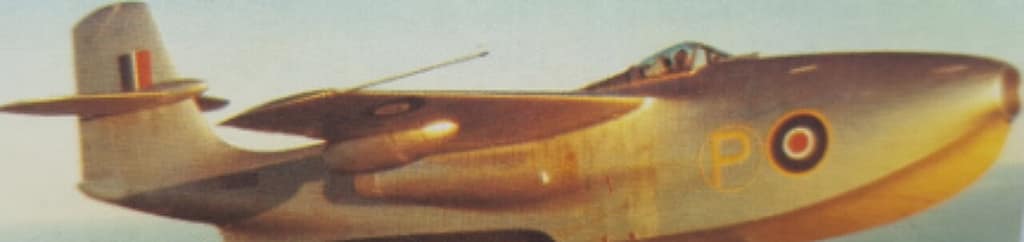
On 16 July 1947, chief test pilot Geoffrey Tyson lifted the first prototype off the water for its maiden flight. Twin Metropolitan-Vickers Beryl turbojets sat side by side in the hull, gulping air through a single high-set nose intake designed to keep the sea out. Retractable wing floats tucked away in flight to cut drag.
And it was, by the standards of a flying brick with fuel tanks, rather good. Handling and performance both impressed, topping out around 512 mph. The cockpit view was frankly awful — a small, heavily framed canopy — but in the air the Squirt was nimble. Tyson made the point emphatically at the 1948 Farnborough display, hauling the jet flying boat through low-level inverted passes in front of an international crowd. A flying boat, upside down, at nought feet. It remains one of the great Farnborough party tricks.
It was never armed in anger. On paper it was to carry four 20 mm cannon, but this was an experimental aircraft proving a concept, not a squadron machine. Two of the prototypes did carry a genuine first, though: among the earliest Martin-Baker ejection seats ever built.
Beaten by carriers, killed by a log and a roll
The trouble with a brilliant answer is that the question can change. By the late 1940s the aircraft carrier had proved a devastatingly effective way to project air power across oceans, and land-based jets were stretching their legs. A specialised seaplane fighter, needing tenders and support ships of its own, was an expensive solution to a problem that was quietly evaporating.
Then came 1949. On 12 August, Eric “Winkle” Brown took one prototype up; on landing in the Solent, submerged debris holed the hull and tore off a float. The aircraft cartwheeled and sank, and Brown was hauled unconscious from the wreck, saved by Geoffrey Tyson, who dived from the launch to reach him. Five weeks later a second prototype was lost off Felixstowe during low-level aerobatics, and its pilot, Squadron Leader Kenneth Major, was killed. Two of the three prototypes were gone.
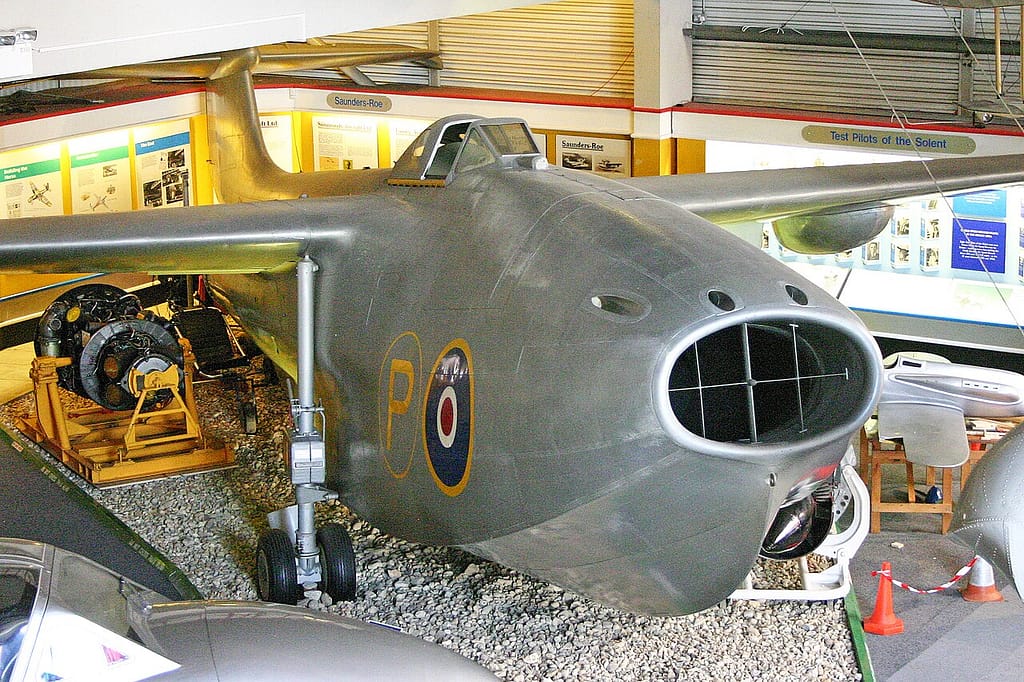
There was a fundamental problem quite apart from the crashes: Metropolitan-Vickers had abandoned jet-engine development, so the Beryl was out of production — no engine, no aeroplane. The Korean War briefly revived interest in 1950, and the data was even shared with the Americans, but the concept was now plainly obsolete. The Squirt flew for the last time in 1951. Today, sole survivor TG263 sits at Solent Sky in Southampton — the only jet flying-boat fighter the world ever built, just across the water from where it was born.
Sources: Wikipedia (Saunders-Roe SR.A/1; Eric Brown); Solent Sky Museum; Robert Craig Johnson, Chandelle (1996); Flight archive.

0 Kommentare