
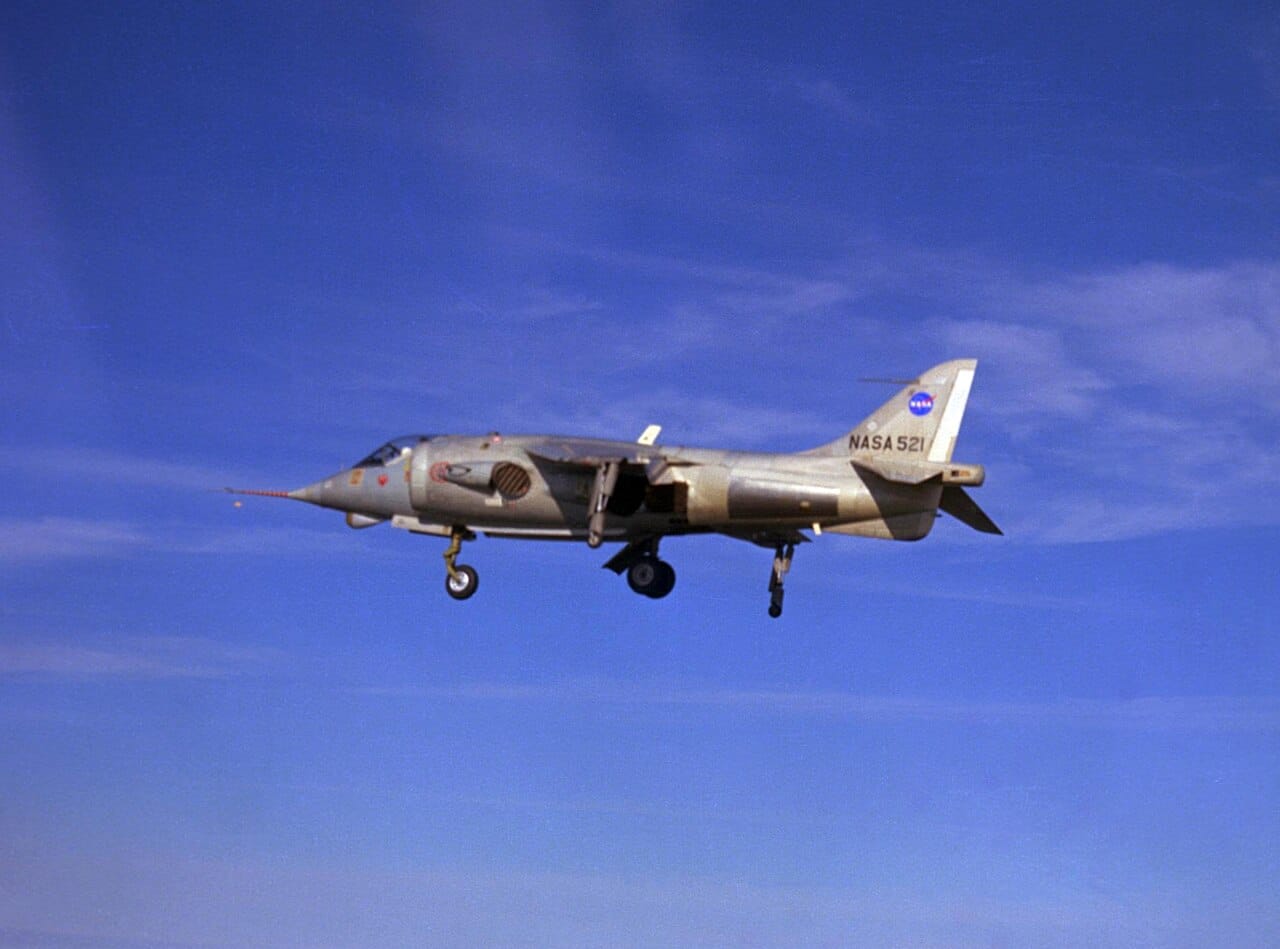
Every elegant aircraft has an ungainly predecessor. Before the Hawker Siddeley Harrier hovered over Falklands task forces and Marine Corps flight decks, there was the Hawker P.1127: a stubby, bug-eyed prototype that looked less like a fighter than an experiment that had escaped the laboratory. It was precisely that.
The problem it set out to solve was brutally simple to state and fiendishly hard to engineer. A jet fighter needs a runway, and runways are the first thing an enemy destroys. Could a high-performance jet instead rise straight up, on nothing but its own thrust, and set down again in a clearing? In the late 1950s almost no one believed it could be done with a single engine and a single pilot.
The P.1127 proved it could. What follows is the story of the engine that made it possible, the test pilot who balanced it on a column of hot gas with his leg in plaster, and the direct line from this awkward machine to the first operational jump jet in service.
Kurzinfo
| Typ | Experimental V/STOL strike aircraft (prototype) |
| Kraftwerk | Bristol Siddeley Pegasus vectored-thrust turbofan (four rotating nozzles) |
| First tethered hover | 21 October 1960, Dunsfold, pilot Bill Bedford |
| First carrier landing | HMS Ark Royal, 8 February 1963 (first jet vertical landing at sea) |
| Evaluation variant | Kestrel FGA.1 — nine built; Tripartite Squadron UK/US/West Germany, 1965 |
| Direct descendant | Hawker Siddeley Harrier — first operational VTOL jet fighter |
The engine was the aircraft
The P.1127 is often described as a triumph of airframe design. It was not. It was a triumph of propulsion, wrapped in the minimum airframe needed to carry it. The enabling technology was the Bristol Siddeley Pegasus, a vectored-thrust turbofan whose principle is best understood as controlled redirection: four nozzles, two forward carrying cool fan air and two aft carrying hot exhaust, all rotating together through nearly a right angle. Point them down, and the aircraft rises. Point them back, and it flies. The transition between the two is simply a matter of turning them.
The concept traced to the French designer Michel Wibault. Bristol’s engineer Gordon Lewis, working under technical director Stanley Hooker, judged Wibault’s engine hopelessly heavy and reworked it around existing components. The airframe side belonged to Hawker: designer Ralph Hooper laid out the aircraft around the engine, and the veteran Sydney Camm oversaw it with characteristic insistence on simplicity.
Bedford’s tethered leap
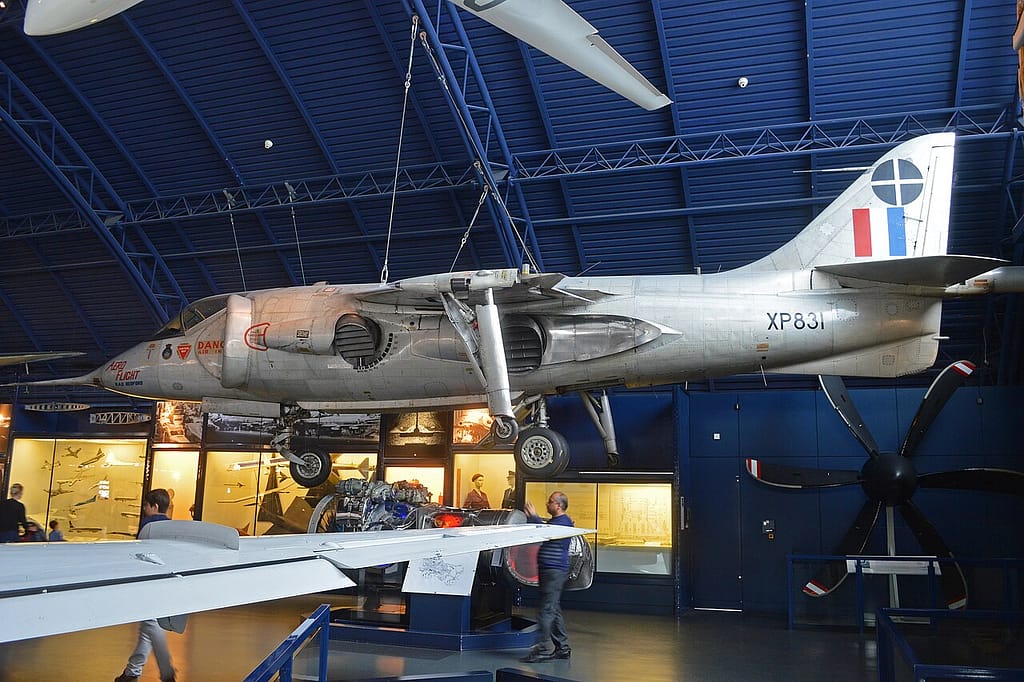
On 21 October 1960 at Dunsfold, test pilot Bill Bedford lifted the first prototype a few feet into the air, tethered inside a wire rig so the machine could not wander or flip. He did so with one leg in plaster, having broken it in a motoring accident shortly before — a detail so improbable that it has followed the aircraft ever since.
The tether came off on 19 November 1960: the first free hover, a jet balanced on its own downward-pointed exhaust with reaction jets at the nose, tail and wingtips holding it steady where wings and rudder were useless. Conventional flight followed on 13 February 1961, and the crucial full transition from hover to wing-borne flight and back on 8 September 1961. Engineers had feared this moment; in practice it proved almost undramatic, a slow nudge of the nozzle lever.
Not everything was undramatic. At the 1963 Paris Air Show, a speck of dirt jammed the nozzle control and a prototype struck the ground hard; the pilot walked away and the aircraft was rebuilt. Earlier that same year, on 8 February 1963, Bedford had achieved the opposite of embarrassment — the first vertical landing by a fixed-wing jet onto a carrier at sea, aboard HMS Ark Royal.
From Kestrel to Harrier
The development batch fed directly into a refined machine: the Kestrel FGA.1, with fully swept wings, a taller tail and a more powerful Pegasus. Nine were built. Their purpose was not combat but assessment, and in 1964 they equipped a genuinely unusual unit: the Tripartite Evaluation Squadron, crewed by military pilots from Britain, the United States and West Germany, testing whether V/STOL could work from rough field sites.
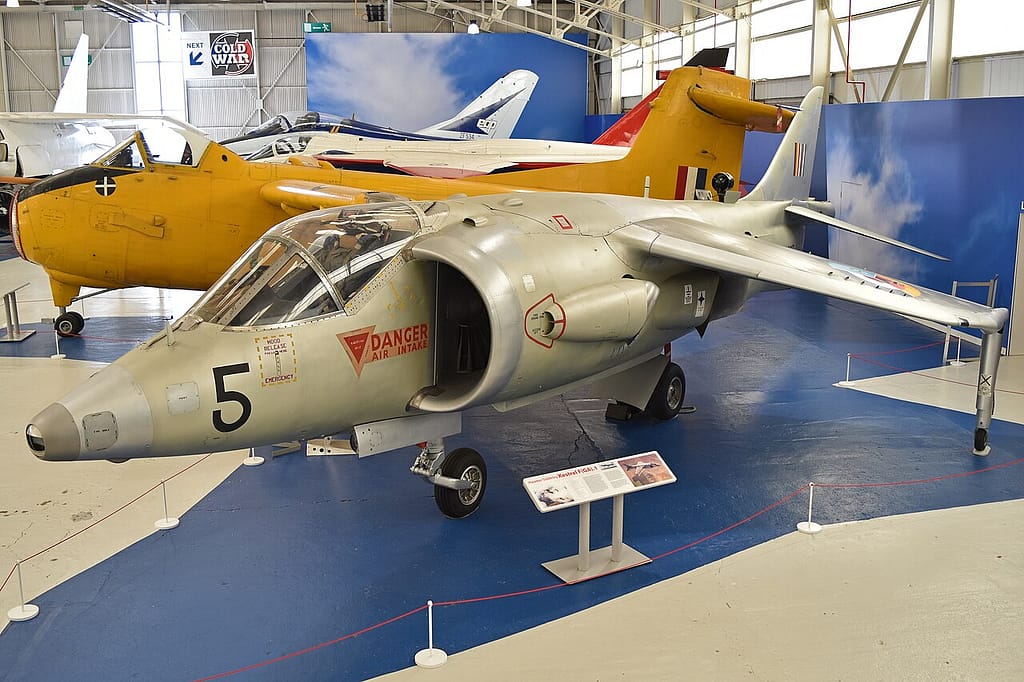
It could. The pilots settled on a signature technique — short take-off, vertical landing — that remains the Harrier’s operating logic to this day. The lineage from there is direct and unbroken. With the supersonic P.1154 cancelled in 1965, the RAF ordered a Kestrel-derived development aircraft that first flew in 1966 and entered production as the Harrier GR.1 — the world’s first operational VTOL jet fighter. The awkward prototype had become the template.
Sources: Wikipedia (Hawker Siddeley P.1127; Bristol Siddeley Pegasus); Francis K. Mason, The Hawker P.1127 and Kestrel; Imperial War Museums; Brooklands Museum.
0 Kommentare