

On 14 August 2026 the Russian state news agency TASS reported that the two-seat Su-57D will be used to test combat artificial intelligence under development at the Sukhoi Design Bureau. The source was Mikhail Strelets, the bureau’s director, speaking on the Zvezda television programme Military Acceptance.
That sentence deserves to be read carefully, because it contains a claim, a claimant, and a broadcaster, and all three belong to the same state.
What is genuinely verifiable is narrower, and still interesting: Russia has built a two-seat stealth fighter, flown it, and says its second cockpit exists to command drones.
Kurzinfo
| Flugzeug | Su-57D, two-seat derivative of the Su-57 (NATO: Felon) |
| Maiden flight | 19 May 2026, Komsomolsk-on-Amur (KnAAZ); approx. 40 minutes |
| Pilot | Sergei Bogdan, Sukhoi chief test pilot |
| Airframe | A converted early T-50 prototype |
| Stated roles | Combat training, airborne strike coordination, control of unmanned combat aircraft |
| Claimed AI role | Testbed for combat AI under development at Sukhoi (Russian state media claim) |
| Intended to control | S-70 Okhotnik-B heavy UCAV, and “swarm or group systems” |
| Patent filed | November 2023, by United Aircraft Corporation |
| Su-57 fleet | Estimated 30–40 airframes including prototypes; 2019 contract nominally covers 76 by 2027 |
| Motoren | Still AL-41F1; the second-stage Izdeliye 30 remains in development |
The One Quote That Is On the Record
Everything else attributed to Strelets in the coverage — the combat AI, the swarms, the Okhotnik — was reported by TASS in paraphrase, not in quotation marks. No architecture, no autonomy level, no timeline and no decision authority has been disclosed. Army Recognition, which covered the story at length, was blunt that this should be viewed as a development objective rather than a demonstrated capability.
A note on names, because a wrong one is circulating widely: TASS says Mikhail Strelets. A viral social media post rendered it “Sergey” Strelets, and several aggregators copied the error. Sergei Bogdan is the test pilot, not the bureau director.
What Actually Flew
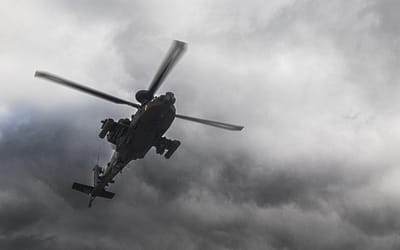
The Su-57D made its first flight on 19 May 2026 from the Komsomolsk-on-Amur plant, after taxi trials on 16 May. The flight lasted around 40 minutes with Sergei Bogdan at the controls. The airframe is a converted early T-50 prototype, though sources disagree on which one: some point to T-50-4, others to an airframe damaged in a 2014 engine fire.
The layout is a tandem two-seat cockpit under an elongated canopy, the rear seat raised above the front, on an otherwise standard Su-57 airframe. United Aircraft Corporation registered a patent covering exactly this concept — a twin-seat Su-57 optimised for UAV coordination and airborne command — in November 2023. Under thirty months from patent to first flight is quick by any standard.

Russian First Deputy Prime Minister Denis Manturov has given the aircraft three jobs: combat training, coordinating airborne strikes, and commanding unmanned combat aircraft. The third is the one everybody cares about.
The Problem With the Plan
Russia is not wrong about the concept. China flies the two-seat J-20S for the same reason. The United States is pursuing the same end through Collaborative Combat Aircraft rather than a second crew member. Putting a dedicated operator in the back of a stealth fighter to run a drone formation is a serious idea.
The problem is everything underneath it. The Su-57 fleet is small — estimates cluster around 30 to 40 airframes including prototypes, against a 2019 contract for 76 by 2027 that essentially nobody believes will be met. The aircraft still flies on the interim AL-41F1 engine; the definitive Izdeliye 30 has been in development for years. The S-70 Okhotnik it is meant to command has been in joint testing with Su-57 prototypes since 2019 without entering series service.
Adapting an existing airframe rather than designing a clean-sheet sixth-generation fighter is a rational response to sanctions and industrial limits. It is also an admission of them.
Russia has flown the aeroplane. Whether it can build the artificial intelligence, the drones, the engines and the fleet to put behind it is a different question, and one that a television appearance does not answer.
Sources: TASS, 14 August 2026; Army Recognition, 18 August, 28 May and 21 May 2026; Militarnyi, 15 August 2026. Claims regarding combat AI capability originate with Russian state media and have not been independently verified.


0 Kommentare