
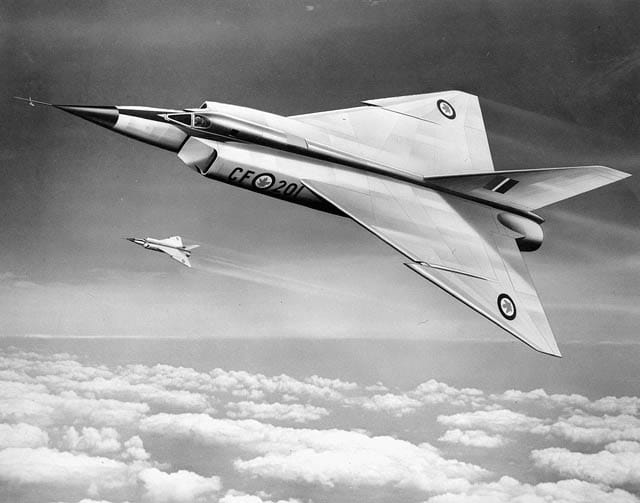
On February 20, 1959 — a day Canadians still call "Black Friday" — Prime Minister John Diefenbaker cancelled the most advanced interceptor on the planet, fired 14,500 people, and ordered every prototype destroyed. Then, for good measure, he had the blueprints shredded.
The Avro Arrow remains Canada's great aviation what-if — a Mach 2 superfighter killed by politics, missiles, and spectacularly bad timing.
Quick Facts
- Aircraft: Avro Canada CF-105 Arrow
- Type: Delta-wing supersonic interceptor
- First flight: 25 March 1958
- Top speed: Mach 1.96 (achieved in testing)
- Chief test pilot: Janusz Zurakowski
- Cancelled: 20 February 1959 (“Black Friday”)
- Jobs lost: ~14,500 at Avro Canada
Built for the Bomber Threat
In the early 1950s, Canada sat directly beneath the polar route from the Soviet Union to North America. Soviet long-range bombers — the Tu-95 Bear, the Myasishchev M-4 Bison — would cross the Arctic and descend on Canadian and American cities. Ottawa needed an interceptor that could reach Mach 2 and 50,000 feet to engage those bombers as far north as possible.
Avro Canada's CF-105 Arrow was the answer. A two-seat delta-wing interceptor spanning 50 feet, it was powered initially by Pratt & Whitney J75s, with plans to switch to the domestically designed Orenda PS.13 Iroquois — a monster producing 26,000 pounds of thrust with afterburner. It carried weapons internally, in a bay that showcased the delta wing's massive internal volume. In testing, it reached Mach 1.96 with the interim engines. The Iroquois-powered Mk.2 was expected to exceed Mach 2 comfortably.
Black Friday
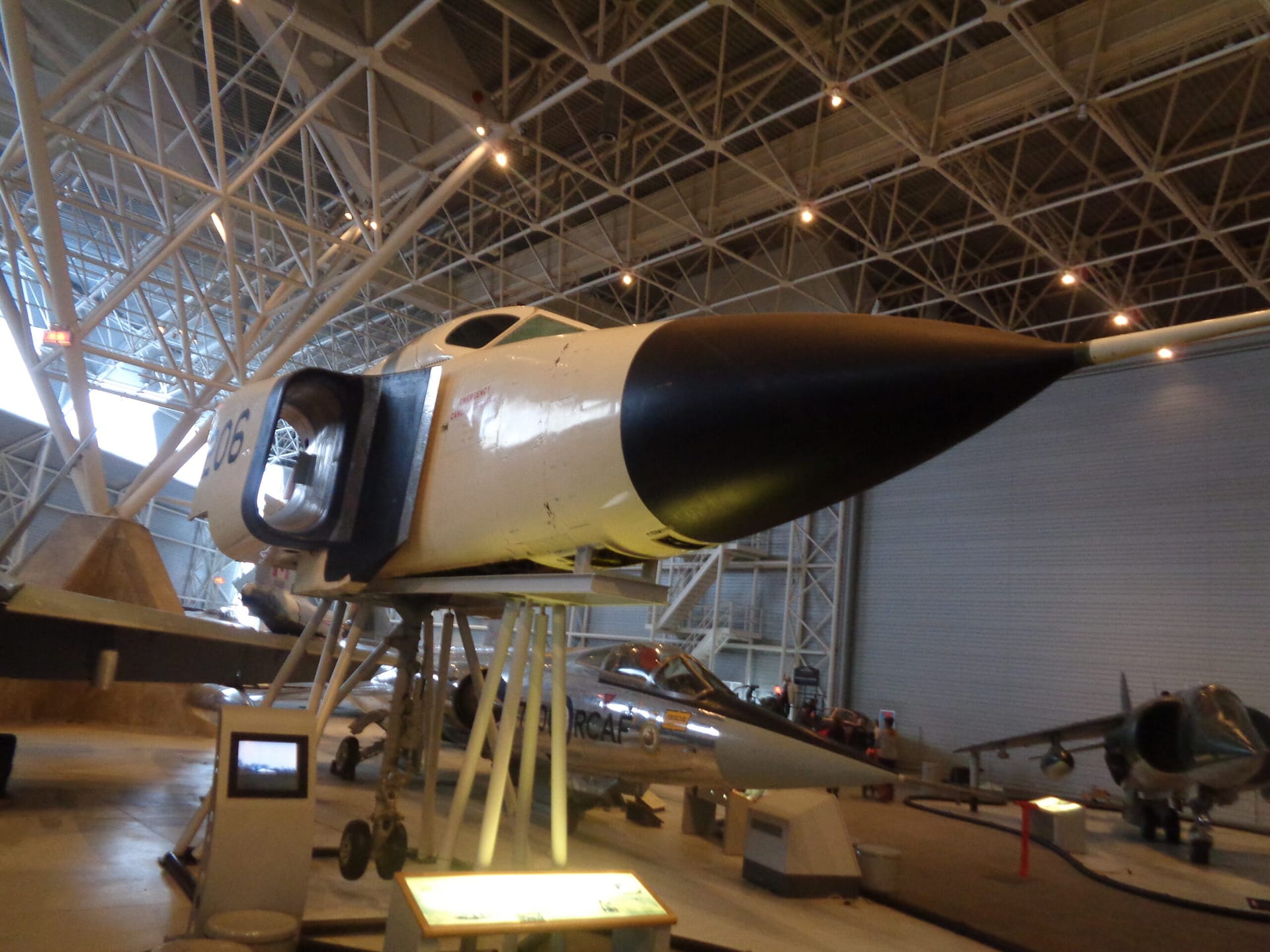
Diefenbaker killed the Arrow on February 20, 1959, citing $1.1 billion in total costs and arguing that missiles — specifically the CIM-10 Bomarc surface-to-air missile — could do the job more cheaply. The 14,500 Avro employees who lost their jobs that day were joined by another 15,000 at 650 subcontractors across Canada.
Then came the destruction order. All five completed aircraft, all components including the Iroquois engines, all blueprints, drawings, and nearly all technical data were cut up for scrap. The thoroughness was methodical and, to many Canadians, unforgivable.
Canada's Loss, the Moon's Gain
Jim Chamberlin led a group of 25 Avro engineers who joined NASA's Space Task Group after the cancellation. The group eventually grew to 32 — collectively known as the "Avro Group." Chamberlin was instrumental in proposing Lunar Orbit Rendezvous as the mission mode for Apollo — the method ultimately used to reach the Moon. Owen Maynard, a former Avro stress engineer, became the primary designer of the Apollo Lunar Module.
Canada killed its greatest fighter. Thirty-two of its best engineers went to NASA and helped put men on the Moon.
The Treasure Hunt
Before the Arrow flew, Avro launched nine 1/8-scale free-flight test models over Lake Ontario. In 2017, the "Raise the Arrow" expedition found one on the lake bottom near Kingston. It was recovered in 2018, and it is now on display at the Canada Aviation and Space Museum. In 2020 the project located fragments of a second model before the search wound down.
Sixty-seven years after Black Friday, Canadians are still diving into Lake Ontario looking for pieces of the dream their government destroyed. The Bomarc missiles that replaced the Arrow were useless. The Soviet bomber threat was real but evolved into ICBMs anyway. And the most advanced interceptor of its era ended its life under a cutting torch.
Some cancellations become footnotes. This one became a national wound.
Sources: Canada Aviation and Space Museum, RCI, Ingenium Canada, Military History Now, Wikipedia
Related Questions
What was the Avro Arrow?
The Avro Canada CF-105 Arrow was an advanced Canadian delta-wing supersonic interceptor of the late 1950s. Capable of around Mach 2, it was one of the most sophisticated aircraft of its era — yet the entire programme was abruptly cancelled and the aircraft destroyed.
How fast was the Avro Arrow?
The Arrow reached Mach 1.96 in testing and was designed to fly even faster. That performance, combined with its advanced electronics, made it a genuine world-class interceptor for the late 1950s.
Why was the Avro Arrow cancelled?
The programme was cancelled on 20 February 1959 — remembered as Black Friday — amid soaring costs, a shift toward anti-bomber missiles, and political pressure. The decision cost about 14,500 jobs at Avro Canada and effectively ended the country's advanced fighter industry.
Why was the Avro Arrow built?
In the early 1950s Canada lay directly under the polar route Soviet bombers would take to North America. The Arrow was designed as a fast, high-flying interceptor to catch long-range bombers like the Tu-95 Bear far out over the Arctic.
What happened to the Avro Arrows?
After cancellation, the completed aircraft, prototypes and tooling were ordered destroyed, with the airframes cut up for scrap. The destruction of such an advanced design has made the Arrow a lasting symbol of lost potential in Canadian history.
Related Posts
Horten Ho 229: The Nazi Flying Wing
0 Kommentare