
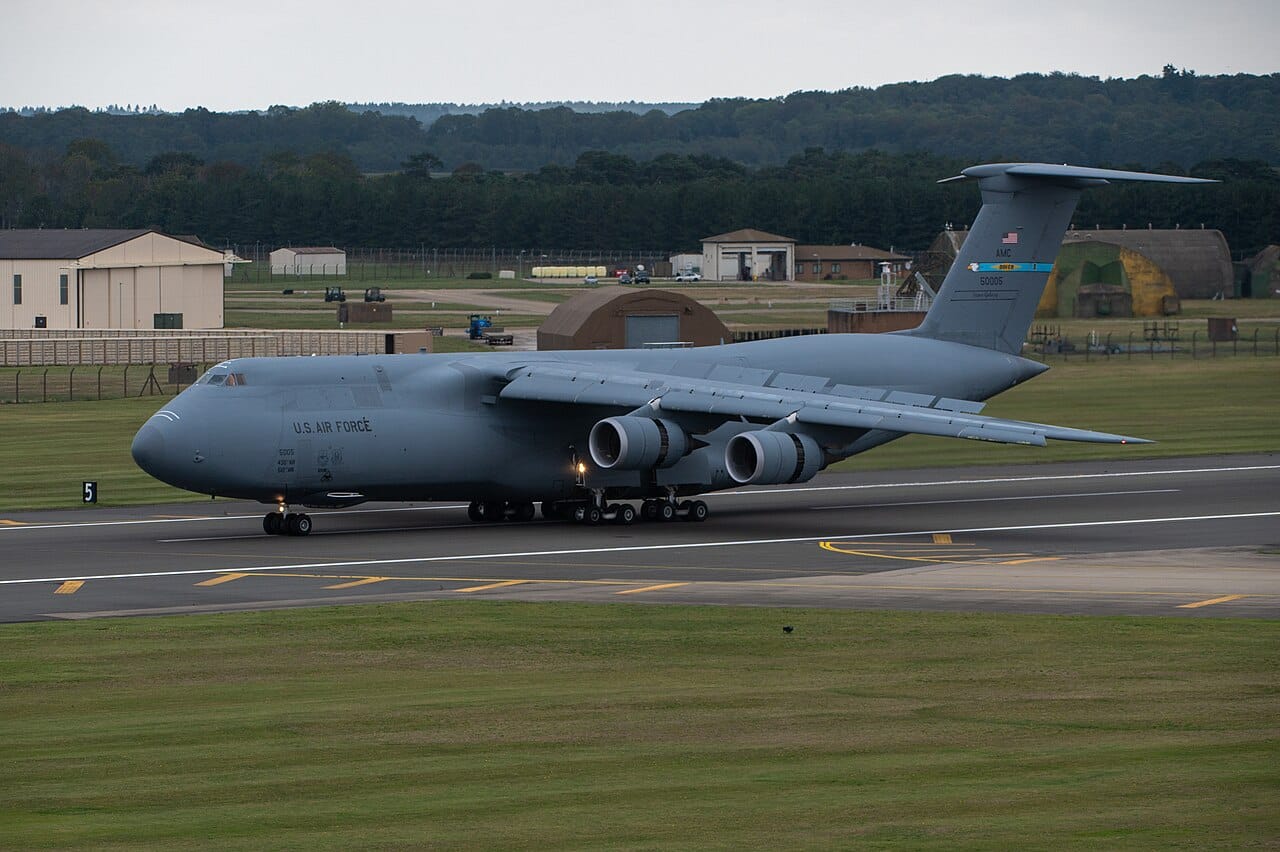
When the An-225 Mriya was destroyed in 2022, the world lost its single largest aircraft. But the West still keeps a giant of its own in the air — one that has been hauling tanks, helicopters and satellites around the planet since before the Moon landings, and is scheduled to keep doing it into the 2040s. It is the Lockheed C-5, and in its modern form it is called the Super Galaxy.
A cathedral with wings
Numbers only get you so far with the Galaxy, so try this one: its cargo hold is around 37 metres long — longer than the entire distance the Wright brothers covered on their first powered flight. You do not load a C-5 so much as drive into it. The nose hinges upward like a giant visor and a ramp drops at the tail, so vehicles can be driven straight through from front to back. Inside, it can swallow two M1 Abrams main battle tanks, six attack helicopters, or outsize loads that fit in nothing else in the American inventory. It rolls on a 28-wheel main landing gear that can “kneel” to bring the floor closer to the ground.
With a wingspan of 67.9 metres and a maximum take-off weight of 840,000 lb (around 381 tonnes), the C-5 is one of the largest military aircraft ever built — second in the West only to the giant Antonovs it was often mentioned alongside.
Born in the 1960s
The Galaxy came out of the US Air Force's CX-HLS heavy-lift requirement of the 1960s — the same programme whose losing airliner concept helped shape the Boeing 747. Lockheed won the military contract, and the first C-5A rolled out in 1968 and made its maiden flight on 30 June 1968. It entered service in 1970 and went straight to work supporting operations in Vietnam, then spent the Cold War as America's strategic-airlift muscle: the aircraft that could put an army's worth of heavy equipment on another continent in days.
The Super Galaxy upgrade
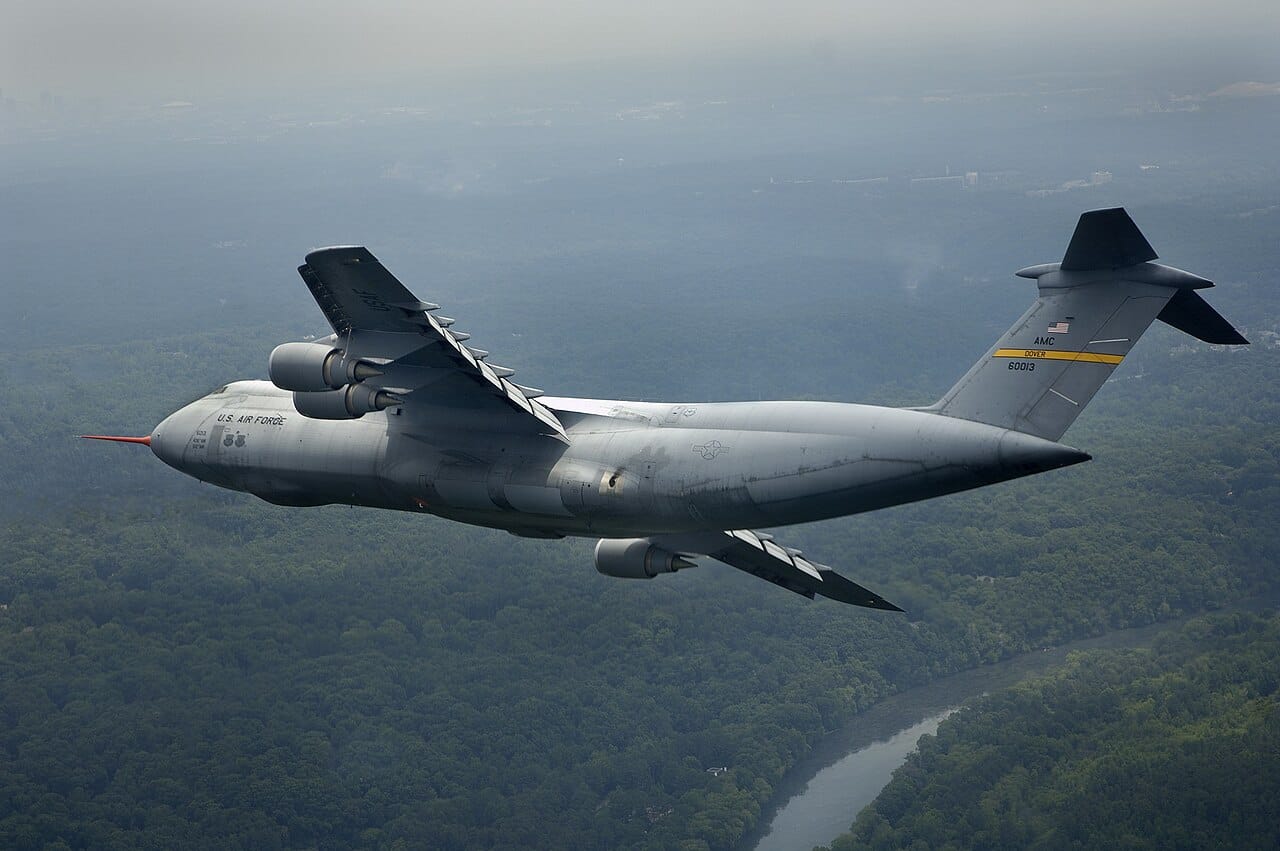
By the 2000s the airframes were sound but the systems and engines were dated. Rather than retire the fleet, the Air Force rebuilt it. The C-5M Super Galaxy programme fitted new General Electric F138 (CF6-derived) engines — each producing about 50,000 lb of thrust, roughly 22% more than the originals — along with modernised avionics, cockpit and dozens of other systems. The payoff was dramatic: about a 30% shorter take-off roll and a far steeper climb, letting the fully loaded giant get airborne from shorter runways and reach altitude faster. Every one of the surviving aircraft — 49 C-5Bs, 2 C-5Cs and one C-5A — had been converted to C-5M standard by August 2018.
Still flying
Today the Super Galaxy remains a backbone of US global reach, moving outsize cargo from hubs such as Ramstein Air Base in Germany to wherever it is needed. With the modernisation, the type is projected to serve into the 2040s — meaning some C-5 airframes will have flown for the better part of eighty years.
The Mriya and the Galaxy were the two great giants of the airlift age. One is gone. The other, older and re-engined and stubbornly useful, is still out there — the largest aircraft most people will ever stand next to, and one that shows no sign of stopping. For the story of the one that got away, see our piece on the An-225 Mriya.
Related Questions
What is the Lockheed C-5 Galaxy?
The Lockheed C-5 Galaxy is a strategic airlifter and one of the largest aircraft ever built. Its cargo hold is around 37 metres long, loaded through a nose that hinges upward and a tail ramp so vehicles drive straight through. It can carry two M1 Abrams tanks, six attack helicopters, or outsize loads that fit in nothing else in the US inventory.
What is the C-5M Super Galaxy?
The C-5M Super Galaxy is the modernised version of the Lockheed C-5. Rather than retire the fleet, the US Air Force re-engined it with General Electric F138 engines producing about 50,000 lb of thrust each, roughly 22% more than the originals, plus new avionics and cockpit. The upgrade delivered about a 30% shorter take-off roll and a much steeper climb.
When did the C-5 Galaxy first fly?
The first C-5A rolled out in 1968 and made its maiden flight on 30 June 1968. It entered service in 1970 and went straight to work supporting operations in Vietnam, then spent the Cold War as America's strategic-airlift muscle, capable of moving an army's worth of heavy equipment to another continent in days.
How much can the C-5 Galaxy carry?
The C-5 Galaxy can swallow two M1 Abrams main battle tanks, six attack helicopters, or outsize cargo that fits in nothing else in the American inventory. Vehicles are driven straight through the fuselage via an upward-hinging nose and a tail ramp. Its hold is around 37 metres long, longer than the Wright brothers' first powered flight.
Is the C-5 bigger than the An-225?
No. The Antonov An-225 Mriya was the world's largest aircraft until its destruction in 2022. The C-5 Galaxy is smaller but remains one of the biggest aircraft flying and the largest most people will ever stand next to. With the Mriya gone, the C-5 is the great surviving giant of the airlift age.
How long will the C-5 stay in service?
Thanks to the C-5M Super Galaxy modernisation, the type is projected to serve into the 2040s, meaning some airframes will have flown for close to eighty years. Re-engined and updated, the old giant remains stubbornly useful for moving outsize military cargo, a role future next-generation airlifters are being designed to take over.
0 Kommentare