
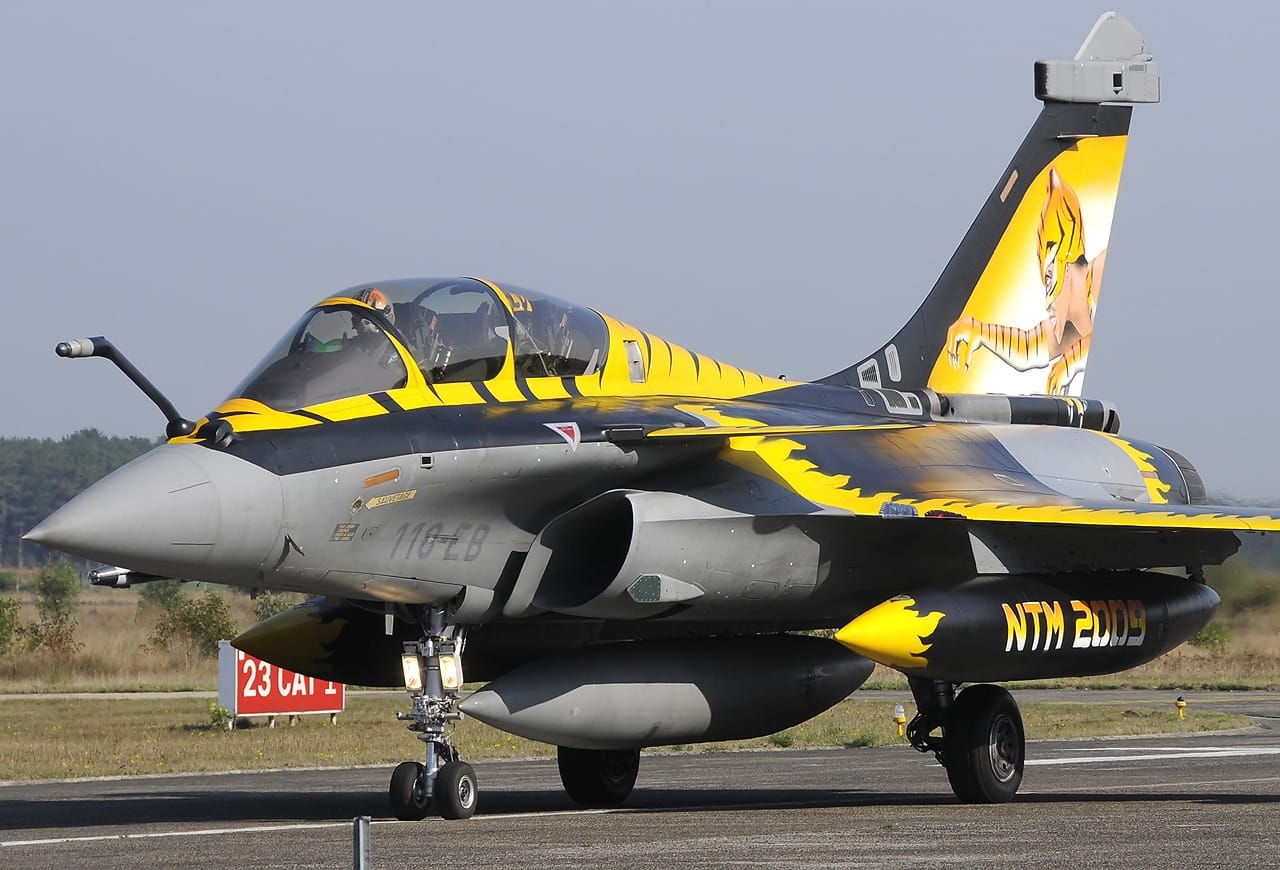
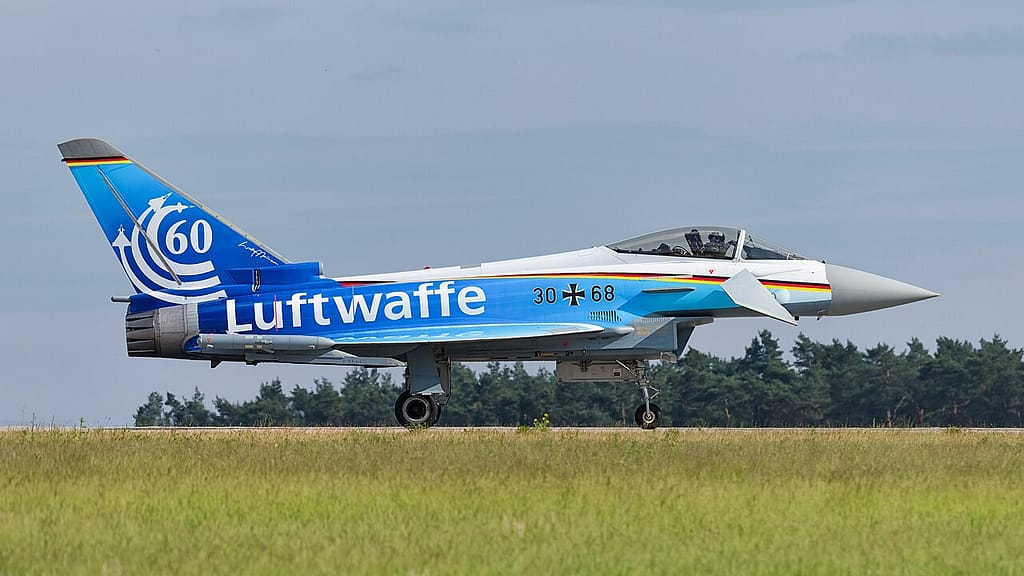
On the morning of 16 July, two French Rafales and two Luftwaffe Eurofighter Typhoons met in European airspace and took fuel from a French A330 Phenix tanker. No weapons were carried. The manoeuvres were unremarkable. Any air force in NATO does this on a quiet Tuesday.
What made it extraordinary was whose aircraft they were. The Rafales belong to the Forces Aeriennes Strategiques, the branch of the French Air and Space Force that has held the airborne half of France's nuclear deterrent since 1964. For sixty-two years that mission has been the most jealously guarded secret in the French republic, flown by French crews, from French soil, answering to one man in the Elysee Palace. On 16 July, for the first time, German fighters flew alongside it.
The next day, at Norvenich air base west of Cologne, Emmanuel Macron and Friedrich Merz explained why.
Kurzinfo
The flight: 16 July 2026, two Rafales and two Luftwaffe Eurofighters, refuelled by a French A330 Phenix MRTT
Nuclear weapons involved: none. The activity was conventional
The announcement: 17 July 2026, Franco-German Defence and Security Council, Norvenich
What was agreed: German conventional forces will take part in a French nuclear exercise before the end of 2026
French units: Forces Aeriennes Strategiques, two Rafale B squadrons based at Saint-Dizier
German unit: Taktisches Luftwaffengeschwader 31 "Boelcke", Norvenich
Framework: Macron-Merz joint declaration of 2 March 2026 and the German-French Nuclear Steering Group
What actually happened in the air
According to The Aviationist, the 16 July sortie was the first joint air activity carried out under Paris's "forward deterrence" initiative. Two Rafales flew with two Eurofighters of Taktisches Luftwaffengeschwader 31 "Boelcke" and performed what the French side described as specific manoeuvres, supported by an A330 Phenix multi-role tanker transport. The report is explicit that no nuclear weapons were involved.
That detail matters, and it is the part most likely to be lost in translation. Germany has not been handed a French warhead. It has not joined a nuclear-sharing arrangement of the kind it already operates with the United States. What it has been offered is proximity: the right to fly with, refuel alongside, and eventually exercise around the force that carries France's airborne deterrent.
Norvenich is a deliberate choice of venue. The base near Dueren, west of Cologne, is home to roughly thirty Eurofighters and some nine hundred personnel. It is also the wing that already trains for Germany's NATO nuclear-sharing role with American weapons. Landing French strategic aircraft there is not subtle.
The communique says the quiet part out loud
The Elysee published the conclusions of the Franco-German Defence and Security Council on 17 July, and the language is unusually direct for a document of this kind. It confirms the establishment of a German-French Nuclear Steering Group under the joint chairmanship of the French President and the German Chancellor, with foreign and defence ministries participating, building on the Macron-Merz joint declaration of 2 March 2026.
On the aircraft, the text is unambiguous. The deployment of Rafales from the French Strategic Air Forces to the German 31 Tactical Air Wing at Norvenich marks, in the communique's words, the first operational step in Franco-German strategic cooperation, to be followed by further steps this year including German conventional participation in a French nuclear exercise.
The document is equally careful about what this is not. The cooperation, it says, will add to and not substitute for NATO's nuclear deterrence and NATO's nuclear sharing arrangements, to which Germany contributes. Paris and Berlin are building a second track, not leaving the first one.

Merz was careful to bolt the announcement to the existing alliance rather than set it against one. The new arrangement, he said, is complementary to Germany's nuclear participation and deterrence within NATO, which Berlin still holds to. It is a formulation designed to be read in Washington as much as in Moscow.
Why France is doing this at all
French nuclear doctrine has always been the most solitary in the alliance. The force de frappe exists precisely because Charles de Gaulle did not believe an American president would trade New York for Paris. Sharing any part of it, even the choreography around it, cuts against sixty years of institutional instinct.

Read that list again and notice what is absent from it. There is no mention of German access to weapons, no consultation right over release, no dual-key mechanism. Macron is offering procedure, familiarity and trust. The decision itself remains, as French doctrine insists it must, with the French President alone.
For Berlin, even that is a significant shift. Germany has spent the post-war era as a nuclear host rather than a nuclear actor, storing American weapons and training to deliver them under American control. Flying with the French strategic force is the first time German aircraft have operated in the orbit of a European deterrent.
The aircraft behind the politics
The Forces Aeriennes Strategiques operate a fleet of roughly forty twin-seat Rafale B fighters from Saint-Dizier, about two hundred kilometres east of Paris. The twin-seat configuration is not incidental: the nuclear strike mission is flown with a weapons systems officer in the back. The Mirage 2000N, which carried the mission before it, was withdrawn in September 2018, leaving the Rafale B as the sole airborne delivery platform.
Its weapon is the ASMPA-R, the renovated version of France's air-launched nuclear cruise missile, first fired in a live test during the French nuclear exercise Operation Durandal in May 2024. The video below shows the pairing that makes this whole story possible: a French Rafale carrying the ASMP-A, on German soil.
None of this changes the arithmetic of European deterrence overnight. France's arsenal is what it was last week. Germany still has no weapons of its own and no intention of acquiring any. What changed on 16 July is narrower and, in its way, more interesting: two nations that spent the Cold War with fundamentally incompatible nuclear philosophies have started flying in the same piece of sky.
Whether that becomes a European deterrent or remains an elaborate confidence-building measure is a question for the exercise later this year. For now, it is four fighters and a tanker, and a signal aimed squarely east.
Sources: Elysee (conclusions of the Franco-German Defence and Security Council, 17 July 2026), The Aviationist, France 24, Al Jazeera, Euronews.
0 Kommentare