
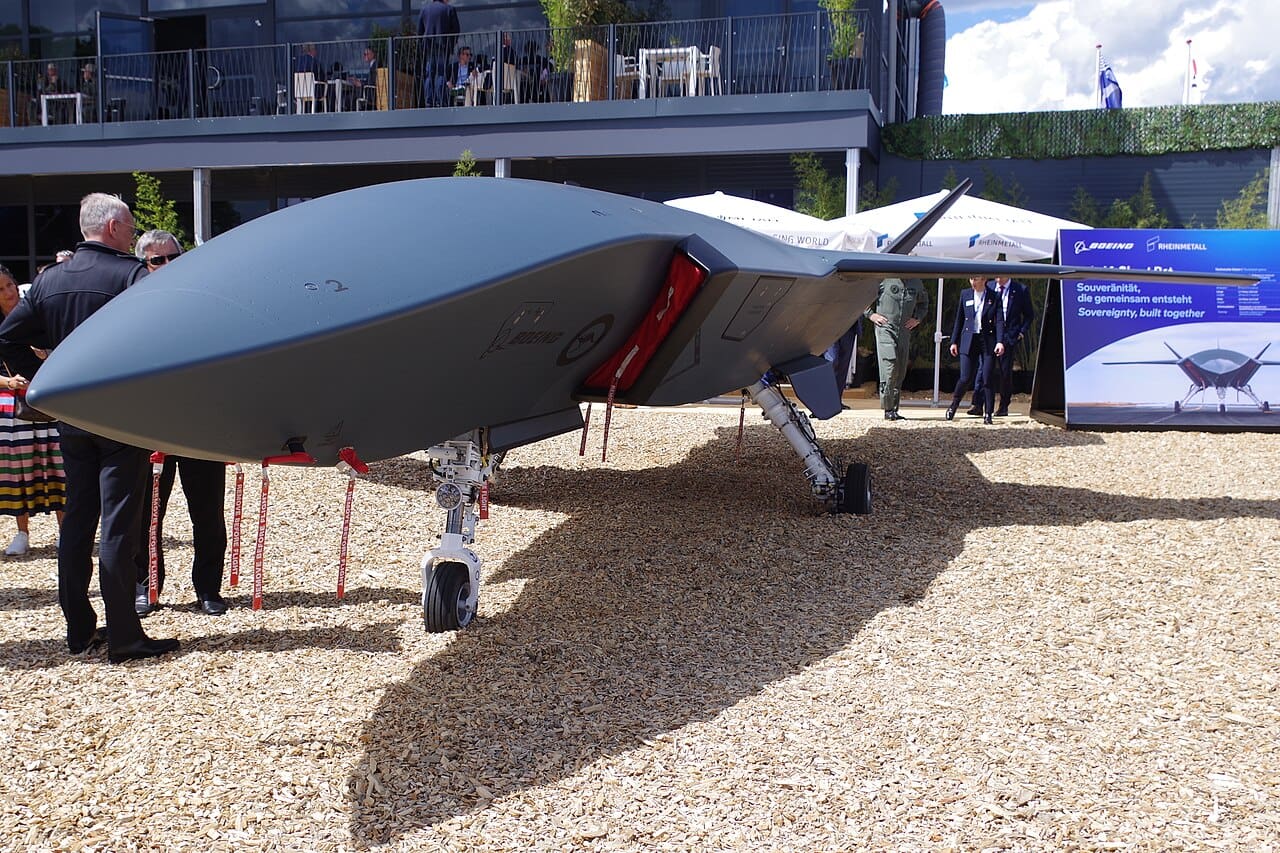
Farnborough has been running since 1948. The Boeing MQ-28 Ghost Bat first flew in 2021. On Monday, finally, the two met.
Australia's uncrewed combat aircraft made its Farnborough debut on the show's opening day — on static display, in the US Department of Defense area, alongside MBDA weaponry. It did not fly. But it did not need to: the point of bringing it 17,000 kilometres was to stand in front of European customers who are all, simultaneously, trying to work out what to buy.
Britain in particular. Boeing is pitching hard.
Kurzinfo
| Flugzeug | Boeing MQ-28 Ghost Bat, developed in Australia for the Royal Australian Air Force |
| Occasion | First-ever appearance at the Farnborough International Airshow, 20 July 2026, static display only |
| Not a first | Not its European debut — that was ILA Berlin in June 2026. It first flew outside Australia at Point Mugu, California, in May 2026 |
| Größe | 11.7 m long, 7.3 m wingspan. Boeing quotes a range of more than 2,000 nautical miles (about 3,700 km) |
| June 2026 upgrade | More than 25% larger wing, around 2,000 lb more weight, 12,000 lb MTOW, and internal bays for two AIM-120s or four Small Diameter Bombs |
| Meilenstein | First live AIM-120 firing in December 2025, teamed with an RAAF E-7A and an F/A-18F against an aerial target. Boeing says weapon integration took seven months |
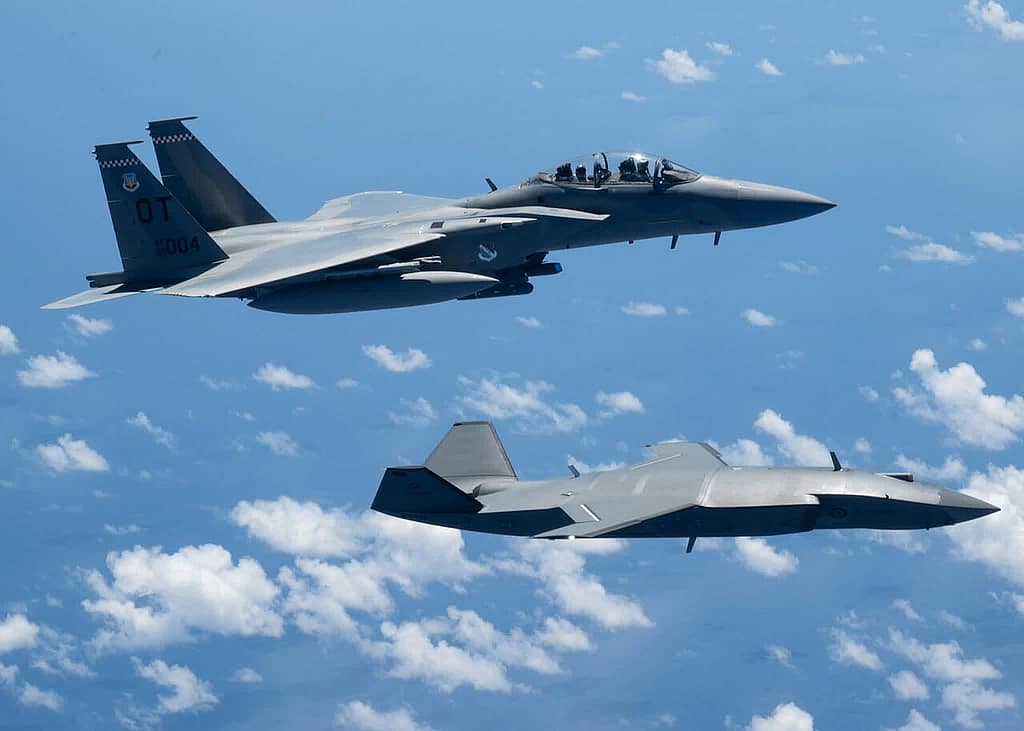
| Combat exercise | Flew in Valiant Shield 2026 alongside USAF F-15EXs — the first CCA to take part in a joint, multinational exercise |
| Not American | The MQ-28 is not part of the USAF Collaborative Combat Aircraft programme. That competition is between the YFQ-42A and the YFQ-44A |
Why maturity is the sales pitch
Every major manufacturer at this show has a drone wingman to sell. Anduril unveiled a tiltrotor on Monday. BAE and Lockheed unveiled a jammer. General Atomics brought its YFQ-42A and parked it not far away.
What separates the Ghost Bat from most of the field is that it has already done things. It has flown for five years. It has fired a live radar-guided missile at a real target. It has operated from a foreign country and taken part in a multinational exercise with American fighters. Very little else in the category can say the same.
That is precisely the argument Boeing Defence UK's managing director has been making to British customers.
Seven months to integrate a missile
The December 2025 shot is the achievement Boeing keeps returning to, and the reason is less the missile than the calendar. Integrating a new weapon onto an existing combat aircraft is normally measured in years — test campaigns, software drops, safe-separation trials, certification.
Boeing did it in seven months, and attributes that to how the aircraft was designed rather than to how hard anyone worked.
Open architecture is one of those phrases that means very little until it means everything. In this case it means the aircraft was built so that adding a weapon does not require reopening the whole design — which, for a platform meant to be produced cheaply and updated constantly, is the difference between a programme and a museum piece.
Block 2, and the British question
The aircraft on display represents where the programme has got to, not where it is going. Eight Block 1 airframes are reported to be in Australian test and evaluation. The first three Block 2 aircraft are in assembly, with rollout expected around the end of this year; Block 2 drops the distinctive dogtooth wing of the earlier jets and brings a new navigation fit.
Australia committed roughly another A$1.4 billion in December 2025 for six more Block 2 aircraft and Block 3 prototype development. RAAF operational service is targeted for 2028, though that date comes from a single source and Boeing has not confirmed it publicly.
The UK, meanwhile, has said in its Defence Investment Plan that it wants to fly a British collaborative combat aircraft before 2030. Boeing would very much like the MQ-28 to be in that conversation. Germany is a second target, via a partnership with Rheinmetall aimed at Bundeswehr procurement from 2029.
No order was announced at Farnborough. What was announced, essentially, was availability — and an aircraft parked where the customers could walk up and touch it.
Behind the scenes on the MQ-28 drone intercept trial with the E-7A Wedgetail and Super Hornet.
Sources: Aviation Week, Boeing, FlightGlobal, Joint Forces News, The Aviationist.

0 Kommentare