
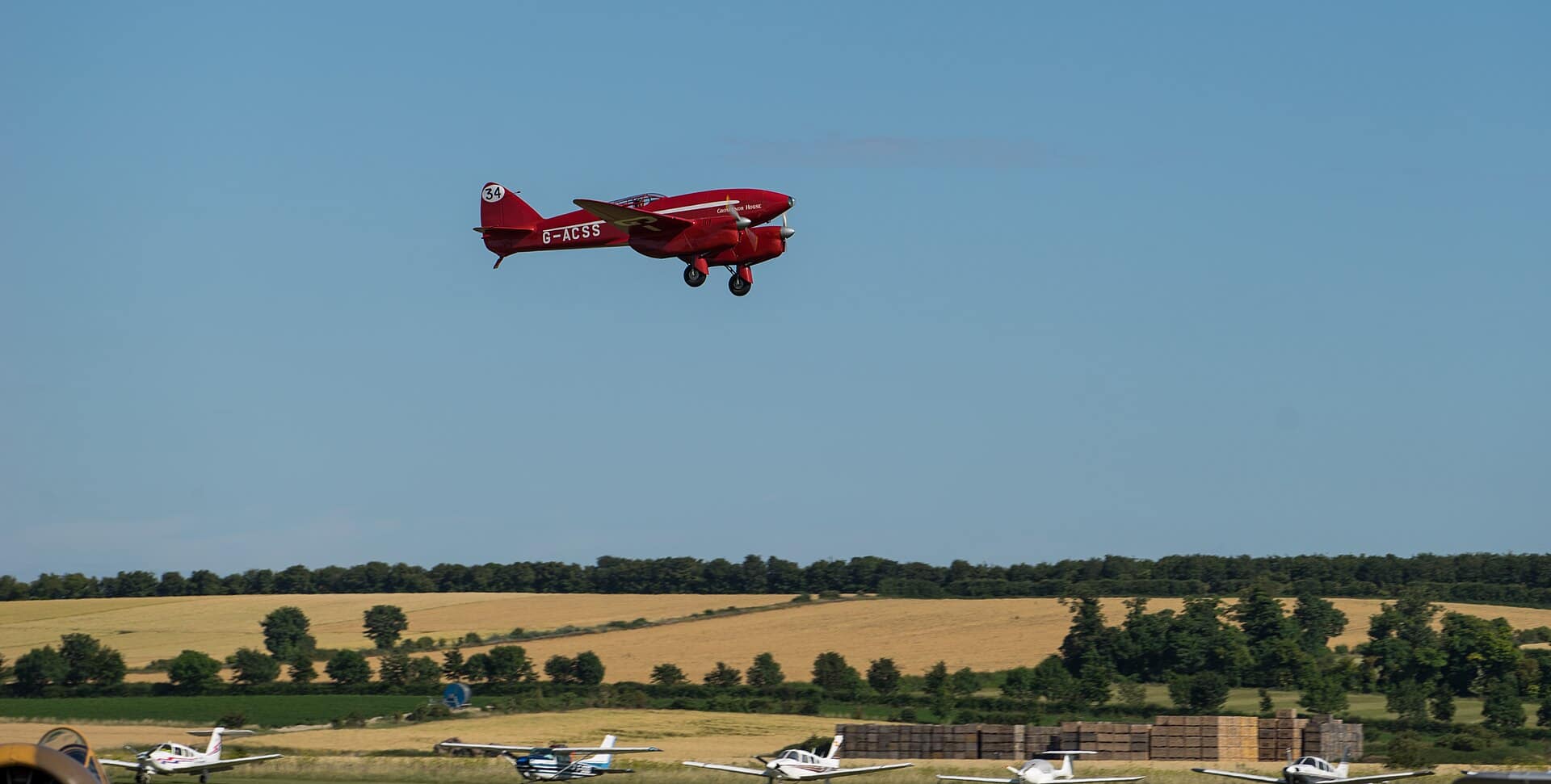
Every so often an aeroplane arrives that is so obviously ahead of its moment that it embarrasses everything parked next to it. In October 1934, on a new airfield at Mildenhall in Suffolk, three of them lined up on the same morning. They were de Havilland DH.88 Comets, and one of them was about to rewrite what anybody thought was possible between England and Australia.
The reason all three existed at all was a single, gloriously audacious offer. In January 1934, de Havilland announced that if it received three firm orders by the end of February, it would build a bespoke long-range racer guaranteed to do 200 mph, and sell it for GBP 5,000 apiece, roughly half what each machine actually cost to build. The board knew they would never recoup the investment. They did it for national prestige, and for the research data, because a new generation of sleek American monoplane airliners had left Britain looking distinctly behind the times.
Quick Facts: de Havilland DH.88 Comet
- British two-seat, twin-engine wooden racing monoplane, designed by A. E. Hagg
- Three built for the race at a subsidised GBP 5,000 each; first flight 8 September 1934
- Power: two de Havilland Gipsy Six R inline sixes, ~230 hp each, with variable-pitch propellers
- Top speed ~237 mph; range ~2,925 miles; hand-cranked retractable undercarriage
- Won the 1934 MacRobertson England-to-Australia Air Race (~11,300 miles) in 70 hr 54 min as G-ACSS "Grosvenor House"
- Flown by C. W. A. Scott and Tom Campbell Black; G-ACSS survives airworthy at the Shuttleworth Collection
A wooden aeroplane that flew like the future
Here is the detail that still makes engineers blink: the Comet was built almost entirely of wood. Designer A. E. Hagg borrowed a boat-building trick, laying diagonal spruce planking in two crossed layers to form a stressed skin, held together with the newly available synthetic bonding resins. The result was a thin, high-aspect-ratio cantilever wing and a fuselage whose strength lived in its skin, not in a heavy metal frame.
Onto that airframe Hagg bolted a shopping list of modern features that no single British aeroplane had ever combined before: stressed-skin construction, a cantilever monoplane wing, an enclosed cockpit, split landing flaps, a retractable undercarriage and variable-pitch propellers. The undercarriage was hauled up by hand, fourteen turns of a wheel on the pilot’s right. The two-position propellers were set to fine pitch on the ground, then flipped to coarse pitch once airspeed built up. It was crude by later standards and brilliant for 1934.
Power came from two de Havilland Gipsy Six R engines, race-tuned inverted inline sixes of about 230 hp each, tucked into slim nacelles. Fuel filled three tanks around the tandem cockpit, feeding a range near 2,925 miles. Top speed was around 237 mph. And because the whole schedule was insane, the first Comet flew on 8 September 1934, roughly six weeks before the race it was designed to win.
Moore-Brabazon had a point, and it is worth being honest about it. The Comet was a thoroughbred built for exactly one job. But that is also what makes the story so good: they built the specialist, and then the specialist delivered.
The MacRobertson race: England to Australia the hard way
The prize was put up by Sir Macpherson Robertson, an Australian confectionery magnate, to mark Melbourne’s centenary. The course ran roughly 11,300 miles from Mildenhall to Melbourne, with five compulsory stops at Baghdad, Allahabad, Singapore, Darwin and Charleville. Beyond that, competitors picked their own route across deserts, jungle and open sea, in aeroplanes ranging from gleaming DC-2 and Boeing 247 airliners to elderly biplanes.
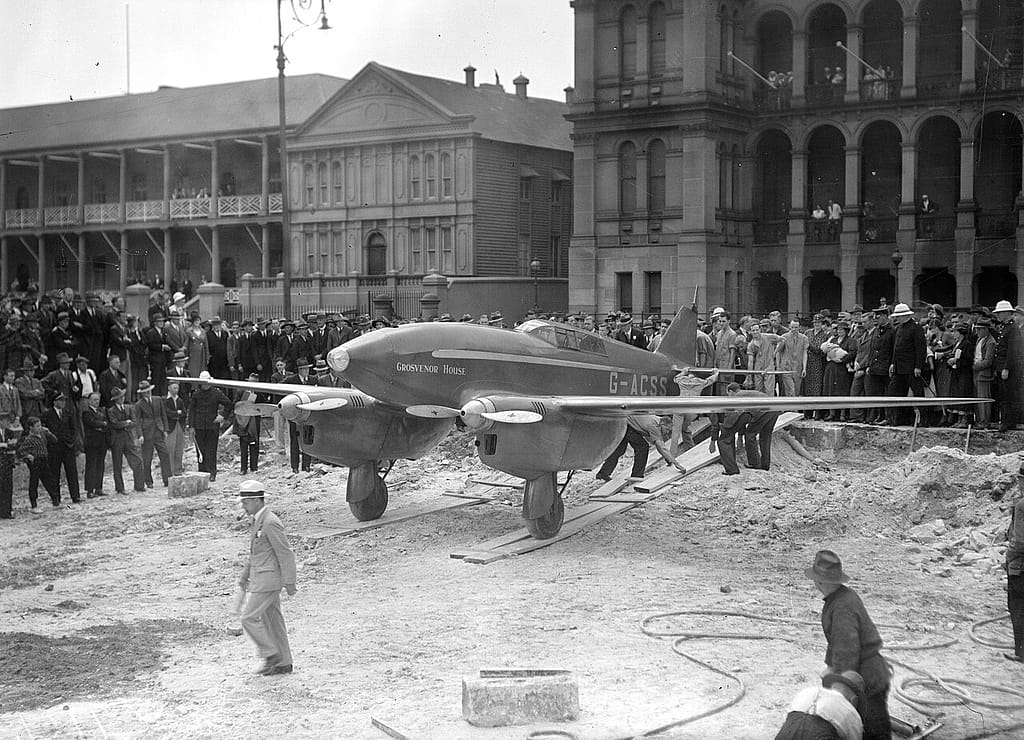
The red Comet, G-ACSS, had been named “Grosvenor House” after the Mayfair hotel run by its owner, A. O. Edwards. Edwards did not fly it himself; he hired two professionals, Flight Lieutenant C. W. A. Scott and Captain Tom Campbell Black. The other two Comets were the black-and-gold “Black Magic” of Jim and Amy Mollison, and a British racing green machine flown by Owen Cathcart Jones and Ken Waller.
The race was brutal. The Mollisons led early, then retired at Allahabad. That left Scott and Campbell Black out front, wrestling their controls together through a savage storm over the Bay of Bengal, and later nursing “Grosvenor House” across the Timor Sea after an engine lost oil pressure. They flew the final legs with one engine deliberately throttled back, trusting a phone call from engine designer Frank Halford in England more than their own warning gauge.
It worked. They crossed the line at Melbourne on 23 October with an official flying time of 70 hours 54 minutes, comfortably under three days. Their lead was so large that entire competitors were still in Europe when the pair reached Darwin. To put the leap in perspective, only 70 years earlier the same journey by ship could take up to a hundred days.
The uncomfortable footnote, and why it mattered
There is a twist the British press preferred to skate over. Second and third fastest were both airliners, the KLM Douglas DC-2 “Uiver” and Roscoe Turner’s Boeing 247D. The DC-2 flew a scheduled route, carried passengers, made extra stops, and still finished less than a day behind a purpose-built racer. The Dutch even took the handicap prize. The message was clear: the future of long-distance flight belonged to the practical American monoplane, and the Comet had proved the concept the airliners would cash in.

That was rather the point. The DH.88 was a technology demonstrator that happened to be gorgeous. Its wooden stressed-skin construction and clean aerodynamics fed straight into de Havilland’s later thinking, and the design lessons rippled forward into the company’s wartime work. Of the Comets built, “Grosvenor House” is the one that endured. After a spell with the RAF, a scrapping, a rescue and years of record attempts, G-ACSS came to the Shuttleworth Collection in 1965. It flew again on 17 May 1987, and after an undercarriage redesign returned to the air once more in 2014.
You can still see it fly at Old Warden, red and impossibly sleek, a wooden aeroplane pushing ninety that looks quicker standing still than most of the metal around it. It won a race that Britain arguably should have been embarrassed to need a special aeroplane to win. But in doing so it dragged everyone, cheerfully and at 220 mph, into the modern age.
Grosvenor House flying today at Old Warden.
Sources: Wikipedia (de Havilland DH.88 Comet; MacRobertson Air Race); The Shuttleworth Collection; This Day in Aviation; Vintage Aviation News; Airminded.
Ähnliche Beiträge


0 Kommentare