

Picture grey water somewhere off the Alaskan coast in April 1924, fog sitting on it like a wet blanket. Four wooden biplanes on pontoons, engines hammering at a frequency that rattles your fillings, wallowing towards a horizon nobody in history has ever managed to fly all the way around and back to.
No radios. No satellite navigation. No cockpit roof, come to that — just eight men in leather coats, a stack of maps and a Liberty engine apiece that they would have to take apart and rebuild themselves roughly every time it sneezed.
This is the story of the first flight around the world. It took 175 days, cost them two of their four aeroplanes, and very nearly cost them their lives more than once. And the daft, glorious thing is that it worked.
Quick Facts
| Aircraft | Douglas World Cruiser (modified DT torpedo bomber) |
| The four | Seattle, Chicago, Boston, New Orleans |
| Departed | Sand Point, Seattle — 6 April 1924 |
| Returned | Seattle — 28 September 1924 (175 days) |
| Distance | ~27,000 miles (~44,000 km), ~70 mph average |
| Finishers | Chicago and New Orleans — first aircraft to circle the Earth |
A torpedo bomber with delusions of grandeur
The US Army Air Service wanted to be first around the planet, and badly — the British, French, Italians, Portuguese and Argentines were all eyeing the same prize. Donald Douglas, a young manufacturer in Santa Monica, offered a shortcut: take his existing Navy DT torpedo bomber, which already existed and therefore did not need inventing, and beef it up for the long haul.
The result was the Douglas World Cruiser. Fuel capacity ballooned to well over 600 gallons across six tanks — the fuel system, incidentally, was an early job for a young engineer named Jack Northrop, a name you will meet again if you like flying wings. A sturdier fuselage, a bigger rudder, a thumping 420-horsepower Liberty V12, and the clever bit: undercarriage you could swap between wheels and pontoon floats depending on whether the next stop was a farmer’s field or the open sea.
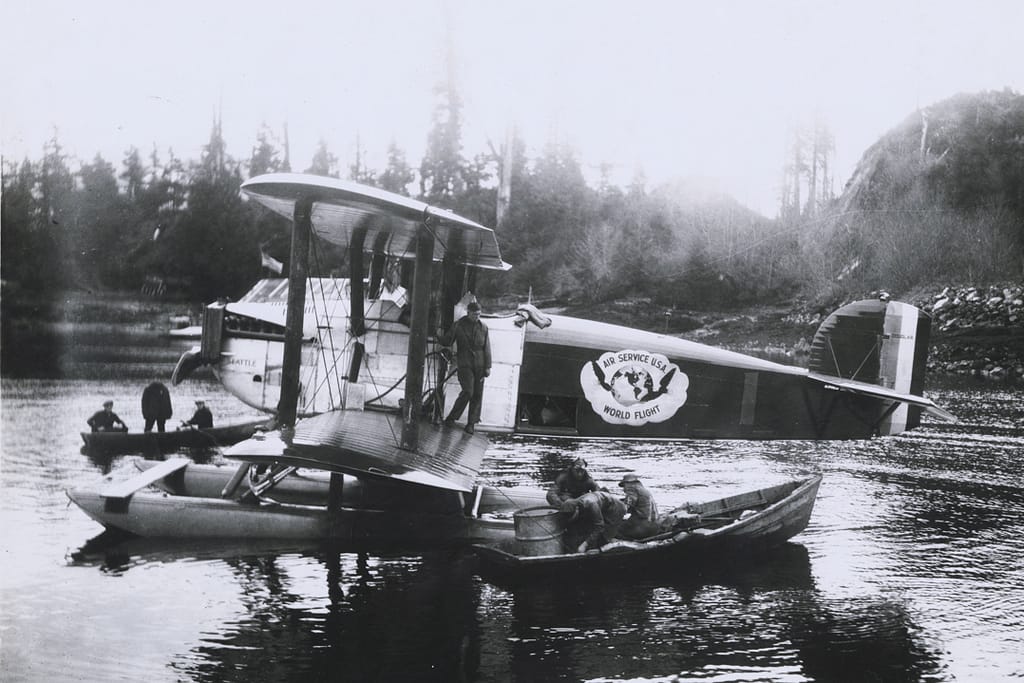
They built five: one to practise on, and four for the main event. Because the Air Service, sensibly, assumed they would not all make it. They were right.
Everything that could go wrong, mostly did
The four aircraft — christened with actual water carried from Seattle, Chicago, Boston and New Orleans — lifted off on 6 April 1924 and flew west, into the prevailing winds, to beat the Alaskan fog, the Pacific typhoons and the Asian monsoon.
The flight leader did not make it out of the first fortnight. On 30 April, Major Frederick Martin and Sergeant Alva Harvey flew Seattle into an Alaskan mountainside in thick fog, then spent ten days walking out of the wilderness. Both survived. Command passed to Lieutenant Lowell Smith in Chicago, and the survivors pressed on across Japan, China, Southeast Asia, India, the Middle East and Europe — sustained by a small army of pre-positioned engines, fuel caches and warships. Everybody was a pilot; everybody was a mechanic.
Then, on the most feared leg of all — the North Atlantic — they lost the second one. Boston dropped its oil pressure between the Faroes and the Orkneys and put down on a rising sea.
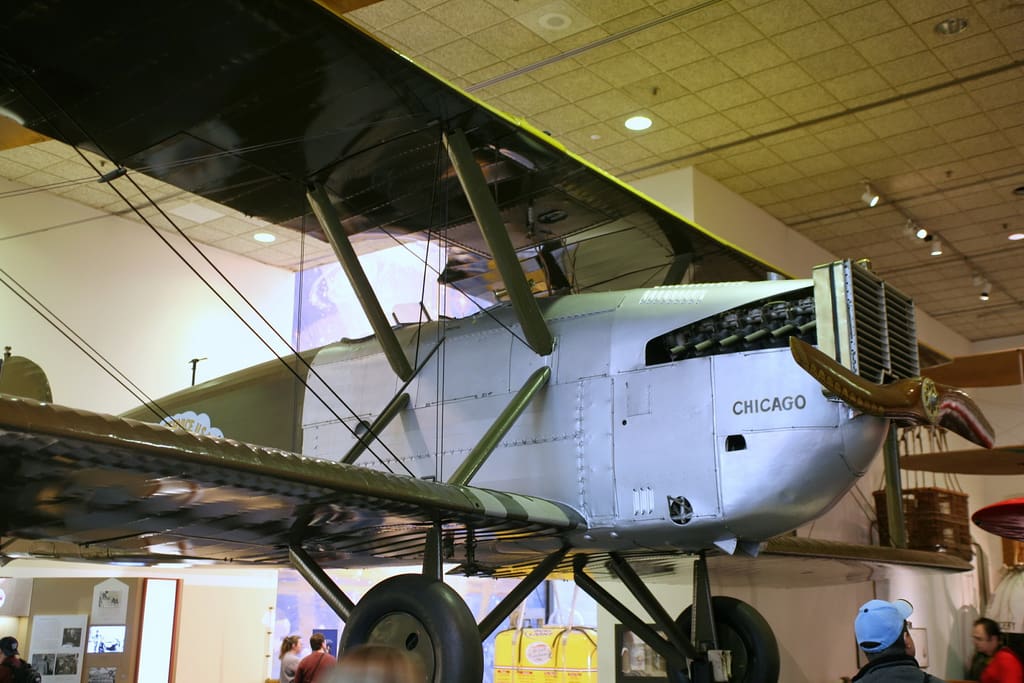
Two biplanes, one planet, no excuses
That left Chicago and New Orleans to finish the job, and the finishing was every bit as grim as the middle. On the long haul from Iceland to Greenland they flew the last stretch at wave-top height, dodging icebergs half-hidden in the mist. When Chicago’s fuel pump failed, co-pilot Leslie Arnold simply worked the emergency hand-pump for hours on end.
They coasted into Nova Scotia and hopscotched across the United States to delirious crowds. On 28 September 1924, Chicago and New Orleans touched down at Seattle — right back where they had started, 175 days and some 27,000 miles later. First around the world, and first to cross both great oceans on one trip. Nobody has ever repeated it in an open-cockpit, single-engine aeroplane, and frankly nobody sane would try.
Douglas took away a motto — “First Around the World, First the World Around” — and an emblem of aeroplanes circling a globe. Not bad for a warmed-over torpedo bomber and eight stubborn men who refused to look down at the cold water for too long.
Sources: Wikipedia (Douglas World Cruiser); C.V. Glines, “Around the World,” Air Force Magazine, September 1999; the crew memoir The First World Flight (1925).


0 Comments