
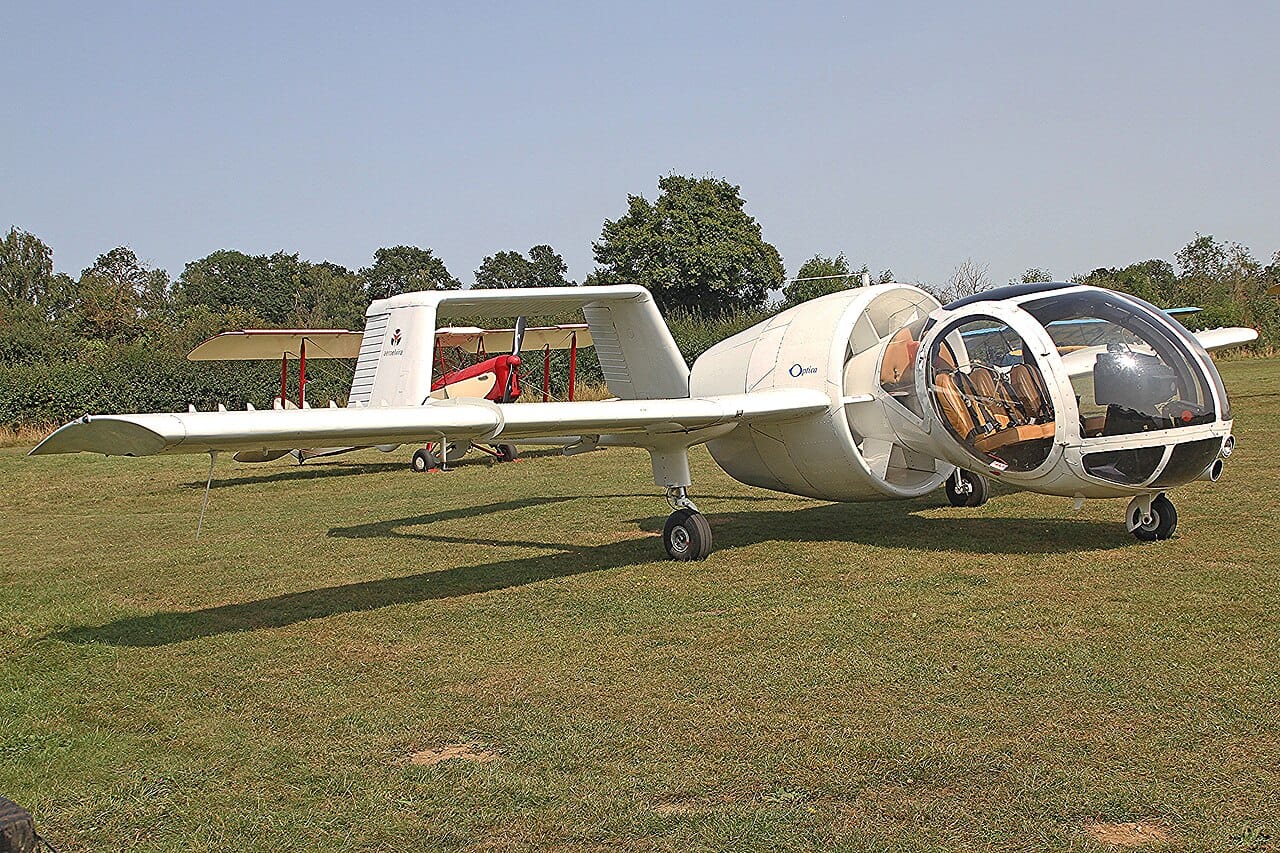
Most aircraft are designed around an engine. Some are designed around a payload. The Edgley EA-7 Optica is the only certified aircraft in aviation history designed around a view. Every other consideration — speed, range, payload, looks — was sacrificed so that three people could sit inside a glass bubble at the front of the fuselage and look at the ground.
It is the strangest light aircraft Britain ever produced. It is also, oddly, one of the most successful designs at the specific job it was built to do: observation. And it was killed not by its engineering, not by its economics, but by a single accident and a fire at the factory.
Quick Facts
- Aircraft: Edgley EA-7 Optica
- Designer: John Edgley
- First flight: 14 December 1979
- Configuration: Single ducted-fan engine + pusher prop, three-seat glass-cockpit bubble forward
- Cruise speed: 130 km/h (81 mph) loiter, 213 km/h (132 mph) maximum
- Visibility from cockpit: 270 degrees (panoramic) — better than any rotorcraft of the era
- Built: 22 airframes total — production halted by company failures
A design problem nobody had really solved
In the late 1970s, the police, coast guards, pipeline operators and forest services of the world had a problem. Helicopters were the obvious answer for low-altitude observation, but they were expensive to buy, hideously expensive to operate, and noisy enough to ruin any covert observation task. Light fixed-wing aircraft — Cessna 172s, Piper Cherokees — were affordable, but a Cessna has a wing in the way of half of what you want to look at, and an engine in the way of the rest.
John Edgley, a British aeronautical engineer, decided to design the aircraft from the view outward. He put the cockpit at the front in a hemispherical perspex bubble — a deliberate visual reference to a helicopter, intended to make pilots immediately comfortable. He put the engine, propeller and tail behind the cockpit, supported by a single boom. He made the propeller a ducted fan, which reduced noise dramatically — an Optica overhead is, by witness reports, quieter than a heavy lawnmower.
The result looked, and still looks, like a children’s drawing of an aircraft — or, depending on your aesthetic, an enormous flying insect. Pilots loved it on sight. The 270-degree visibility from the cockpit was better than any helicopter. Operating costs were a quarter of equivalent rotorcraft. Loiter capability — the actual point of an observation aircraft — was excellent: an Optica could stay airborne for eight hours.

First customers and quiet success
By 1985, the Optica had received UK certification and the first customer aircraft had been delivered, flying police trials with the Hampshire Constabulary. Pilots reported that the aircraft was startlingly easy to fly: the ducted-fan engine had relatively benign single-engine-failure behaviour, and the slow-speed handling was forgiving. For the very specific job of "loiter low, look at things, take photographs," the Optica was simply the best aircraft anyone had ever built.
Then, on 15 May 1985, an Optica operated by Hampshire Police crashed on a low-altitude observation sortie near Ringwood. Both occupants died. The accident investigation found no structural or mechanical failure, concluding that control was most likely lost when the aircraft stalled in a steeply banked low-level turn — but the small-aircraft press latched onto the event. Orders paused. Then, in 1987, the factory at Old Sarum airfield was set ablaze in an arson attack that destroyed ten aircraft. The company never recovered.
A second life and a third
The Optica design has been resurrected more than once. Production passed to Brooklands Aerospace and then, around 1990, to FLS Aerospace, which ultimately cancelled the project. In 2007 the rights were offered back to designer John Edgley, whose new company AeroElvira returned an Optica — G-BOPO — to flight in 2008, and in 2017 Interflight Global announced plans to relaunch production. Whether the project succeeds this time is an open question.
What is not in question is that of the 22 Opticas built, only a small handful survive, and fewer still fly. When one does appear at a British airfield, a small, devoted crowd shows up to watch.
It is, in the inventory of British aviation, the most distinctive small aircraft ever certified — an honest engineering answer to a real problem, killed by bad luck rather than bad design. The world is poorer for not having more of them.
Sources: FLYER Magazine, Air-Britain Aviation, the UK Civil Aviation Authority type-certificate file, Flight International archive.
Related Questions
What was the Edgley Optica?
The Edgley EA-7 Optica was a British observation aircraft of the late 1970s, designed for low, slow surveillance flying as a cheaper, quieter alternative to a helicopter. Its huge bug-eye bubble cockpit gave occupants an almost panoramic view of the ground below.
Why does the Optica look like an insect?
Its distinctive bug-eye look comes from a large glass bubble cockpit at the very front, designed to give a 270-degree panoramic view. The wraparound glazing — better than any helicopter of its era — is what makes the Optica resemble a giant insect.
What was the Edgley Optica used for?
It was built for observation work — police patrols, surveying, traffic and wildlife monitoring — where slow, quiet, low-level flight with excellent visibility matters. It aimed to do a helicopter's surveillance job far more cheaply and quietly.
How good was visibility from the Optica?
Exceptional — about 270 degrees of panoramic vision from its bubble cockpit, better than any rotorcraft of its time. That all-round view was the whole point of the design, ideal for watching the ground during patrol and survey missions.
How many Edgley Opticas were built?
Only 22 were built. Despite its clever design, production was repeatedly halted by the failure of the companies that owned it, and the unusual observation plane never achieved commercial success.
0 Comments