
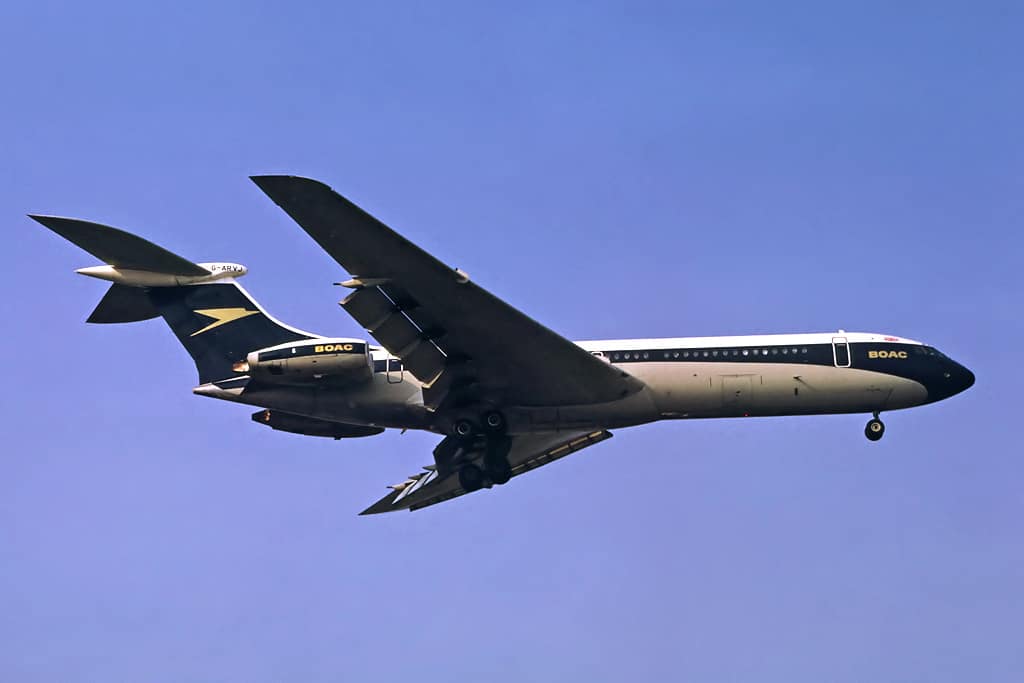
For 41 years, the record for the fastest subsonic airliner crossing of the Atlantic belonged not to a Boeing or a Douglas, but to a graceful British jet with four engines bunched at its tail. The Vickers VC10 did London to New York in 5 hours and 1 minute, and nothing without an afterburner beat it until a British Airways 747 caught a freak storm tailwind in 2020.
The VC10 was, by almost every account, one of the most beautiful and best-loved airliners ever built. Passengers adored its whisper-quiet cabin. Pilots praised its handling. And yet it was, commercially, a disappointment, because it had been designed to be brilliant at a job the world was about to stop needing.
Datos rápidos
| Aeronave | Vickers VC10 and Super VC10 |
| Primer vuelo | 29 June 1962 |
| Entered service | 1964, with BOAC |
| Motores | Four Rolls-Royce Conway turbofans, rear-mounted, under a T-tail |
| Diseñado para | BOAC’s hot-and-high routes across Africa |
| Construido | 54 (32 VC10s and 22 Super VC10s) |
| Registro | Fastest subsonic Atlantic crossing, 5h 1m, held for 41 years |
| Segunda vida | RAF transport and air-to-air tanker, retired only in 2013 |
Built for the Empire’s Runways
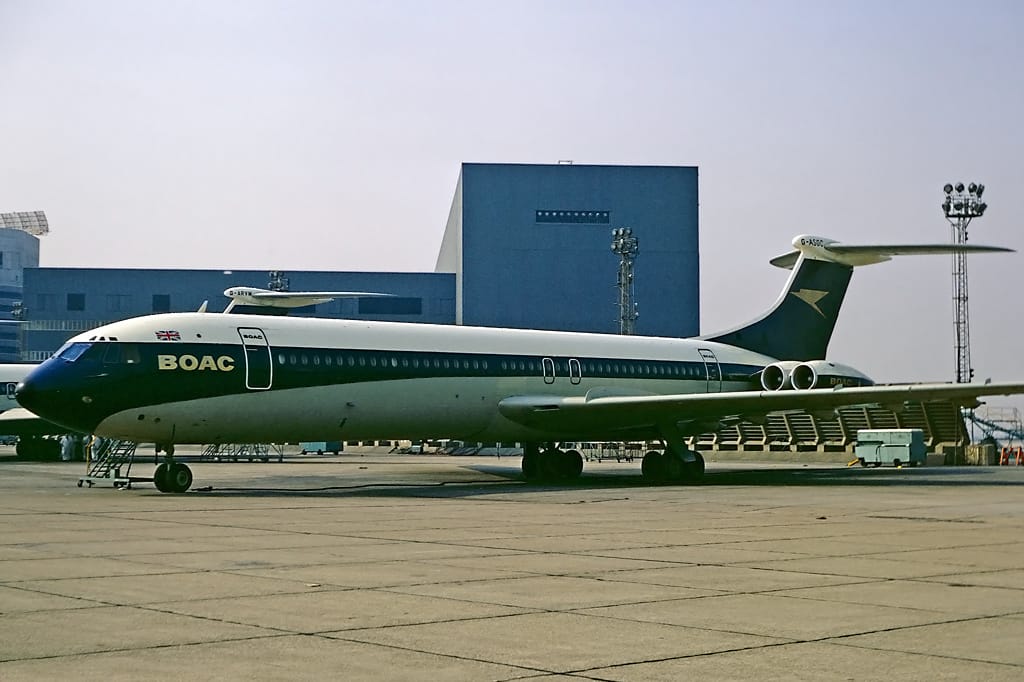
The VC10's whole character came from a single demanding customer. BOAC, Britain's state airline, needed a jet that could serve the old imperial routes across Africa and the Far East, where airfields were often short, high above sea level, and baking hot, the worst possible combination for a heavily loaded jet. So Vickers gave the VC10 an enormous, superbly efficient wing and hung four powerful Conway engines at the back, keeping that wing clean and uncluttered.
The result had short-field and high-altitude performance no other big jet could match. A VC10 could get off a runway that would have stranded a 707. The rear-engine layout had a lovely side effect, too: with all four engines behind the cabin, the front of the aircraft was extraordinarily quiet. BOAC built an entire advertising campaign around it.
Beloved, and Beaten by Economics
Here is the catch. All that hot-and-high capability came at a price: the VC10 was heavier and thirstier than the Boeing 707, and it cost more to run per seat. As jet airports across the world lengthened and improved their runways through the 1960s, the very problem the VC10 had been built to solve simply melted away. Airlines wanted the cheapest seat-mile, and that was the 707, not the beautiful, expensive Vickers.
So only 54 were built, against more than a thousand 707s. Airlines that flew it and passengers who rode it loved it; the accountants did not. It became a case study in a hard truth of aviation: being the best aircraft is not the same as being the right one.
A Long Second Career
If the airlines gave up on the VC10, the Royal Air Force did not. Its remarkable performance made it a superb military transport, and from the 1960s onward the RAF flew VC10s hard, later converting many into air-to-air refuelling tankers. They served through the Falklands, the Gulf, the Balkans and Libya, passing fuel to fighters over three continents.
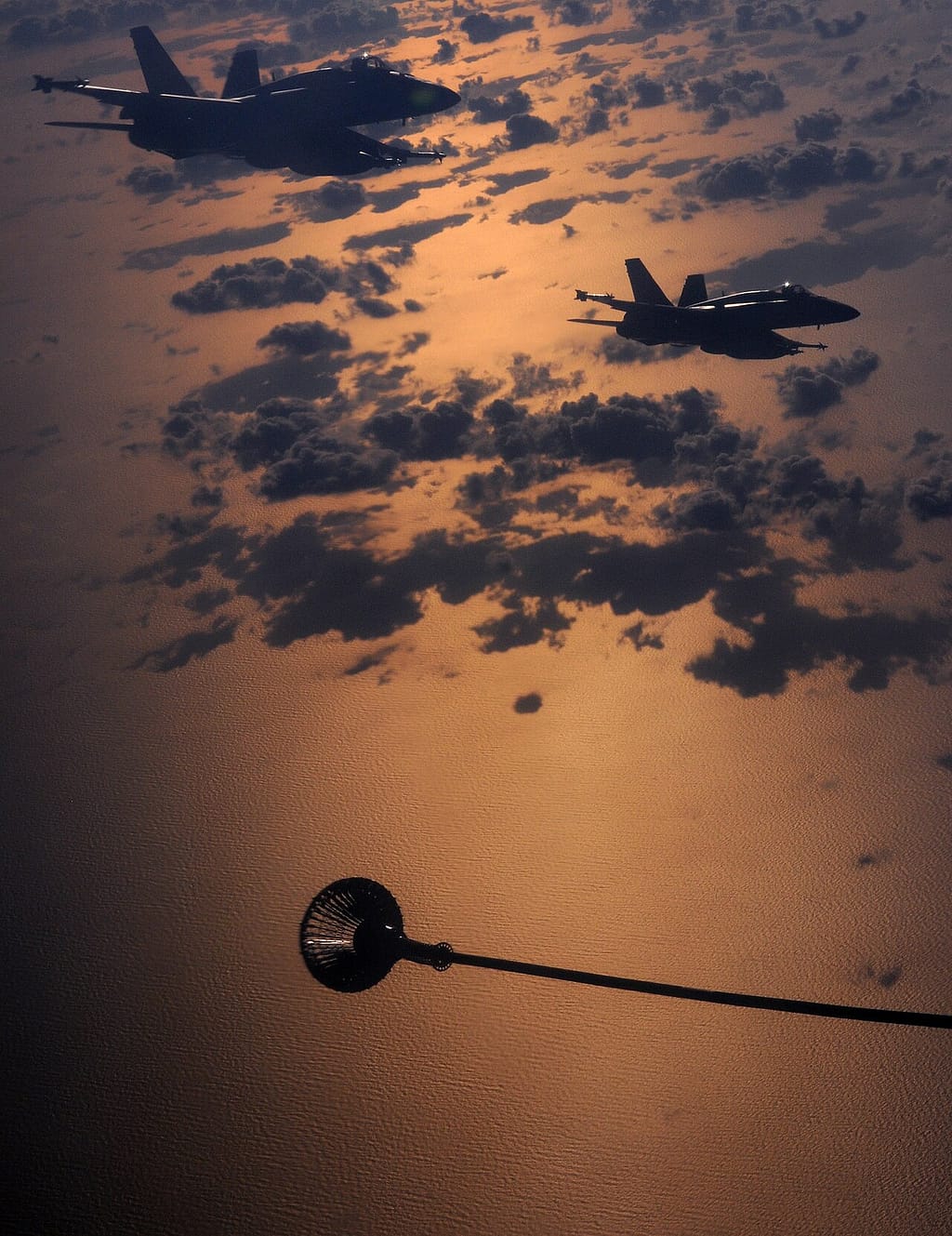
The last RAF VC10 was not retired until 2013, half a century after the first one flew. That is an extraordinary innings for an aircraft the airlines had written off decades earlier. The VC10 never made Vickers much money, but it earned something more durable: the lasting affection of everyone who flew it, and a transatlantic record that stood for two generations. Swift, silent, and serene to the end.
Sources: BAE Systems Heritage; Wikipedia; Simple Flying; Flightradar24; World Airline Historical Society.

0 Comentarios