
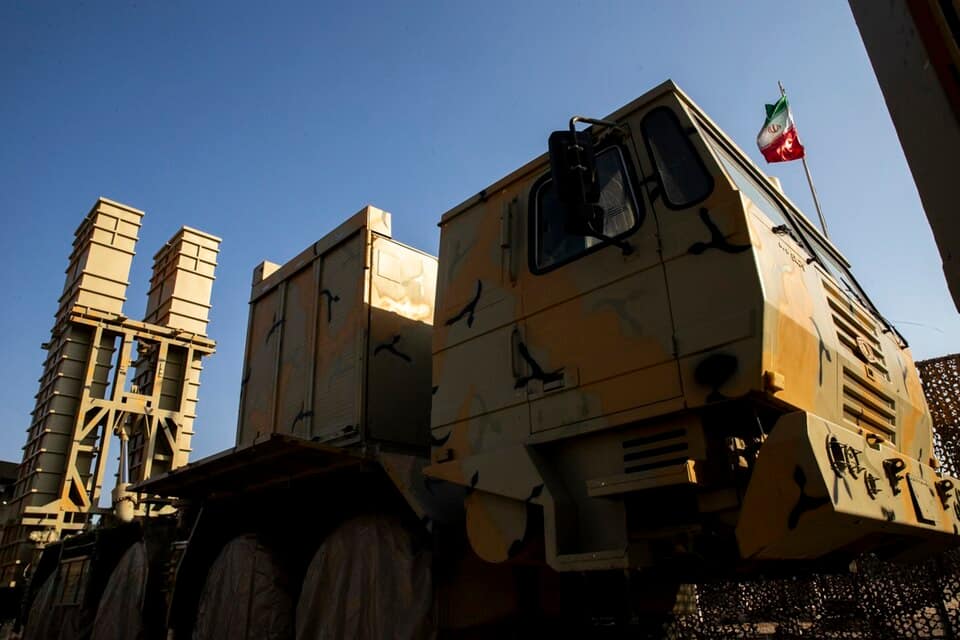

The Russian Backbone: S-300PMU-2
The cornerstone of Iran’s strategic air defence arrived in 2016, when Moscow delivered four batteries of the S-300PMU-2 — NATO designation SA-20B. The system fires the 48N6E2 missile, capable of engaging aircraft, cruise missiles, and some ballistic targets at ranges up to 200 kilometres and altitudes above 25 kilometres. Four batteries is not many. Russia, by comparison, fields hundreds. But Iran positioned them carefully: around Tehran, Isfahan, and its nuclear enrichment facilities at Natanz and Fordow. Commercial satellite imagery from Planet Labs and Airbus, collected in February 2026, showed the launchers being repositioned as US strikes intensified — a sign that at least some batteries survived the opening salvos. The S-300’s greatest strength is its proven track record. Variants of this system have been exported to over a dozen countries and tested in real combat. Its greatest weakness in Iranian hands is scarcity. Four batteries cannot cover a country of 1.6 million square kilometres. Once located, they can be targeted. And the US has spent decades developing tactics specifically designed to kill S-300s.
The Homegrown Contender: Bavar-373
When international sanctions delayed the S-300 delivery for years, Iran did what it has done across its entire defence sector: built its own. The Bavar-373 is Tehran’s flagship indigenous long-range SAM, built around the Sayyad-4 interceptor and guided by the Meraj-4 active electronically scanned array radar. Iranian officials claim the system matches or exceeds the S-300’s capabilities. The baseline Bavar-373 reportedly engages targets at 200 kilometres. An upgraded variant, the Bavar-373-II, uses the Sayyad-4B missile to extend that envelope to 300 kilometres — putting it in the same class, on paper, as Russia’s S-400. How much of that is real and how much is propaganda is an open question. Iran’s defence industry has a track record of overstating capabilities. But at least two operational Bavar-373 batteries exist, and the system has been paraded extensively. Even if its performance falls short of the claims, it adds another layer of radar coverage and missile threat that US mission planners cannot ignore.The Mobile Middle Layer
Between the long-range umbrellas and the foot soldiers with shoulder-fired missiles sits a dense middle layer of medium- and short-range systems. This is where Iran’s investment in domestic production pays dividends — and where the maths of suppression become brutal for an attacker. The Khordad-15 is the most capable of the medium-range systems. It is fully mobile, radar-integrated, and designed to engage multiple targets simultaneously at ranges up to 150 kilometres. Unlike the S-300 or Bavar-373, which protect fixed strategic sites, the Khordad-15 can relocate within minutes. It was designed, in part, to counter exactly the kind of air campaign now being waged against Iran.
The MANPADS Problem
At the bottom of the pyramid — and arguably the top of the threat — sit the man-portable air defence systems. MANPADS are shoulder-fired, heat-seeking missiles that a single operator can carry, hide, and launch with almost no warning. They require no radar. They emit no signal before firing. They are, for all practical purposes, invisible. Analysts at the Foundation for Defense of Democracies and the Center for Strategic and International Studies assessed that a MANPADS — not a fixed SAM — most likely brought down the F-15E on April 3. The logic is straightforward: as the US has destroyed Iran’s fixed radar sites and strategic batteries, American aircraft have descended to lower altitudes to prosecute ground targets more effectively. Lower altitude means shorter range to the ground. And shorter range is exactly where MANPADS live. This is the paradox of a successful SEAD campaign. The more you destroy the high-altitude threat, the lower your aircraft fly. The lower they fly, the more exposed they become to the cheapest, most dispersed, most survivable weapon in the enemy’s arsenal. A disabled air defence system is not a destroyed air defence system, as one analyst put it. And a man with a missile tube on a hillside is the hardest target of all.Designed to Survive
Iran’s air defence doctrine was not designed to stop the US Air Force. It was designed to survive it. The country’s planners studied what happened to Iraq in 1991 and 2003, to Libya in 2011, and to Serbia in 1999. In each case, centralised, fixed air defence networks were located, jammed, and systematically destroyed in the opening hours of an air campaign. Iran drew the obvious conclusion: do not be centralised. Do not be fixed. The result is a defence network that trades peak performance for survivability. Mobile launchers that relocate after every engagement. Decentralised command structures that allow batteries to operate independently if communications are cut. Camouflaged positions, decoys, and an emphasis on dispersal over concentration. It is not the most lethal air defence in the world. But it may be the most persistent. Justin Bronk of the Royal United Services Institute noted that even after a highly effective suppression campaign, there is not a complete absence of threat over Iran. Residual mobile systems and MANPADS continue to operate. The threat is degraded, not eliminated — and the distinction matters when pilots are flying over hostile territory every day.What This Means for the Air Campaign
The US will continue to fly over Iran. The loss of an F-15E and an A-10 in a single day does not change the strategic calculus — 13,000 sorties with two confirmed shootdowns is a loss rate that any air force in history would accept. But it changes the political calculus. And it changes the experience of every pilot strapping into a cockpit for a mission over Iranian airspace. Air superiority does not mean zero risk, as retired Lieutenant General David Deptula of the Mitchell Institute put it. It means the ability to operate despite the risk. The question now is whether the American public — accustomed to two decades of bloodless air wars — can accept that definition. And whether Iran’s battered, dispersed, but still lethal air defences can extract a price high enough to matter. The network is damaged. It is not dead. And in a war of attrition, that difference is everything. Sources: Defense Express, Army Recognition, Washington Institute for Near East Policy, Air & Space Forces Magazine, Military.com, National Defense Magazine, RUSIRelated Questions
What air defences does Iran have?
Iran operates a layered air defence network: long-range systems like the Russian S-300PMU-2 and indigenous Bavar-373 (200–300 km), medium-range Khordad-15 and Mersad, and short-range Tor-M1 and Ya Zahra-3 batteries, backed by widespread shoulder-fired MANPADS. The doctrine is dispersed and mobile, built to survive an opening strike.
What is the Bavar-373?
The Bavar-373 is Iran's domestically built long-range surface-to-air missile system, which Tehran presents as a rival to Russia's S-300. Iran claims the upgraded Bavar-373-II can engage targets out to about 300 km, making it the backbone of its indigenous air defence.
What is the S-300 and does Iran have it?
The S-300 is a Russian long-range surface-to-air missile system; Iran received four batteries of the S-300PMU-2 (NATO designation SA-20B) in 2016. Firing the 48N6E2 missile, it can engage aircraft and cruise missiles out to 200 km and above 25 km altitude, and was positioned around Tehran, Isfahan, Natanz and Fordow.
Did US and Israeli strikes destroy Iran's air defences?
Not entirely. Despite the Pentagon declaring air superiority after roughly 13,000 sorties, Iran's mobile launchers and MANPADS survived well enough to keep fighting — even shooting down an American fighter. Fixed radar sites and strategic batteries were hit hardest.
What are MANPADS?
MANPADS are man-portable air-defence systems — shoulder-fired surface-to-air missiles. Cheap, mobile and easy to hide, they are nearly impossible for a suppression campaign to eliminate, and they are assessed as a likely weapon behind manned aircraft losses over Iran.
What is Iran's air defence doctrine?
Iran follows a layered, dispersed, mobile-first doctrine designed to survive an opening strike and keep fighting. By spreading mobile launchers and relying heavily on MANPADS, it accepts the loss of fixed sites while preserving enough survivable assets to threaten attacking aircraft.

0 Comentarios