
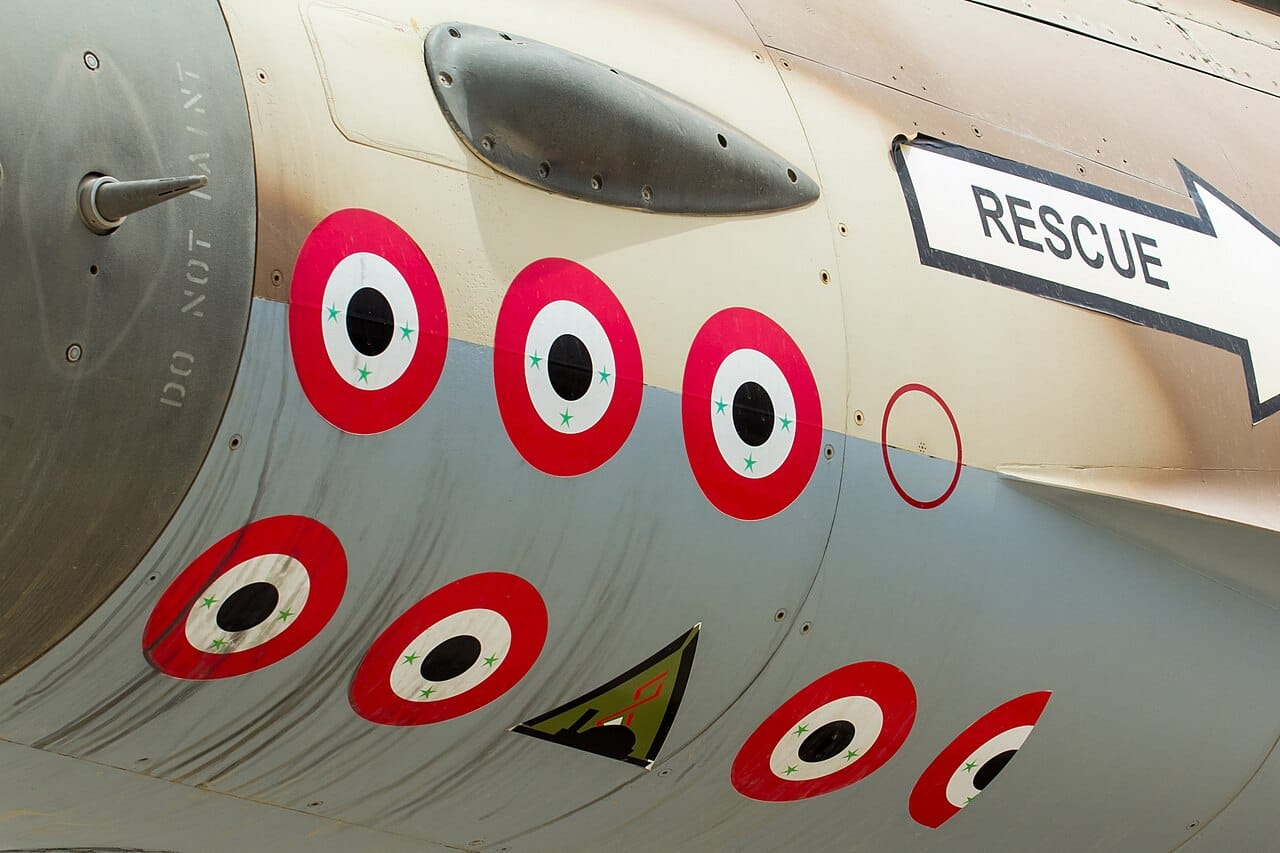
Late in the afternoon of 7 June 1981, eight Israeli F-16s are skimming the desert at rooftop height, fuel gauges a constant worry. Flying the last and most exposed aircraft in the formation is the youngest of them, a 27-year-old named Ilan Ramon, who has done the arithmetic and quietly accepted that he may not have the fuel to make it home.
Ahead lies Baghdad, and on its outskirts a French-built nuclear reactor named Osirak. The jets pop up, roll in on the great concrete dome, and release their two-thousand-pound bombs. In under two minutes, Iraq’s path to a nuclear weapon is rubble.
Then all eight aircraft turn for home — and, against the odds, every one of them makes it.
Quick Facts
| Date | 7 June 1981 |
| Force | 8 IAF F-16A Netz (two Mk-84 2,000-lb bombs each); 6 F-15A escorts |
| Target | The Osirak (Tammuz-1) nuclear reactor near Baghdad |
| Distance | More than 1,600 km each way — near the F-16’s range limit |
| Result | Reactor destroyed before it went operational; all aircraft returned safely |
| Notable pilot | Ilan Ramon, later Israel’s first astronaut (died aboard Columbia, 2003) |
A reactor and a deadline
Iraq, under Saddam Hussein, was building the Osirak reactor with French help, and Israel was convinced it was a step toward a bomb. Diplomacy went nowhere. The planners faced a hard deadline: once a reactor is loaded with fuel and goes “hot,” bombing it risks scattering radioactivity over a city. The strike had to come first — and it had to come from a long way away.
Low, fast, and almost out of fuel
Eight F-16As, each carrying a pair of unguided Mk-84 bombs, with six F-15s riding shotgun, crossed Jordanian, Saudi and Iraqi airspace at low level to slip under the radar. They flew so close to the edge of their range that fuel, not the enemy, was the real threat. Ramon flew the rearmost slot, the one most likely to run dry.
Over the target they climbed, tipped into their dives, and walked their bombs into the reactor dome. The raid killed ten Iraqi soldiers and one French technician. Within minutes the formation was racing back across the desert.

The doctrine it created
At the time, the raid drew widespread international condemnation. In the decades since, it has become the textbook example of the preventive strike — the so-called Begin Doctrine that a state will act alone to stop an enemy from acquiring nuclear weapons. Israel invoked the same logic over Syria in 2007, and the debate returns every time Iran’s nuclear programme makes headlines.
Eight aircraft flew to Baghdad and back in a single afternoon and rewrote the rules for how the world tries to stop a bomb before it is built. And the youngest pilot who came home that day would, two decades later, carry the memory of it all the way to space.
Sources: Wikipedia; The Times of Israel; The Aviationist.
Related Questions
What was Operation Opera?
Operation Opera was an Israeli air strike on 7 June 1981 that destroyed Iraq\u2019s Osirak nuclear reactor near Baghdad. Eight Israeli F-16 fighters, escorted by six F-15s, bombed the reactor before it could become operational.
When did Israel bomb the Osirak reactor?
The raid took place on 7 June 1981, in the late afternoon, during a period of heightened concern over Iraq\u2019s nuclear programme.
How many aircraft took part in the Osirak raid?
Eight F-16A fighters carried out the bombing, each armed with two 2,000-pound Mk-84 bombs, supported by six F-15A fighters flying escort.
Who were the pilots of Operation Opera?
The eight F-16 pilots were Ze\u2019ev Raz (the leader), Amos Yadlin, Dobbi Yaffe, Hagai Katz, Amir Nachumi, Iftach Spector, Relik Shafir and Ilan Ramon. Ramon, the youngest, later became Israel\u2019s first astronaut.
Did all the aircraft return safely?
Yes. Despite flying near the limit of their range and deep into hostile territory, all eight F-16s and their F-15 escorts returned safely to Israel.
What is the Begin Doctrine?
The Begin Doctrine, named after Israeli Prime Minister Menachem Begin, holds that Israel will act pre-emptively, including with military force, to prevent hostile states from acquiring nuclear weapons. The Osirak raid is its founding example.
0 Comentarios