
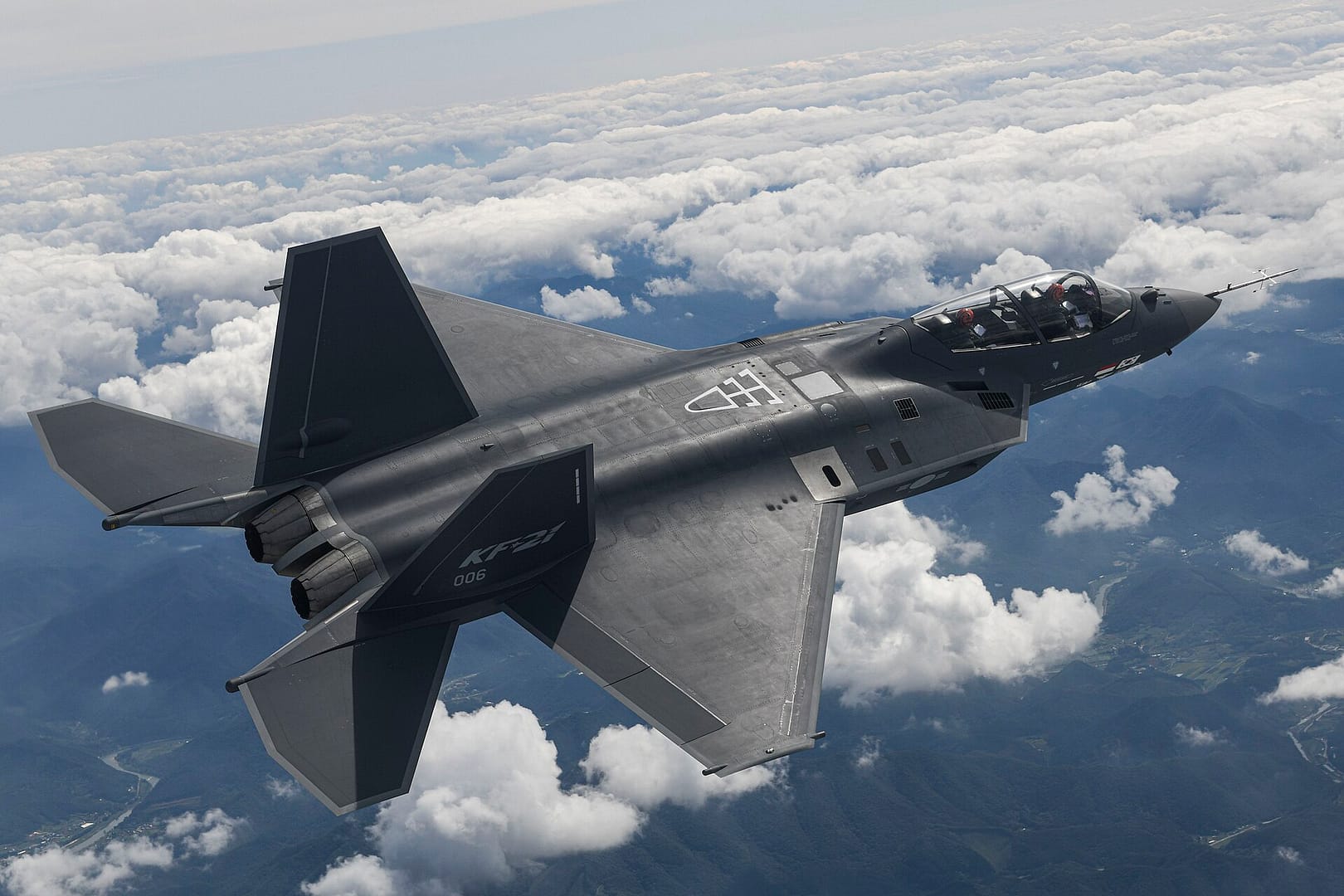
South Korea reached a landmark milestone on March 25, 2026, when the first series-production KF-21 Boramae fighter jet rolled out of the Korea Aerospace Industries (KAI) factory in Sacheon under its own power — marking the birth of a new chapter in the nation's air combat capability.
The ceremony, presided over by South Korean President Lee Jae-myung, drew broad coverage from defence outlets across the globe. For a country that flew its first indigenous fighter prototype less than four years ago, the transition to mass production is striking in its speed.

From Concept to Combat-Ready
The KF-21 program traces its origins to a proposal made in 2001 by President Kim Dae-jung, who sought to end South Korea's dependence on foreign fighter imports. Twenty-five years later, the production line is running. The first prototype took to the air in July 2022, and since then six test aircraft have accumulated approximately 1,600 sorties over 42 months of flight testing — a programme that, notably, completed without incident.
The production KF-21 is a twin-engine, 4.5-generation fighter measuring 17 metres in length with an 11-metre wingspan. Two General Electric F414 afterburning turbofans give it a maximum speed of Mach 1.8, a service ceiling of 16,700 metres, and a combat radius of 1,500 nautical miles. Primary armament is four recessed MBDA Meteor beyond-visual-range missiles — one of the most capable air-to-air weapons currently in service — supplemented by IRIS-T short-range missiles and JDAM precision-guided bombs. An Hanwha Systems APY-016K domestically developed AESA radar sits in the nose.
Production and Delivery Schedule
The aircraft that rolled out on March 25 is the first of 40 Block I jets, all of which are scheduled for delivery to the Republic of Korea Air Force (ROKAF) by 2028. An additional 80 Block II aircraft — with expanded air-to-ground capabilities — are planned for delivery by 2032, bringing the total fleet to 120 airframes. Eight aircraft are expected to be handed over this year alone, with full operational deployment beginning in September 2026 following final verification testing.
The two-seat configuration of the Block I is worth noting: the rear cockpit is designed to allow the backseater to command unmanned systems and Collaborative Combat Aircraft (CCA) — a capability architecture that mirrors approaches being explored by the U.S. and several European programmes.

Export Prospects
International interest in the Boramae is substantial. Indonesia has agreed to purchase 16 airframes, and the Philippines is expected to formalise an order before mid-2026. KAI has prior export experience with the FA-50 light combat aircraft and T-50 trainer across six countries, giving it an established sales network. Defence analysts note that the KF-21's combination of Western-compatible avionics, competitive pricing, and demonstrated flight safety makes it an attractive alternative to more expensive fifth-generation options for mid-tier air forces.
Presidential Remarks
President Lee framed the rollout in terms of strategic independence. "South Korea has become a nation that possesses weapons to safeguard peace through its own technology and willpower," he told the assembled crowd, adding that the country aims to become a "top four defence power" across all domains. For a country that spent decades acquiring combat aircraft exclusively from the United States, the symbolism was not lost on anyone present.
Sources: The War Zone · Jane's Defence Weekly · The Defense Post
Preguntas relacionadas
What is the KF-21 Boramae?
The KF-21 Boramae is South Korea's first domestically developed fighter jet, a twin-engine 4.5-generation aircraft built by Korea Aerospace Industries (KAI). Designed to replace aging F-4 y F-5 jets, it blends advanced radar and weapons with provisions for future stealth features, reducing South Korea's reliance on imported fighters.
When did KF-21 mass production begin?
South Korea rolled out its first series-production KF-21 Boramae on March 25, 2026, at the KAI factory in Sacheon, with President Lee Jae-myung presiding. The milestone came less than four years after the type's first prototype flew, a strikingly fast transition from development to mass production for an indigenous fighter.
Who makes the KF-21 fighter?
The KF-21 Boramae is built by Korea Aerospace Industries (KAI), South Korea's main aerospace manufacturer, at its Sacheon plant. The program reflects a broader global trend of nations developing home-built fighters to gain independence, similar to India's Tejas Mk2 and Europe's next-generation fighter efforts.
Why did South Korea build its own fighter jet?
South Korea pursued the KF-21 to end its dependence on foreign fighter imports, a goal first proposed in 2001 by President Kim Dae-jung. A domestic program gives Seoul control over upgrades, exports, and industrial jobs, and positions South Korea among the small group of nations that design and build their own combat aircraft.
Is the KF-21 a stealth fighter?
The KF-21 Boramae is considered a 4.5-generation fighter rather than a full stealth aircraft. It incorporates some low-observable design features and carries weapons externally at first, with plans to add internal weapons bays and other stealth enhancements in later versions, gradually closing the gap with fifth-generation jets.
0 Comentarios