
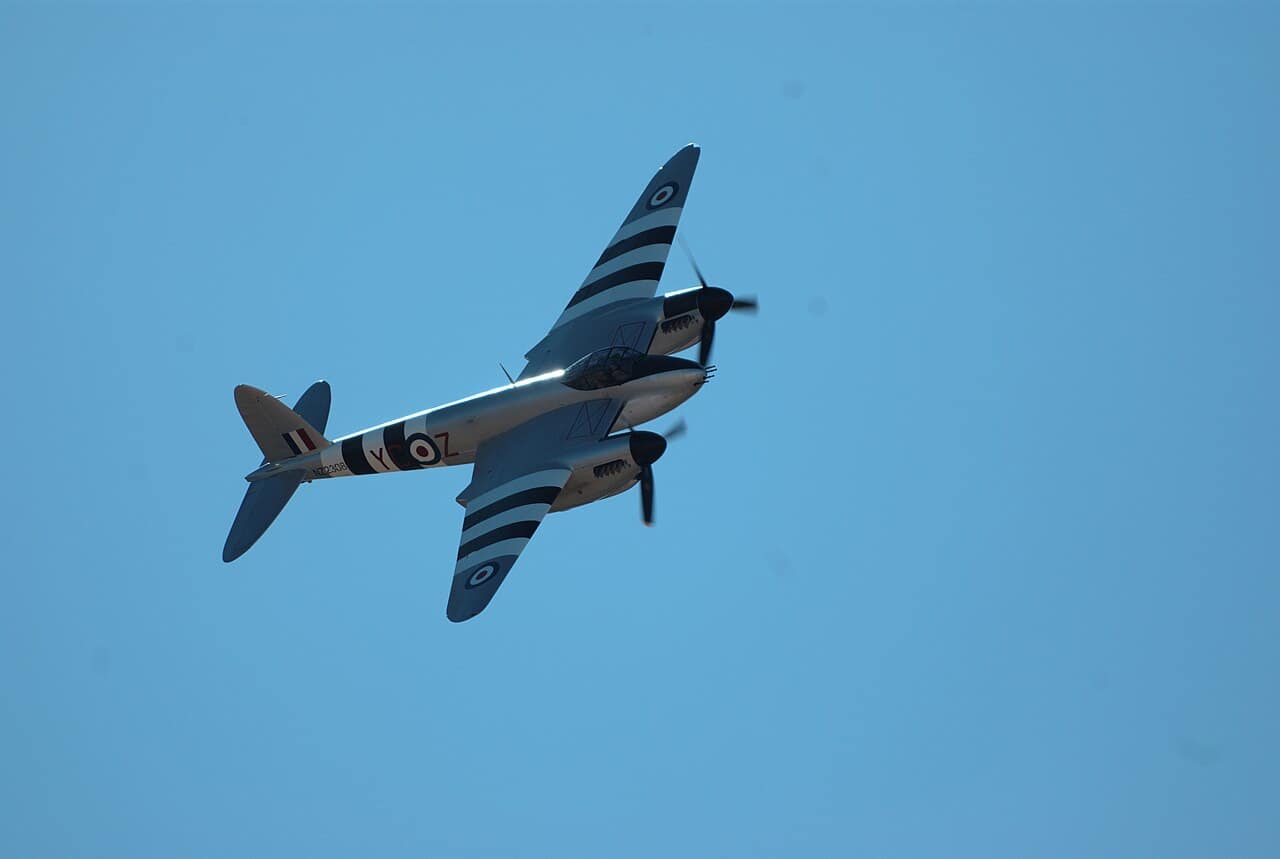
In 1940, as the Battle of Britain raged, the de Havilland company was quietly building a bomber the Air Ministry had not asked for and did not want — and it was making it out of wood. Officials scoffed. Within two years, that wooden aeroplane was the fastest thing in RAF service and the most versatile combat aircraft of the entire war.
The de Havilland Mosquito — the “Wooden Wonder,” or simply the “Mossie” — had no defensive guns, relied on sheer speed to survive, and terrified the Luftwaffe. It could do almost anything, and it did.
DATOS RÁPIDOS
| Aeronave | de Havilland DH.98 Mosquito |
| Origen | United Kingdom, first flew 1940 |
| Construction | Mostly wood — plywood and balsa |
| Motores | 2 × Rolls-Royce Merlin |
| Speed | 380+ mph; later marks over 400 mph |
| Roles | Bomber, night fighter, pathfinder, recon, strike — all of them |
| Construido | Around 7,780, in Britain, Canada and Australia |
A bomber built by furniture makers
Sir Geoffrey de Havilland made a heretical bet. Almost every combat aircraft of the era had a metal structure; he was convinced a wooden aircraft could be lighter, more streamlined and faster — and it would use non-strategic materials and the skills of Britain’s furniture and piano makers rather than scarce aluminium and aircraft factories. He laid out the logic before the war even began.
That was the whole idea: build it fast enough and it would simply outrun the fighters sent to catch it, carrying no guns and no gunners — just two Merlin engines, two crew and a bomb load. When it appeared in 1941, it was one of the fastest aircraft in the world.

The story of the Wooden Wonder.
The aircraft that could do everything
Conceived as an unarmed fast bomber, the Mosquito refused to stay in one lane. It became a night fighter, a pathfinder marking targets for the heavy bombers, a low-level fighter-bomber, a photo-reconnaissance platform, a maritime strike aircraft and an intruder hunting over occupied Europe. It also had the lowest loss rate of any aircraft in RAF Bomber Command — because the enemy so often simply could not catch it.
Its precision became legendary. Mosquitos flew rooftop-height raids to breach the walls of Amiens prison and to strike Gestapo headquarters in Oslo, Copenhagen and Aarhus. On 30 January 1943, a daylight Mosquito raid knocked a Nazi anniversary broadcast off the air in Berlin — a humiliation the regime never forgot.

Green and yellow with envy
No one resented the Mosquito more than the man tasked with stopping it. In a rant to German aircraft manufacturers — a quote long attributed to Hermann Göring, though it has never been fully verified — the Luftwaffe chief is said to have vented his fury at the little wooden bomber that kept getting through.
Whether or not those were his exact words, they capture the truth perfectly. The Mosquito was cheap, fast, adaptable and everywhere — a triumph of clever engineering over brute industrial might. It proved that in war, as in design, the smartest answer often beats the biggest one.
Why the Luftwaffe feared the Mosquito.
The unsung hero of the RAF’s war.
Sources: Imperial War Museums; RAF Museum; HistoryNet; Britannica.

0 Comentarios