

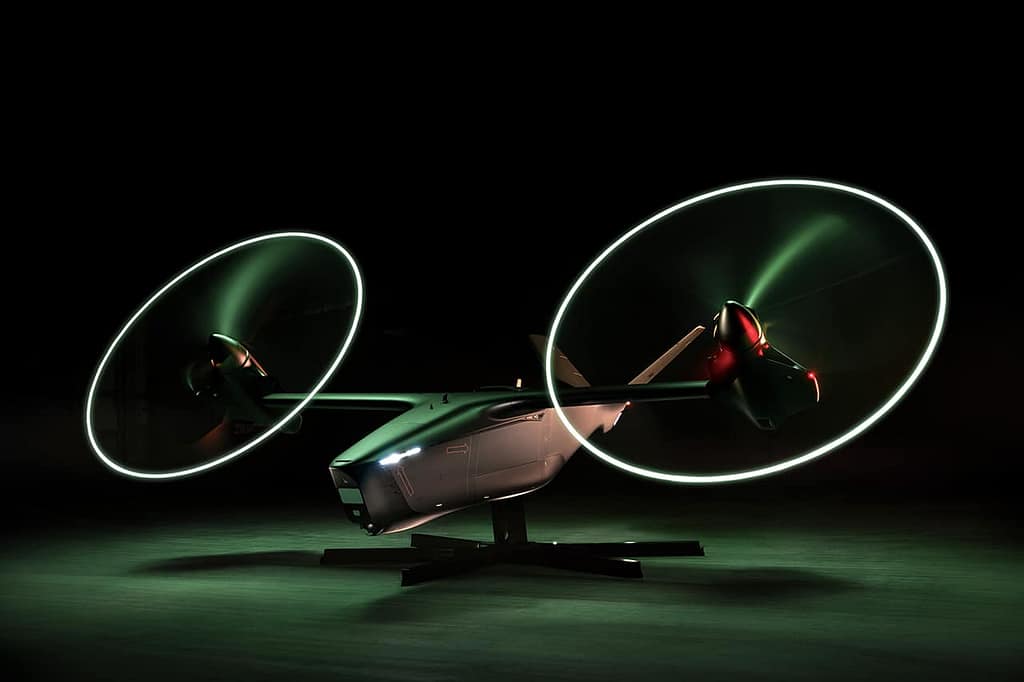
The model sitting under the lights on Anduril's stand at Farnborough on Monday morning does not look like anything currently in the US Army inventory. It has two enormous tilting rotors, a fuselage shaped like a stretched teardrop, and where a cockpit should be there is simply more airframe. Nobody sits in it. Nobody ever will.
This is Thunder, and Anduril unveiled it on the opening day of the show with a pitch that is deliberately unsubtle: bolt three of these onto an Apache and you triple the number of weapons that formation carries into a fight, without putting a single extra crew member at risk.
The company has been building it quietly for about three years. Its first flight is expected in 2027.
Datos rápidos
| Name | Thunder, an uncrewed tiltrotor from Anduril Industries |
| Unveiled | 20 July 2026, opening day of the Farnborough International Airshow, as a full-scale model |
| Class | Group 5 UAS — the top tier, covering aircraft over 1,320 lb that operate above 18,000 ft |
| Propulsión | Hybrid-electric, developed with Archer Aviation. Rotor RPM is variable in flight |
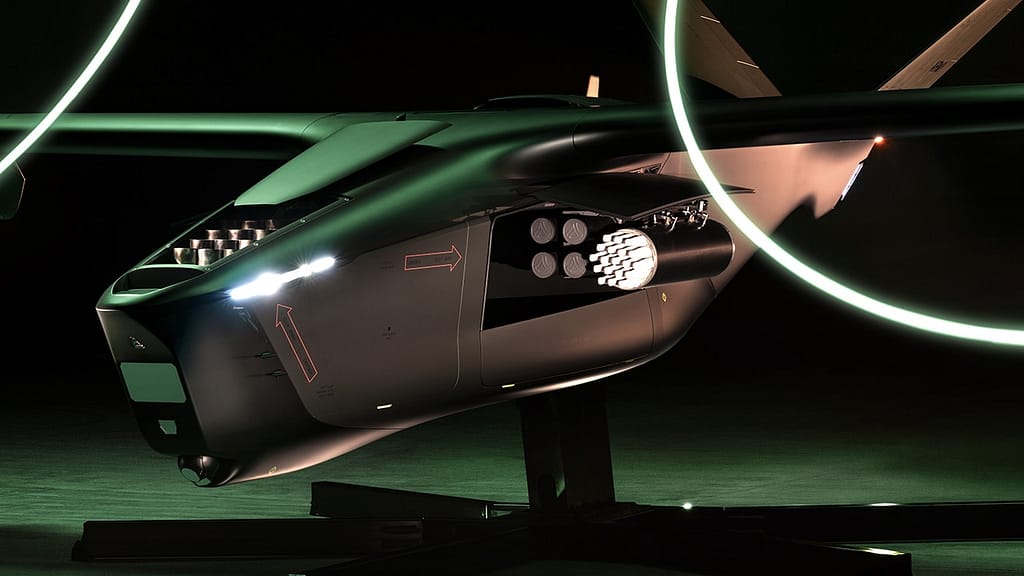
| Payload | Two configurable bays. Anduril lists Hellfire-class missiles, APKWS kits, launched effects, tube-launched drones, counter-drone effectors, or up to 76 70 mm rockets |
| Teams with | AH-64 Apache and the US Army’s forthcoming MV-75 Cheyenne II |
| Primer vuelo | Expected 2027. Test flying with full-scale surrogate aircraft has already been done |
| Transporte | Fits inside a standard shipping container; can also self-deploy within range |
A loyal wingman that lands like a helicopter
The collaborative combat aircraft idea is not new any more. The US Air Force has two jet-powered designs in its Increment One programme, one of which — Anduril's own YFQ-44A Fury — fired its first live AMRAAM earlier this month. Australia has the MQ-28 Ghost Bat. Europe has a scramble of competing prototypes.
All of them are built to fly alongside fighters, at fighter altitudes and fighter speeds. Thunder is aimed at the layer underneath: the low, cluttered, contested air where army aviation actually operates, and where a fixed-wing drone that needs a runway is no use at all.
Being a tiltrotor is the whole point. It can lift off from a clearing, then convert and cruise considerably faster than a conventional helicopter. Shane Arnott, Anduril's senior vice president of programs and engineering, put the performance envelope in terms army aviators will understand instantly: the range and speed of an MV-75, with the payload capacity of an Apache.
That framing matters. Anduril is not selling Thunder as a cheaper Apache. It is selling it as a way to put more sensors and more weapons into a fight that has become lethally expensive for crewed helicopters — a lesson Ukraine has been teaching in public for four years.
The autonomy package is tuned for the same environment. Anduril says it is built specifically to operate fast and low among terrain, obstacles and threats, sharing data in real time with crewed and uncrewed platforms alike.
Commanding, not controlling
The number Anduril keeps repeating is three. Three Thunders flying with one Apache, tripling the munitions the formation brings to the target without tripling the crews exposed to getting there. Arnott went further and sketched formations of up to six.
The distinction he draws is the one that separates this generation of drones from the last one. A Reaper needs a crew flying it from a ground station. Thunder is meant to be told what to achieve, not how to fly.
Look into the open bay on the model and the ambition is obvious. Anduril's own images show stacked rocket tubes, missile racks and modular cells that can be swapped for something else entirely — ISR sensors for maritime patrol, or simply cargo.
The part nobody has answered yet
For all the confidence on the stand, Thunder does not yet have a customer. Anduril has developed it against what it believes the US Army, Marine Corps and Special Operations Command will want, rather than against a signed requirement. Brose was candid that the procurement question is one for later, and that the immediate job is proving the need exists at all.
That is a familiar Anduril posture. The company — founded less than a decade ago, named after a sword in Tolkien, and co-founded by Oculus creator Palmer Luckey — has a habit of building the thing first and arguing about the contract afterwards. It has worked often enough that the derision it once attracted has largely stopped.
The engineering questions are real, though. A hybrid-electric powertrain in a Group 5 tiltrotor is not a solved problem, which is presumably why Archer Aviation is involved. And an aircraft that claims Apache payload with MV-75 range is making a promise no prototype has yet had to keep.
Which is what 2027 is for.
A first look at Thunder on the Farnborough stand, showing the scale of the full-size model.
Sources: DefenseScoop, The Aviationist, Breaking Defense, The War Zone, Aviation Week.
0 Comentarios