
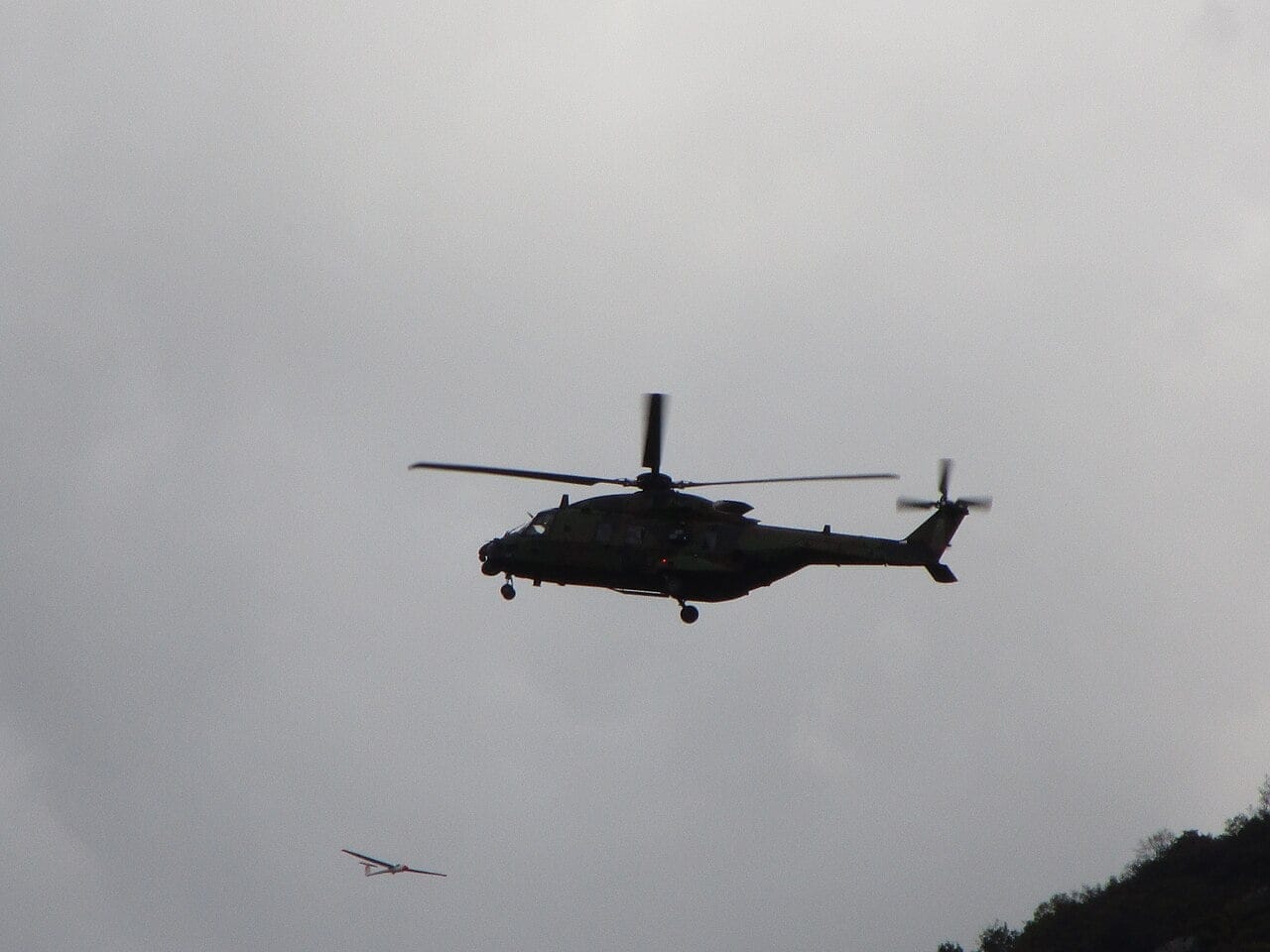
France’s special forces are about to get a very different kind of helicopter. On Jul. 30, 2026, Airbus Helicopters announced the delivery of the first NH90 Caïman Standard 2 — a purpose-built special-operations version of France’s standard battlefield transport, bristling with sensors and designed to slip commandos into the hardest places on Earth, by night, in any weather.
The French procurement agency DGA, which formally took the aircraft on behalf of the Armée de Terre, said the delivery “heralds a new era” for the country’s special operations forces. It is the first of 18 on order for the elite 4th Special Forces Helicopter Regiment at Pau.
Datos rápidos
- Aeronave: NH90 Caïman Standard 2 (NH90 FS – Forces Spéciales)
- Entregado: announced by Airbus Helicopters on Jul. 30, 2026
- Operador: 4th Special Forces Helicopter Regiment, Pau (French Army Aviation / ALAT)
- Orden: 18 for France, all by mid-2029; Spain ordered 31 similar in Dec 2025
- Key sensor: Safran Euroflir 410 electro-optical turret with laser designator
- Sustituye a: H225M Caracal and H215M Cougar
- Base variant: NH90 TTH; built by NHIndustries at Marignane
A Caïman with sharper senses
The Standard 2 — also called the NH90 FS, for Forces Spéciales — is a derivative of the NH90 TTH tactical transport that France already flies as the Caïman. What sets it apart is what has been bolted on and built in. The defining feature is a Safran Euroflir 410 electro-optical ball turret with infrared modes and a laser tracker and designator, giving crews the ability to find, track and mark targets in the dark.
Around that sit a new digital map generator, room for a third crew member, and enlarged rear sliding windows sized to take self-protection machine guns. The airframe is wired for the future too, with provisions for the Eurofl’eye distributed-aperture system — multispectral cameras giving all-round vision — while a Thales TopOwl helmet display feeds sensor imagery straight onto the pilot’s visor.
Easier to fly, harder to surprise
Underneath the mission kit, the Standard 2 gains an all-new digital fly-by-wire flight-control system for smoother handling, single-pilot capability, an anti-icing system and an automated fault-and-maintenance diagnostic suite. The production aircraft wears the French Army’s green-grey-brown camouflage; the prototype used during earlier trials flew in an all-black scheme that delighted the country’s aviation spotters.
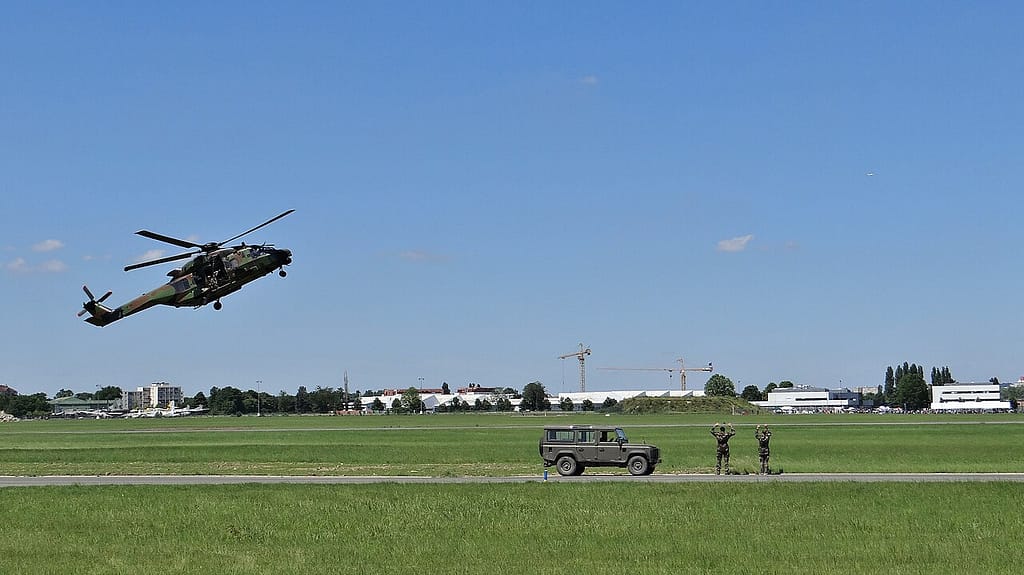
Airbus Helicopters chief executive Matthieu Louvot framed the delivery as a milestone not just for France but for the wider NH90 programme.
A European programme, not just a French one
The 18 French machines will be delivered by mid-2029, replacing the ageing H225M Caracal and H215M Cougar in the special-operations role. France is not alone: in December 2025 Spain joined the effort, ordering 31 helicopters in a similar standard, a sign the design may become a continental benchmark.
The NH90 itself is a pan-European product, built by NHIndustries — a joint venture of Airbus Helicopters, Leonardo and GKN Fokker — and assembled at Marignane. France already flies 64 NH90 TTH Standard 1s with the Army and 27 naval NH90 NFHs with the Marine Nationale. The Standard 2 is the sharpest branch yet on that family tree, and a second, more demanding round of operational trials is now under way to wring out its new systems before it goes to war.
Sources: Airbus Helicopters; DGA / Ministère des Armées; Aviation Week; Army Recognition; The Aviationist; Militarnyi.
Publicaciones relacionadas
0 Comentarios