

The Lockheed U-2 was designed by Kelly Johnson at Skunk Works in 1955 to fly at 70,000 feet, photograph Soviet missile silos in colour, and never — under any circumstances — go anywhere near a body of water. The U-2 had bicycle landing gear. The U-2 had a 24-metre wingspan that flexed visibly in cruise. The U-2 had to be flown onto the runway with someone in a Pontiac driving alongside calling out the altitude over the radio because the pilot could not see the ground. The U-2 was, in short, the worst possible candidate for carrier operations ever proposed by a serious aerospace engineer.
In 1963 the CIA proposed exactly that. Kelly Johnson agreed. The project was given the codename Project Whale Tale, and on 3 August 1963, a U-2 was lowered by crane onto the deck of USS Kitty Hawk in San Diego. What happened next is one of the most improbable carrier-aviation programmes in history.
Informations clés
| Programme codename | Project Whale Tale (1963–1969) |
| Aéronef | Modified Lockheed U-2A → U-2G → U-2R |
| First carrier landing attempt | 3 August 1963, USS Kitty Hawk, off San Diego (damaged wingtip on landing) |
| First successful U-2G carrier landing | 2 March 1964, USS Ranger, Lockheed test pilot Bob Schumacher |
| Operational mission | Operation Fish Hawk — May 1964 from USS Ranger, photographing a French nuclear test in the Pacific |
| Modifications | Strengthened landing gear, arrestor hook, wing spoilers for lift-dump on touchdown |
| Final tests | 1969, USS America (CVA-66), the U-2R successfully landed but never operationally deployed |
Why the CIA wanted a carrier-launched spy plane
The 1960 shoot-down of Francis Gary Powers over Sverdlovsk had ended overflights of the Soviet Union. But the world was full of other places the CIA wanted to photograph — many of them across oceans, in the territory of allies who would not grant overflight rights, or against targets like atmospheric nuclear tests that took place in the middle of the Pacific. A U-2 could only fly from a runway, and runways were political. A carrier was American sovereign territory wherever it sailed.
The CIA approached Kelly Johnson at Lockheed Skunk Works in May 1963 with the idea. Johnson was famously skeptical of foolish proposals. He agreed to consider this one because the Agency was paying. His engineers concluded that the modifications would not be trivial — the U-2 was a glider that had been retrofitted with a jet engine, and its airframe was built like a glider — but the modifications were achievable.
The first test: a bounce, a wingtip, and an open mouth
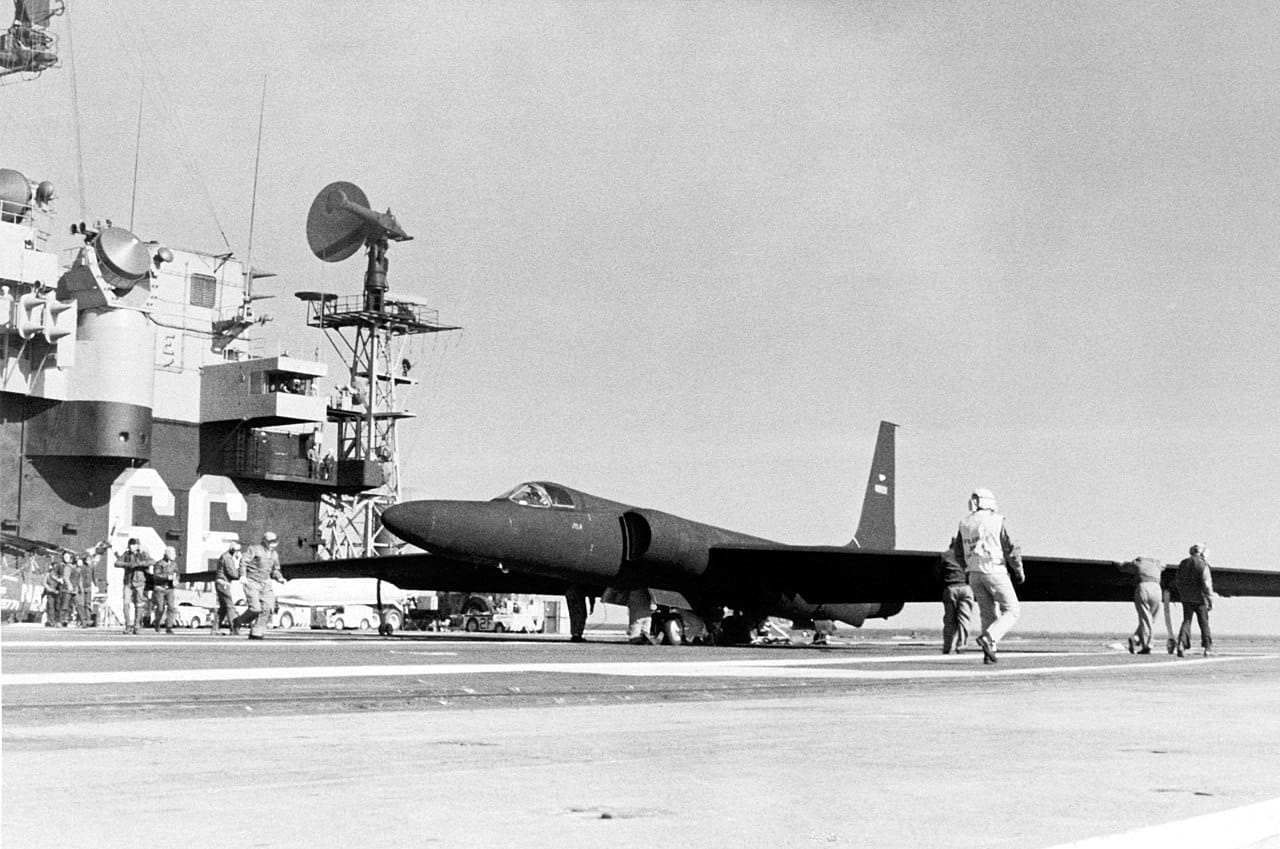
On 3 August 1963, a Navy crane lifted U-2 article 349 onto the flight deck of USS Kitty Hawk. The carrier sailed off the coast of San Diego. On the morning of 5 August, Lockheed test pilot Bob Schumacher accelerated the U-2 down the deck, lifted off in just 321 feet without using the catapult, climbed away, and came back to land. The landing did not go well. The U-2 bounced, one wingtip struck the deck, and the aircraft staggered back into the air just before reaching the end of the deck.
Schumacher returned to North Island Naval Air Station with a broken wingtip and a list of necessary modifications. The U-2 needed an arrestor hook. The U-2 needed strengthened landing gear. The U-2 needed lift-dump spoilers on the wing — because the U-2's gigantic span meant it kept flying for several seconds after touchdown, exactly what you cannot do on a 250-metre deck. The carrier-qualified variant, designated U-2G, was assembled and ready by late 1963.
Operation Fish Hawk — May 1964
On 2 March 1964, Schumacher made the first true successful carrier landing of a U-2G aboard USS Ranger off the California coast. Touch-and-go runs followed. Three CIA pilots were qualified during the same deployment. They were ready in time for the real mission.
The first operational mission, codenamed Operation Fish Hawk, was a photographic reconnaissance of French nuclear-test preparations at the Mururoa Atoll in the South Pacific. The U.S. wanted to know what kind of device the French were testing, how big it would be, and how their delivery infrastructure was developing. France was not going to allow American overflights from any of its territories. USS Ranger sailed close, the U-2G launched on 19 May 1964 — and immediately ran into cloud cover that obscured the targets.
A second sortie went up on 23 May. This one delivered. Every target was photographed at high resolution. The CIA had its data. The first ever operational U-2 mission from an aircraft carrier was a complete success — and it would be the only such mission in the entire programme.
Why it ended
The 1969 trials of the larger U-2R from USS America were technically successful — Lockheed test pilot Bill Park made multiple successful landings — but by then the entire premise of carrier-launched strategic reconnaissance had been undermined by another piece of American technology: the CORONA reconnaissance satellite. Photographs from orbit, with no risk to any pilot, no diplomatic incident, no carrier deployment, were now possible. The U-2R never flew an operational mission from a ship. The whole programme was quietly retired.
Today the U-2 still flies. The latest variants, the U-2S, operate from runways at Beale Air Force Base in California and from forward operating locations around the world. None of them have arrestor hooks. None of them have wing spoilers for lift-dump. The carrier configuration died with Project Whale Tale, a footnote of Cold War aviation that nearly nobody outside Lockheed Skunk Works ever fully believed had really happened.
Footage and analysis of how the impossible — landing a U-2 on an aircraft carrier — was actually achieved by Project Whale Tale.
Sources: CIA historical archives; Wikipedia; The Aviationist; Air & Space Forces Magazine; National Interest; Coffee or Die; Naval History Magazine (USNI); Aerospaceweb.
Questions connexes
Did the CIA ever land a U-2 spy plane on an aircraft carrier?
Yes. Under the secret Project Whale Tale (1963–1969), the CIA modified Lockheed U-2 spy planes to operate from aircraft carriers. The first successful carrier landing came on 2 March 1964 aboard USS Ranger, flown by Lockheed test pilot Bob Schumacher.
What was Project Whale Tale?
Project Whale Tale was a covert 1960s programme to fly the U-2 spy plane from aircraft carriers, giving the CIA reconnaissance reach far from any land base. It required modified U-2s with strengthened landing gear and an arrestor hook.
Why operate a U-2 from an aircraft carrier?
A carrier let the U-2 reach remote targets without needing a friendly land base nearby. The capability was used operationally in May 1964, when a carrier-launched U-2 photographed a French nuclear test in the Pacific during Operation Fish Hawk.
How was the U-2 modified to land on a carrier?
The fragile, long-winged U-2 was fitted with strengthened landing gear and an arrestor hook so it could withstand carrier landings. Even so, the first attempt in August 1963 damaged a wingtip; success came months later after further refinement.
When did the first U-2 land on a carrier?
The first carrier landing attempt was on 3 August 1963 aboard USS Kitty Hawk, but it damaged the aircraft. The first fully successful U-2 carrier landing followed on 2 March 1964 aboard USS Ranger.
Articles similaires
36 Metres, No Second Chance: Eugene Ely Invented the Carrier Landing
0 commentaire