

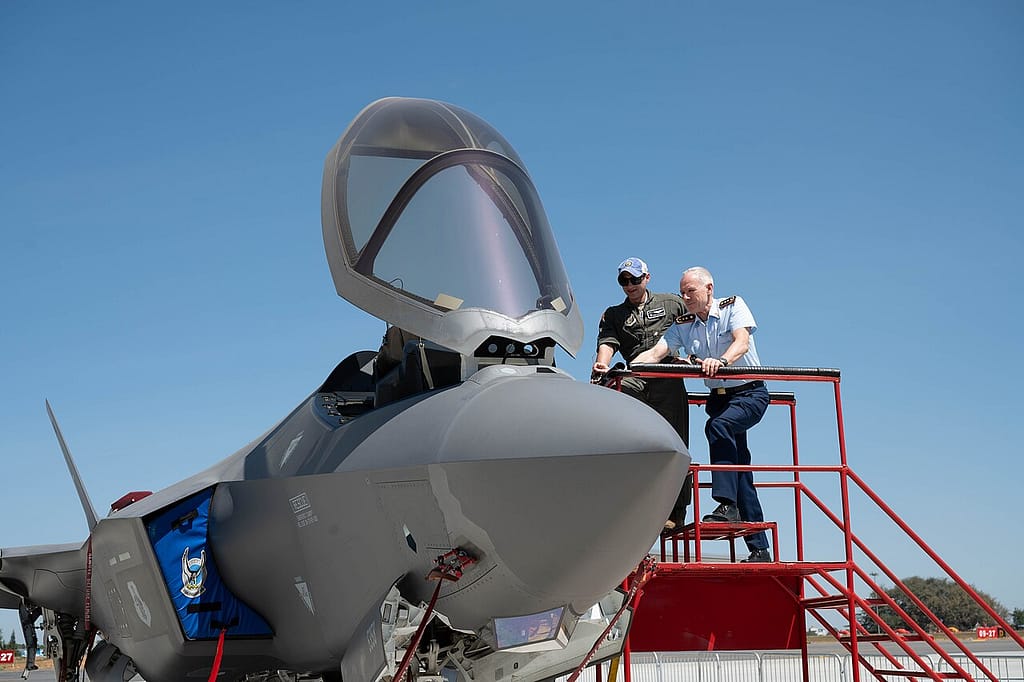
In a high-bay hall in Fort Worth, Texas, a matte-grey shape is about to disappear. Germany's first F-35A Lightning II, the airframe stamped MG-01, has rolled out of final assembly and into the stage Lockheed Martin calls Aircraft Final Finishes: the point where the jet receives its paint and its radar-swallowing low-observable coating. When it comes out, it will look like a fighter. Right now it looks like the future of the Luftwaffe with its skin half on.
The milestone, confirmed on 17 August 2026, is the clearest sign yet that Germany is weeks away from a fighter it has been waiting on since 2022. MG-01 is the first of 35 F-35As ordered to take over NATO's most sensitive job in German hands: carrying the American B61-12 nuclear bomb in a European crisis.
It is also a quietly historic changing of the guard. The jet MG-01 replaces, the Panavia Tornado, has flown that nuclear-strike mission for the Luftwaffe since the Cold War.
Informations clés
Aéronef: Lockheed Martin F-35A Lightning II (airframe MG-01)
Opérateur: German Luftwaffe
Commande: 35 aircraft (a further 15 planned, lifting the fleet toward 50)
Rôle: Dual-capable — conventional strike plus the B61-12 nuclear mission, replacing the Tornado IDS
Moteur: Pratt & Whitney F135-PW-100
Rollout: Planned 18 September 2026; maiden flight later in 2026
Basing: Training at Ebbing ANGB, Arkansas; first German-based jets at Büchel from 2027
Milestones: IOC targeted 2029, full operating capability 2030
From Fuselage to Final Finish
MG-01's path down the Fort Worth line reads like a countdown. The wing and the forward, centre and aft fuselage sections were joined in March 2026. In early June, technicians mated the Pratt & Whitney F135-PW-100 — the single engine that gives the F-35 both its supersonic dash and the electrical power to run its sensors. With the airframe complete, the jet has now moved into final finishes for paint and stealth coating before ground and flight testing.
Lockheed Martin has set the rollout ceremony for 18 September 2026, with a maiden flight to follow later in the year. Seven more German F-35As are already moving down the same line behind MG-01, so the first jet is the leading edge of a steady stream, not a one-off.
Why the F-35A's nuclear certification matters for NATO's European members.
The Nuclear Mission
The reason Germany is watching this particular airframe so closely sits in a weapons bay. In October 2023 the U.S. Air Force certified the F-35A to carry the B61-12 guided nuclear bomb, making it the first fifth-generation fighter ever cleared for the role. That certification is what lets the F-35 inherit the Tornado's place in NATO's nuclear-sharing arrangement, under which U.S. bombs are stored in Europe and delivered, in extremis, by allied aircraft.
Those weapons are believed to be held at Büchel Air Base in the Eifel, where construction crews have been upgrading facilities for the new jet. From 2027 the first F-35As will stand alert there; until then, German crews will train on the type at Ebbing Air National Guard Base in Arkansas, the international schoolhouse where several European F-35 operators learn the aircraft.
A Bigger Fleet, a Fractured Alternative
Germany's 35 jets may not be the end of it. Berlin has signalled it wants roughly 15 more F-35As, which would push the Luftwaffe fleet toward 50 aircraft. The appetite has grown as the Franco-German-Spanish FCAS sixth-generation project has stumbled, leaving the F-35 as the only stealth fighter Germany can actually field this decade.
Germany is not alone in the queue. By mid-August 2026, roughly 200 of more than 650 planned F-35s had been delivered to European air forces, a continent-wide re-equipment that is quietly making the Lightning II the backbone of NATO's European air power. MG-01, still wearing its undercoat in Texas, is one jet in that wave — but for the Luftwaffe, it is the one that ends the Tornado era.
When the paint dries and the hangar doors open on 18 September, Germany will finally see the aircraft it has argued over for years. The Cold War workhorse is bowing out. Its stealthy replacement is getting dressed.
Sources: Lockheed Martin / F35.com; Janes; Aerospace Global News; defence-industry.eu; Army Recognition; U.S. Air Force.


0 commentaire