

The men on the beach at Hammam al-Shatt heard the sea before they heard the sky. It was a clear Tuesday morning, just after ten, the first of October 1985, and the Tunisian coast south of Tunis was doing what it always did at that hour, fishermen, a few children, the smell of pine and salt drifting over a cluster of low, sand-coloured buildings among the palms. Then two silver shapes dropped out of the light and came in so low that the people standing on the shore could read the tails. On each one was a blue Star of David.
Six minutes later, the headquarters of the Palestine Liberation Organization was a field of twisted steel and broken concrete, and the Israeli Air Force was already turning east for the longest flight home in its history.
Informations clés
- Date: 1 October 1985
- Cible: PLO headquarters at Hammam Chott (Hammam al-Shatt), about 20 km south of Tunis, Tunisia
- Distance: Roughly 2,060 km (about 1,280 miles) each way; a round trip of over 4,000 km
- Aéronef: Around ten F-15 Baz Eagles launched, eight pressing on to strike (106 “Spearhead” and 133 “Knights of the Twin Tail” Squadrons); led by Lt. Col. Avner Naveh
- Refuelling: Two Boeing 707 tankers refuelled the fighters twice over the Mediterranean; a third 707 served as airborne command post
- Armes : GBU-15 TV-guided glide bombs (two-seaters) and Mk 82 bombs (single-seaters); target destroyed in about six minutes
- Résultat: PLO HQ destroyed; roughly 60–70 killed (estimates range 41–71) and dozens wounded; Yasser Arafat was away and survived; condemned by UN Security Council Resolution 573
A headquarters in exile
To understand why Israeli fighter jets appeared over North Africa, you have to go back three years, to a war that ended without ending. In 1982 Israel invaded Lebanon and drove the PLO out of Beirut. It looked, on paper, like a victory. But the fighters did not disappear; they were simply loaded onto ships and scattered. Their new home was Tunisia, and, in one of history’s quiet ironies, it was the United States that had asked Tunisia to take them in.
So the PLO set up its offices at Hammam Chott, a seaside village outside Tunis, more than 2,000 kilometres from Israel. On the map it looked like distance. To the men who ran it, it felt like safety. That assumption was about to be tested.
The yacht at Larnaca
On 25 September 1985, three Israelis were on a yacht moored at Larnaca, in Cyprus. Three gunmen boarded the boat and, after a long standoff, killed all three. Israel blamed Force 17, an elite unit within the PLO; the organization denied it. The killings, carried out on Yom Kippur, landed in Israel as a wound that demanded an answer.
Inside the Israeli cabinet the debate was short. A seaborne commando raid was considered and set aside as too risky at that range. What remained was the option almost no one thought possible: to send fighter jets across the width of the Mediterranean and back.
Two thousand kilometres of open water
The aircraft chosen for the job were F-15 Eagles, in Israeli service the Baz, or falcon. Israel had bought them in the 1970s to win dogfights, not to drop bombs, and by 1985 the Baz already had a fearsome air-to-air record. But Israeli engineers had quietly widened the jet’s talents, fitting conformal fuel tanks and the systems to carry precision-guided weapons. Wooden Leg would be the first time the IAF sent the F-15 to war as a bomber.

The arithmetic was brutal. Hammam Chott lay about 2,060 kilometres away, roughly 1,280 miles, which meant a round trip of more than 4,000 kilometres, most of it over open sea with nowhere to land. Around ten Baz jets, drawn from the 106 Spearhead and 133 Knights of the Twin Tail Squadrons and led by Lieutenant Colonel Avner Naveh, took off from Tel Nof that morning. Two carried enough fuel worries that they were held as spares; once the formation had refuelled cleanly, those two peeled away and went home, leaving eight to press on.
Six minutes over the sea
What made the flight survivable was a small fleet of support aircraft most people never picture when they imagine a fighter strike. Two Boeing 707 tankers, converted airliners, met the Eagles over the Mediterranean and topped off their tanks, once on the way out and again on the way back. A third 707 flew as an airborne command post. E-2C Hawkeyes worked the radar picture, and near Malta an Israeli naval vessel waited with helicopters in case a pilot went into the water.

The route was flown to slip between Egyptian and Libyan radar and to stay clear of the US Sixth Fleet. It worked. When the formation finally split into two flights and ran in over the coast, the two-seat Eagles released GBU-15 glide bombs, each one steered onto its own aim point inside the compound by the officer in the back seat, watching a television image beamed from the falling weapon. The single-seaters followed with conventional bombs. The whole attack lasted about six minutes.
Le coût
It is easy, writing about aircraft, to stay in the cockpit, where the story is all skill and nerve and distance conquered. The ground tells a different story, and it has to be told plainly. The PLO headquarters was destroyed. Yasser Arafat, the man Israel most wanted, was not there, he had left the area, as he so often did, and he survived.
But the buildings were not empty, and neither was the beach. Estimates of the dead vary widely and remain contested: Israel claimed roughly 60 PLO members killed, while overall counts range from about 41 to 71 dead, Palestinians and Tunisians together, with dozens more wounded. Among the casualties were civilians who had no part in any of it. A precise, honest figure has never been fixed. That uncertainty is itself part of the record.
The world answers
Israel called the raid a complete success and defended it as self-defence. Much of the world called it something else. Three days later the United Nations Security Council passed Resolution 573, condemning the attack on Tunisian soil as a flagrant violation of the UN Charter and declaring that Tunisia was entitled to reparations. The vote was 14 to nil. The United States, Israel’s closest ally, abstained, and even that was a story, because Washington had first called the strike a legitimate response to terrorism before walking the language back to something it could not condone.
The diplomatic damage rippled outward. Egypt suspended talks with Israel over the disputed strip at Taba. President Hosni Mubarak warned that answering terror with terror only built an endless chain. Tunisia, a country that had once been among the first in the Arab world to speak of peace with Israel, spoke instead of state terrorism. A fragile Jordanian-led peace initiative, alive that very week, did not recover.
The long reach
Strip away the politics and one hard fact remained, and every air force in the region understood it. Israel had flown a strike package the width of the Mediterranean, hit a target within metres, and brought every crew home. No IAF operation had reached so far since the Entebbe rescue of 1976. Overnight, no capital in North Africa could assume that distance alone would keep it safe.
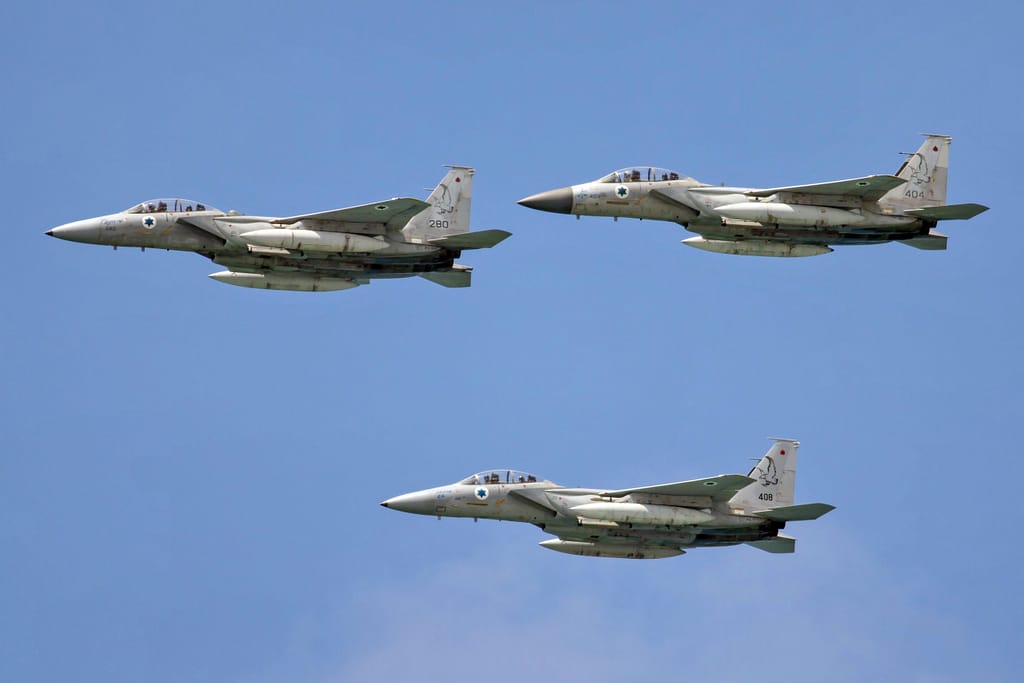
For the men who flew it, the meaning was quieter and more human. One of the pilots later described the strange weight of those final seconds over the target, the adrenaline, the tight focus, and then the flight back across all that empty water to a base where the whole squadron stood waiting.
Operation Wooden Leg is remembered in aviation circles as a feat of range and planning, and it was. It is remembered in Tunisia as a morning of dead and wounded on a quiet beach, and it was that too. Both things are true, and the honest way to hold this story is to hold them at once: an extraordinary demonstration of what a fighter jet and a pair of tankers could do, and a reminder that at the far end of every such reach are people who never saw it coming.
Sources: Wikipedia; TIME (14 Oct 1985); IDF; The Aviation Geek Club; The National Interest; UN Security Council Resolution 573.


0 commentaire