
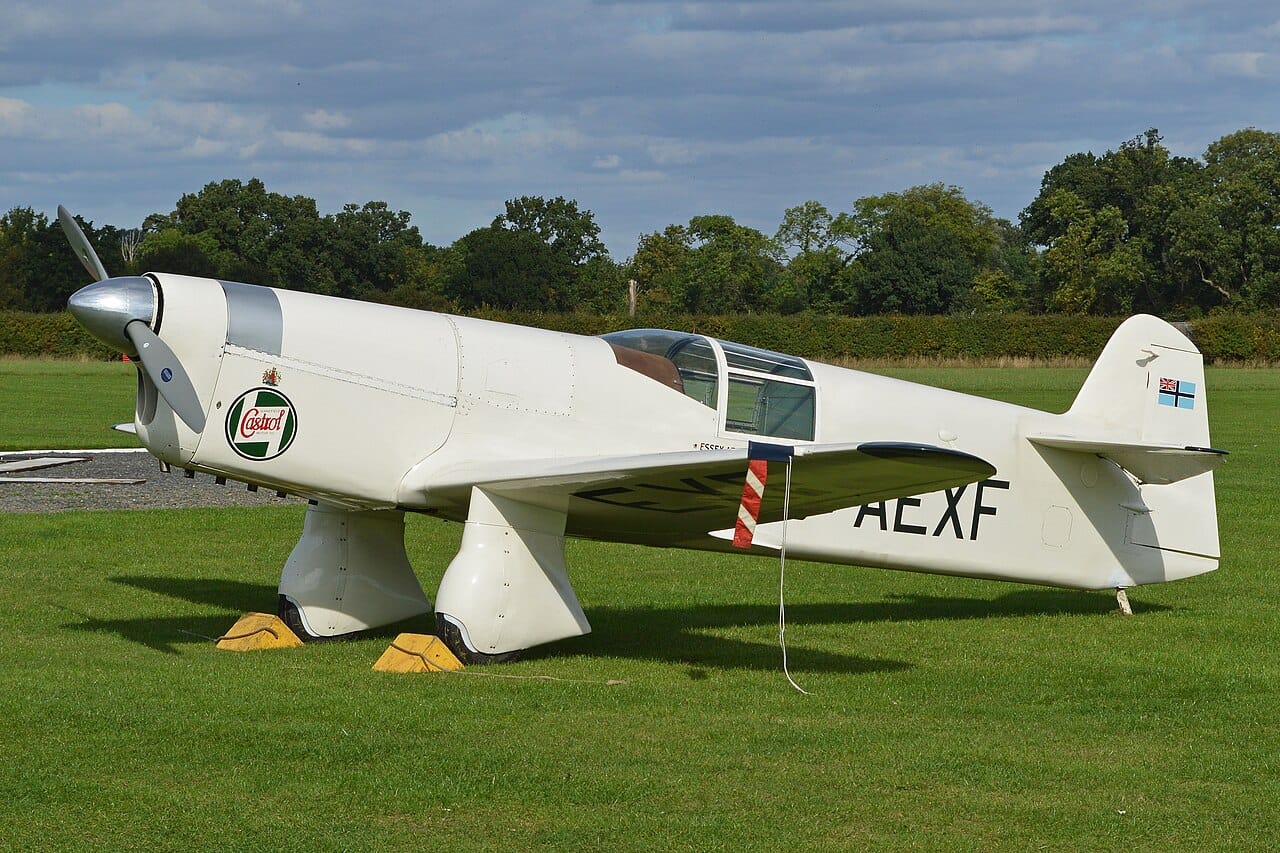
Some aeroplanes shout. The Percival Mew Gull whispered — a slip of a thing, barely twenty feet long, its wings not much wider than a family car, built almost entirely of wood and glue in a shed at Gravesend. You could have mistaken it for a toy. And yet, through the second half of the 1930s, this little single-seater humbled everything that lined up against it.
The Mew Gull is a story about doing enormous things in a small package. Nowhere is that truer than in February 1939, when a twenty-six-year-old named Alex Henshaw climbed into one, pointed it south, and flew to Cape Town and back — alone — in four days, ten hours and sixteen minutes.
It is a record that stood for the better part of seventy years. This is how a wooden racer and a very stubborn young man pulled it off.
Informations clés
| Taper | Single-seat wooden racing monoplane |
| Designer | Edgar Percival, Percival Aircraft (Gravesend) |
| Premier vol | Prototype, 22 March 1934 |
| Engine / top speed | de Havilland Gipsy Six; up to ~265 mph in final 1939 form |
| Construit | Only five or six aircraft |
| Famous feat | Henshaw’s 1939 England–Cape Town round trip: 4 days, 10 hrs, 16 mins |
A racer carved out of wood
Edgar Percival was a designer with a taste for speed and a builder’s eye for what worked. After the success of his Percival Gull tourer, he set about shrinking the idea into something built purely to win races, and in 1934 the first Mew Gull took to the air. It was tiny by any measure — around twenty feet long, a wingspan of just twenty-four feet — and its low-slung wooden fuselage was shaped to knife through the air on the modest power of a six-cylinder de Havilland Gipsy Six.
Only a handful were ever made; sources put the total at five or six. But their impact far outweighed their numbers. Through the late 1930s, Mew Gulls simply dominated British air racing. In the 1938 King’s Cup, Henshaw’s G-AEXF averaged an astonishing 236 mph around the course — a class record that would stand for decades. In its most extreme, tuned-up 1939 guise, the little racer could reportedly touch 265 mph on barely two-hundred-odd horsepower. For a wooden aeroplane you could practically lift by the tail, that was witchcraft.
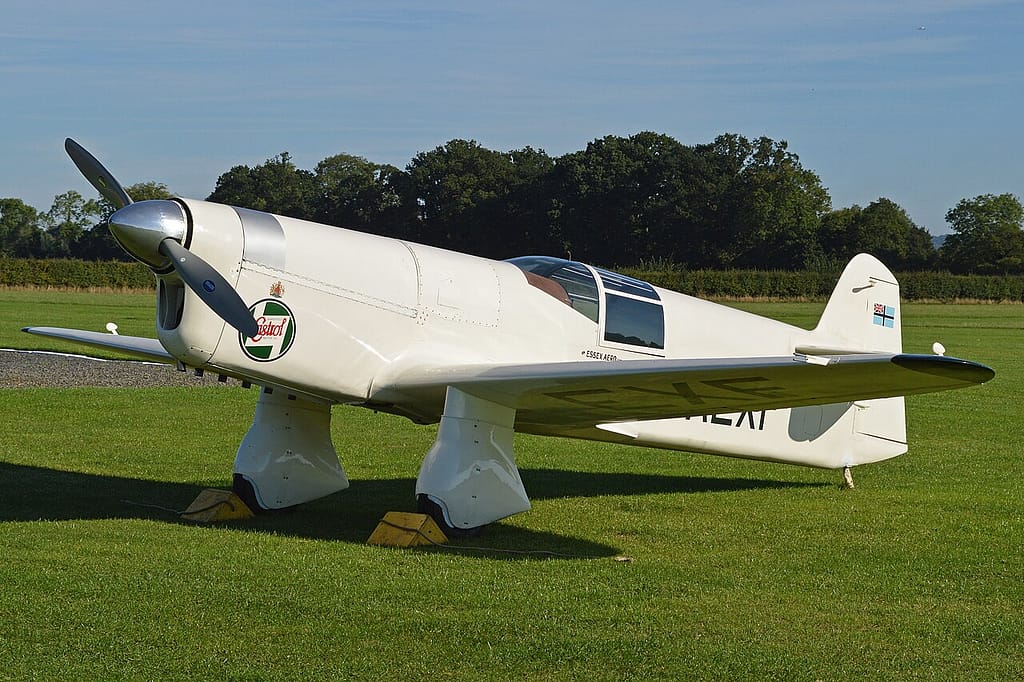
The trade-off was that these were unforgiving machines — small, fast, and demanding, with famously feeble flaps and a narrow margin for error. They rewarded pilots who flew with their fingertips. Which is exactly the kind of pilot Alex Henshaw was.
Four days, ten hours, sixteen minutes
Henshaw had already made G-AEXF his own, winning trophies and that record-breaking 1938 King’s Cup. Then he turned to something far bigger: flying solo to the very bottom of Africa and home again, faster than anyone ever had.
In the small hours of 5 February 1939, he lifted off from Gravesend in the dark. Ahead lay roughly six thousand miles of open sea, Saharan sand, tropical storm and jungle airstrip — each way. He refuelled in Algeria, crossed the Sahara, dropped through the Congo and Angola, and touched down near Cape Town after around forty hours in the air. He rested barely a day, then turned the little Mew Gull around and did the whole thing again in reverse, landing back in England on 9 February.
The round trip — some 12,750 miles — had taken four days, ten hours and sixteen minutes. He broke the record for each leg and set a solo mark for the out-and-home run that would not be bettered for decades. The physical toll was brutal.
From racer to Spitfire whisperer
When war came, Henshaw’s gift for flying fast, tricky aeroplanes found a new home. Invited by Supermarine, he moved in 1940 to the vast Castle Bromwich factory near Birmingham and was soon its chief test pilot, leading a team responsible for signing off newly built fighters.
The scale is hard to grasp. Castle Bromwich built more than half of all the Spitfires ever made, and Henshaw personally test-flew something like ten per cent of every Spitfire and Seafire produced — around 2,300 aircraft — sometimes twenty or more in a single day, in weather that grounded everyone else. He also tested Lancaster bombers, and is the only pilot known to have barrel-rolled one. It was dangerous, unglamorous, relentless work, and it mattered enormously.
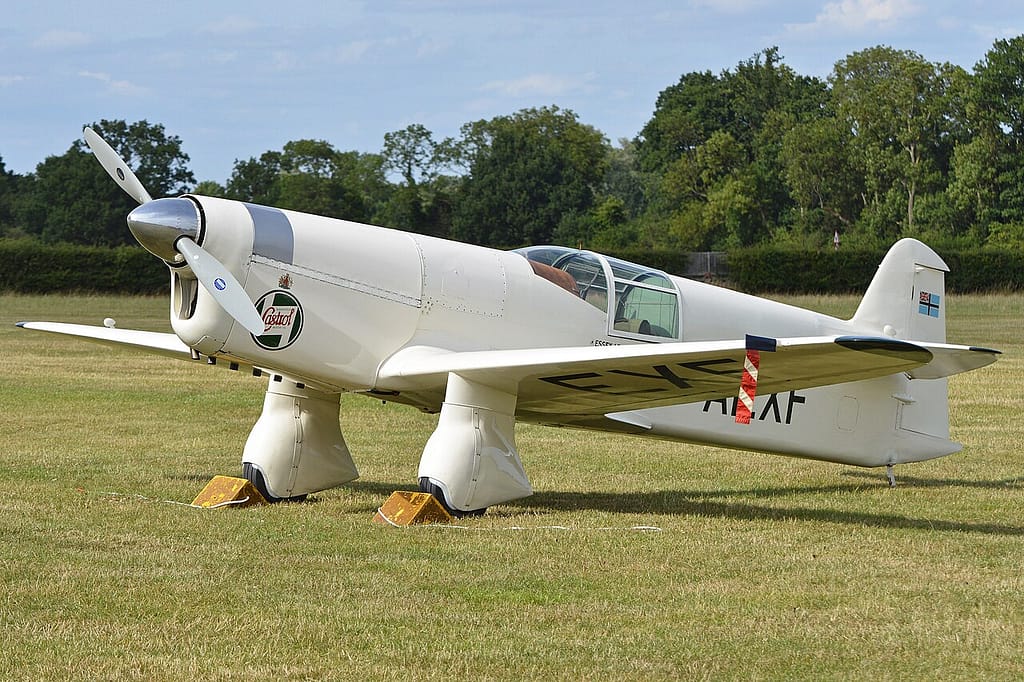
For all the drama, his verdict on the Spitfire was almost tender.
The same fingertip feel that tamed a wooden racer over the Sahara, poured into the fighter that helped win the war. Henshaw died in 2007, aged 94 — and his Mew Gull, G-AEXF, still flies today with the Shuttleworth Collection at Old Warden, small and swift as ever.
Sources: Wikipedia (Percival Mew Gull; Alex Henshaw); The Shuttleworth Collection; François Prins, “Spitfire test pilot,” Aviation Classics; Alex Henshaw, The Flight of the Mew Gull (1980).

0 commentaire