
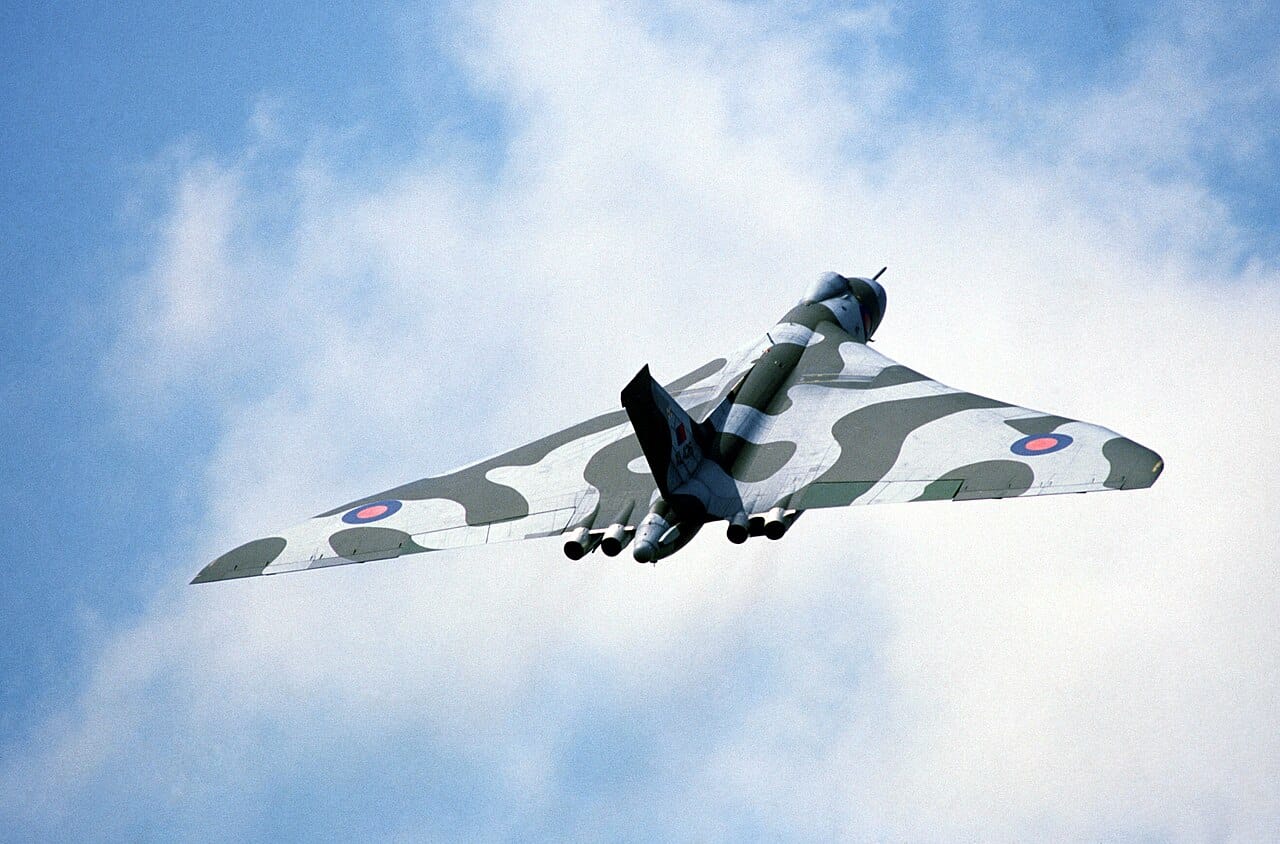
The first time you hear it, you feel it before you understand it — a deep, rising howl that climbs the back of your neck and rattles your chest as a vast triangular shadow sweeps overhead. For generations of British airshow-goers, that sound meant one thing: the Vulcan was in the air. No bomber was ever so loved, or made an entrance quite like it.
The Avro Vulcan was the most famous of Britain’s three V-bombers — and the only one people still travel miles just to remember.
QUICK FACTS
| Aircraft | Avro Vulcan — the delta-wing V-bomber |
| First flight | 30 August 1952 |
| Service | 1956–1984 |
| Engines | Four Bristol Olympus turbojets |
| Signature | The huge delta wing and the “Vulcan Howl” |
| Famous mission | Operation Black Buck, Falklands, 1982 |
A wing like nothing before it
When the Vulcan first flew in 1952, its enormous delta wing looked like science fiction. That wing was not just for show: it gave the big bomber huge fuel capacity, a high ceiling, and — astonishingly for an aircraft designed to carry nuclear weapons — genuine agility. In 1955, test pilot Roly Falk stunned the Farnborough air show by barrel-rolling a Vulcan, flying a strategic bomber as though it were a fighter.
Powered by four Bristol Olympus engines, the Vulcan entered RAF service in 1956 and became a pillar of Britain’s airborne deterrent, carrying free-fall nuclear bombs and later the Blue Steel stand-off missile through the tensest years of the Cold War.
The longest raid in the world
For most of its career the Vulcan’s job was to wait — armed, ready, and never used. Then, in 1982, it went to war. During the Falklands conflict, Vulcans flew Operation Black Buck: bombing missions from Ascension Island to the Falklands and back, roughly 8,000 miles round trip, sustained by a fragile chain of air-to-air refuellings. At the time they were the longest-range bombing raids ever flown. An ageing nuclear bomber, months from retirement, had just pulled off one of the great feats of aerial logistics.
The bomber that refused to be forgotten
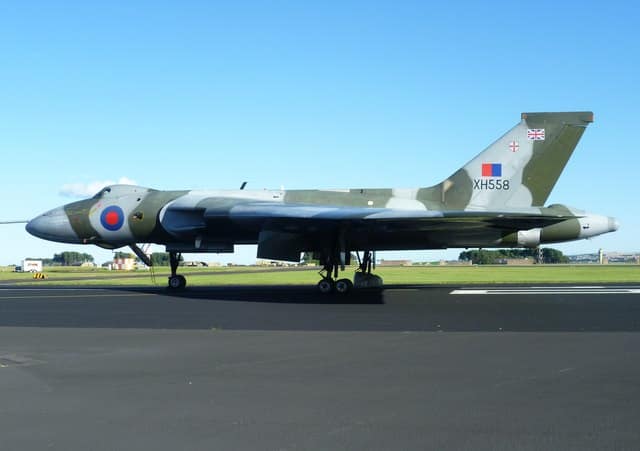
The RAF retired the Vulcan in 1984, but the public never let it go. In 2007, after a monumental restoration effort, a single aircraft — XH558, “The Spirit of Great Britain” — returned to the sky, becoming the world’s only flying Vulcan. For eight years it toured British airshows, drawing enormous crowds who came for that unmistakable howl, until it finally flew for the last time in 2015.
Today the Vulcans that survive sit silent in museums. But ask anyone who stood beneath one at full throttle, and they will tell you: no aircraft ever announced itself quite like the delta that howled.
Sources: Vulcan to the Sky Trust; Royal Air Force Museum; Imperial War Museum.
Related Questions
What was the Avro Vulcan?
The Avro Vulcan was a British delta-wing jet bomber and the most famous of the three V-bombers. Entering service in 1956, it carried Britain’s nuclear deterrent for decades and became a beloved airshow performer thanks to its enormous triangular wing and thunderous engine noise.
What is the “Vulcan Howl”?
The Vulcan Howl is the distinctive, spine-tingling roar the aircraft makes at high power, produced by air rushing into its engine intakes at certain throttle settings. Airshow crowds came specifically to hear it — a sound unlike any other aircraft.
Was the Vulcan really agile for a bomber?
Remarkably so. Its huge delta wing gave it surprising manoeuvrability, and test pilot Roly Falk famously barrel-rolled a Vulcan at the 1955 Farnborough air show. For a strategic nuclear bomber, it could be flown almost like a fighter.
What was Operation Black Buck?
Operation Black Buck was a series of 1982 Vulcan raids during the Falklands War — bombing runs from Ascension Island to the Falklands and back, around 8,000 miles round trip with many air-to-air refuellings. At the time they were the longest-range bombing missions in history.
Can you still see a Vulcan fly?
Not any more. One Vulcan, XH558 “The Spirit of Great Britain,” was restored to flight and delighted airshow crowds from 2007 until 2015, when it was grounded for good. Several Vulcans survive in museums, but none are currently airworthy.
0 commentaire